

A line producer Tunisia team holds the budget, schedule and contracts and manages the filming-authorisation file, while film fixers in Tunisia handle location access, local crew, equipment and daily logistics from Tunis and Sidi Bou Said to Tozeur and the Sahara. Both connect to our Film Fixers in Middle East coverage, so a Tunisia leg can sit inside a multi-country MENA schedule with Morocco or Jordan.
Tunisia is widely recognised for its role as Tatooine. Matmata’s underground dwellings, Ong Jmal near Tozeur, Sidi Bouhlel and Chott el-Jerid provide the principal desert and science-fiction locations. The country’s location range extends well beyond that: the Roman amphitheatre at El Djem, the Dougga ruins, the Carthage archaeological zone, the blue-and-white architecture of Sidi Bou Said and the medina districts of Tunis and Kairouan all carry their own production history.
Film Fixer in Tunisia and Line Production: Roles and Responsibilities
The line producer holds control: budget, schedule, supplier contracts, cash flow, production reporting and the filing for filming authorisation. The fixer holds access: location scouting and clearance, heritage-site and community permissions, local crew, equipment, accommodation, transport and cultural protocols on the day. A film fixer in Tunisia starts with the location list, access requirements, local crew and daily logistics; the line producer builds those requirements into the budget and schedule. On a single-region commercial one person may carry both; on a feature moving between south, centre and north they are usually separate roles under one production-services contract. Where the structure requires it, a locally registered line production company in Tunisia handles contracting, invoicing and compliance, and the foreign producer deals with one accountable lead.
- Filming-authorisation filing through the Ministry of Cultural Affairs single window, with script, location list, schedule, crew manifest and equipment list
- Heritage-site permissions confirmed with the responsible heritage authority and site manager for El Djem, Dougga, Carthage, the Tunis medina and Kairouan
- Community and owner access at the Star Wars sites: Hotel Sidi Idriss at Matmata, Ksar Ouled Soltane at Tataouine and Ong Jmal near Tozeur
- Temporary equipment admission planned with a Tunisian customs broker, who confirms eligibility, port procedure, inspection and re-export requirements
- Local crew sourcing from the Tunis base, with department heads matched to the brief
- Sahara logistics: water, fuel, 4×4 support, base camp and guides for Tozeur, Chott el-Jerid, Matmata and Tataouine
- Multi-region scheduling between Tozeur, the El Djem and Sousse belt and Tunis, plus coordination with Morocco or Jordan legs
Multi-Region and MENA Scheduling
Tunisia runs long north to south, with the main filming clusters at Tozeur in the south (roughly six hours by road from Tunis), El Djem and Sousse in the central east, and Tunis, Carthage and Sidi Bou Said in the north. A multi-region brief anchors on one base, Tunis for schedules weighted to the north and centre, Tozeur or Djerba for schedules weighted to the south, and rotates the unit to the other regions in compressed legs.
Tunisia, Morocco and Jordan are often evaluated together as MENA doubles. Desert briefs may weigh Chott el-Jerid against the Erg Chebbi work our film fixers in Morocco cover; fortified-heritage briefs may weigh Ksar Ouled Soltane against Petra with our film fixers in Jordan. Scripts, access terms and each territory’s current permit and customs requirements usually decide the pick, and for a multi-country schedule the Tunisia team coordinates dates, crew movement and equipment routing with the leads on the other legs.

Filming Permits in Tunisia: The Single-Window Procedure
Tunisia’s Ministry of Cultural Affairs operates the single-window procedure for Tunisian, foreign and co-production filming authorisations. The Idaraty procedure listing records 7 to 15 days for a complete application; that figure comes from the listing rather than a Ministry publication, and current processing expectations are confirmed with the Ministry for each project. Heritage sites, aerial work, restricted activity, municipal locations and private properties can require additional approvals, so the working schedule is confirmed against the final brief. The CNCI, the Centre National du Cinéma et de l’Image, is Tunisia’s national cinema institution; the filing is planned against the Ministry procedure.
The application carries the location list, shoot dates, crew manifest, equipment list and a content synopsis. Film fixers in Tunisia keep each submission complete and follow it through, but the timeline is set by the authorities, not the filer. Heritage filming adds its own layer: for El Djem, Dougga, Carthage, the Tunis medina and Kairouan, the responsible heritage authority, the site manager and any additional permissions are confirmed for the specific location alongside the authorisation, with lead time scaling with the production footprint at the site. The Star Wars heritage sites work through the single window plus the hotel owners and local community who manage day-to-day access. Desert work beyond the marked routes around Tozeur and the Chott is coordinated with the regional governorate and the relevant security authorities, and drone work needs its own permission before any aircraft ships.

Tunisia’s major filming locations
For production planning, Tunisia is usually worked as three clusters rather than a fixed geography. The Sahara and Tatooine cluster covers Tozeur, the Tataouine governorate, Matmata and Chott el-Jerid in the south. The Roman antiquity cluster covers El Djem in the central interior and Dougga in the north-west, with Sousse and Monastir adding Roman and medieval Islamic architecture on the central coast. The Tunis and coastal cluster covers Sidi Bou Said, Carthage, the Tunis medina and Hammamet, with Kairouan, inland and south of Tunis, grouped with it for scheduling. A brief that crosses two of these clusters in one schedule is the standard problem a line producer Tunisia engagement manages.

Tozeur, Ong Jmal and Chott el-Jerid
Tozeur in the southwest is the base for Star Wars location work. Ong Jmal, about thirty kilometres out, hosted the Mos Espa set built for The Phantom Menace; the set was left standing after filming, and any use of the surviving set is subject to confirmation of access, intended use and rights clearances with the responsible authorities. Sidi Bouhlel canyon, also near Tozeur, carries the Star Wars Canyon sequences from A New Hope. Beyond the sets, the Tozeur base offers oasis, palm-grove and desert-margin environments. Location permits run through the single window with the regional governorate, and Sahara work off the marked routes is coordinated with the security authorities. Tozeur-Nefta and Djerba are evaluated against the current flight schedule, charter availability and road-transfer plan for the shoot dates.

Chott el-Jerid, the salt-pan basin between Tozeur and Kebili, supplied the Lars homestead exterior near Nefta on the chott’s edge. The salt flat runs to roughly 7,000 square kilometres and shifts between a dry mineral crust in summer and shallow brackish water in winter, so productions time the shoot against that cycle. Ground bearing, permitted routes and vehicle access are assessed locally before any movement onto the chott, in either season.

Matmata, Tataouine and the Tatooine homestead sites
Matmata’s underground dwellings provided the Skywalker homestead interior in A New Hope. Hotel Sidi Idriss still operates as a hotel and preserves the set rooms, so productions filming there coordinate with the hotel ownership and the local community as well as the formal authorisation. Tataouine, the governorate town that lent its name to the planet, sits a few hours’ drive south and holds Ksar Ouled Soltane, a Berber fortified granary of multi-storey vaulted ghorfas around two courtyards.

El Djem amphitheatre and the Roman sites
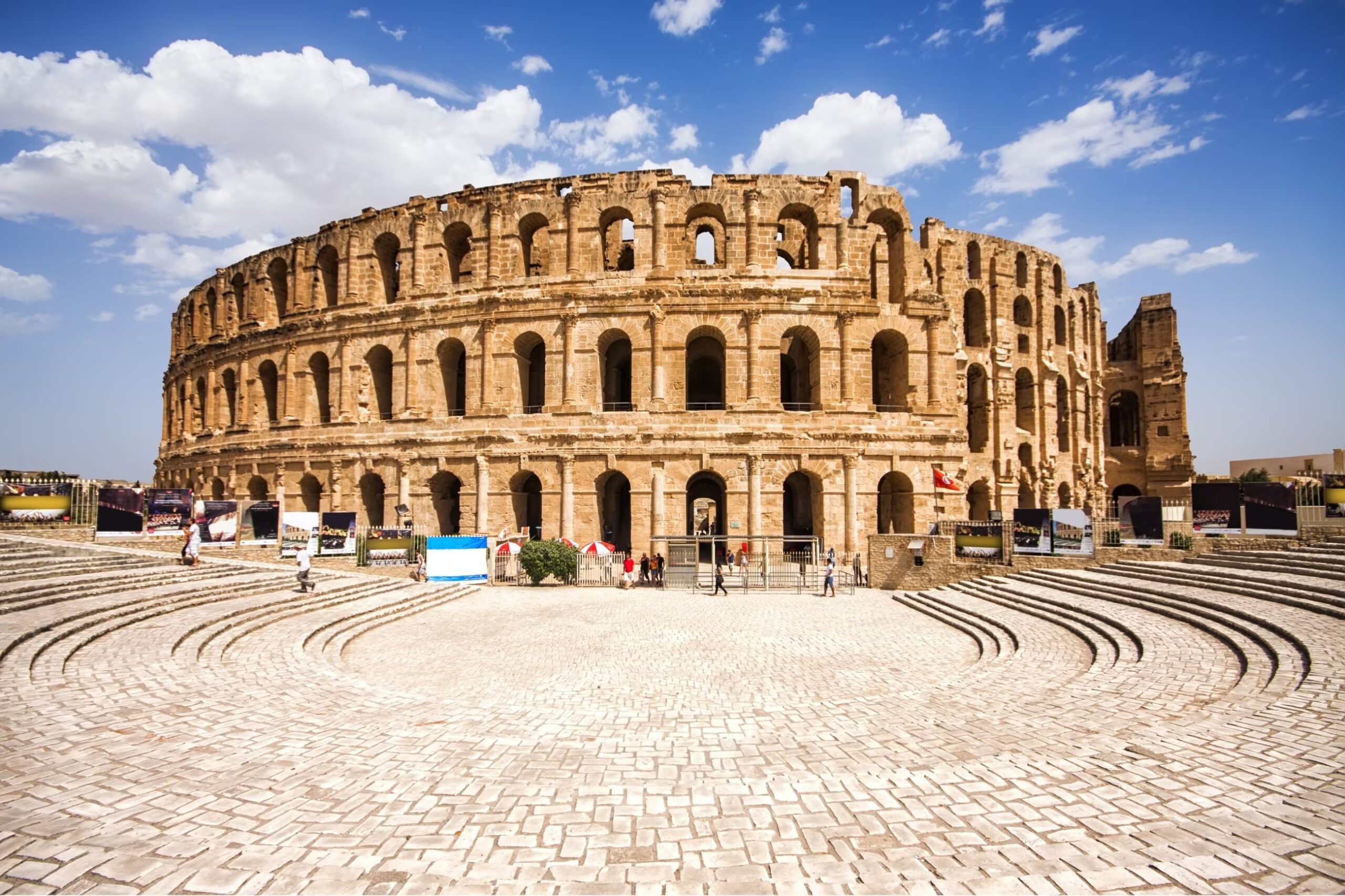
El Djem in the central interior holds one of the largest and best-preserved Roman amphitheatres outside Italy, a third-century structure that seated roughly 35,000. Permissions are confirmed with the responsible heritage authority and site management alongside the filming authorisation, and their documentation and crew-protocol requirements scale with the production. The Roman circuit extends to Dougga, the UNESCO-listed Numidian-Roman site in the northwest, and Carthage on the northern coast, the layered Punic, Roman and Byzantine site at the edge of Tunis.

Sidi Bou Said, Tunis and Kairouan
Sidi Bou Said, twenty kilometres from Tunis, is a location that can serve as a double for Greek island settings: the blue-and-white architecture reads as Cycladic and the clifftop position over the Gulf of Tunis matches the Aegean coast. Permits run through the municipality alongside the filming authorisation. The cobbled lanes, summer tourist density and resident sensitivity shape the schedule. The shoulder seasons, March to May and October to November, can offer lighter crowds and workable morning and afternoon light.
The Tunis medina, UNESCO-listed and roughly 270 hectares of dense lanes, souks and historic residences, carries the contemporary-and-historic urban settings alongside Carthage. Kairouan, two hours south, holds the Great Mosque, the oldest in the Maghreb, and its own UNESCO-listed medina. Both work through the heritage authority alongside the authorisation, with pacing constraints around prayer times and resident access.
Rate ranges for Tunisia productions
Costs are quoted per project from dated supplier quotations and refreshed for the project dates; the categories below describe what drives each line rather than publishing rate bands. Actual costs depend on project tier, season, crew credits, equipment specification, location charges, exchange rates and permit complexity. Cost against Morocco, Jordan or Egypt is quoted per project on the final schedule rather than as a standing comparison.
Film Crew Tunisia: Local Crew and Department Heads
Crew costs for a film crew in Tunisia are driven by the department mix, the seniority and credits of each head, the length of the engagement and whether the role is filled from the Tunis base or travels in. Senior heads with international feature credits are quoted individually. Heads flown in from Europe or the Gulf carry fees, per diem, travel and accommodation riders on top of the local crew structure, and those lines are quoted against the specific people and dates.
Equipment Hire and Sahara Logistics
Tunis-based rental houses stock cinema camera packages including ARRI, Red and Sony bodies, lighting and grip inventories and vehicles, with availability and pricing confirmed for the dates. Camera, lighting and grip lines are driven by package specification, fixture count and output, days on hire and any sub-rental from Europe where the local inventory does not cover the brief. Moving equipment from Tunis to Tozeur, Djerba or Sfax adds fuel, per diem and load-crew costs per unit move. Equipment brought in from abroad enters on the arrangements the Tunisian customs broker confirms for the package: eligibility, port-of-entry procedure, inspection, clearance and re-export requirements, with timing confirmed by the broker rather than assumed.
Saharan work around Tozeur, Chott el-Jerid, Matmata and Tataouine carries its own logistics load. Water is a defining line on multi-day desert shoots, with tanker capacity sourced through Tozeur or Gafsa for crew hydration, wardrobe, equipment cleaning and base-camp catering. Sand protection for cameras, sound and lighting runs on standard desert protocols: cleaning and cover routines, dry storage at base camp and standby lenses. Generator fuel runs heavier than a standard shoot, with reserve capacity held through the Tozeur or Gafsa depots. 4×4 support vehicles, local desert guides and camel-handler units for talent or background are quoted case by case, and drone work in summer heat needs more spare-battery capacity than a temperate shoot.
Accommodation, per diem and heritage-site access fees
Accommodation costs are driven by the tier required, the region (Tunis and the coast, Djerba, or Tozeur and the desert), the season and the length of stay, with desert camps around Tozeur and Matmata quoted separately from hotel blocks. Domestic crew per diems and international crew per diems are set in the engagement terms, with local top-ups where required.
Heritage-site access charges depend on the activity, closure requirements and commercial versus editorial classification, and are confirmed with each site authority for the specific request; Star Wars sites, Roman sites and private heritage houses in Sidi Bou Said and the Kairouan medina each carry their own terms, with private properties negotiated with the owners.

Weather and Tunisia production calendar
October through April, the prime window
October through April is the prime window. Daytime temperatures run about 15 to 24°C in Tunis and on the northern coast and 20 to 28°C around Tozeur and Djerba, and the Sahara light is clean and directional through the shoulder months. Daytime heat, overnight cold, wind and rain are checked for the specific location and dates before the schedule is set. December and January bring occasional rain to the Tunis, Sousse and Sfax belt while the south stays dry. This period can tighten availability across crew, hotels and the principal Tunis rental inventory.
Heat, Ramadan and Holiday Scheduling
May through September is peak heat. Tozeur, Matmata and the deep Sahara run very hot from mid-June through August, dust haze reduces long-lens sharpness, and drone batteries drain faster in high temperatures. Sandstorm risk rises from March into May and again in late September, and the sirocco can halt outdoor Sahara operations at short notice. Productions that must shoot in this band work early-morning and late-afternoon windows and plan the day count accordingly. Coastal Tunisia stays workable through summer with sea-breeze cooling, though the tourist season tightens hotel and vehicle availability.
Ramadan affects crew availability, permit-office processing and catering. Working hours, catering and welfare arrangements are agreed with the actual crew and suppliers for the dates, and foreign productions do shoot during Ramadan with the schedule built around those arrangements. Winter rain reaches the northern belt between December and February, usually enough to cost an exterior day, so the schedule should carry interior or weather-cover options. National holidays including Eid al-Fitr, Eid al-Adha and Republic Day close permit offices and are built into the lead-time allowance.
Tunisia film incentives: what to budget on
Any tax relief or production support included in the budget must be confirmed for the project with the relevant authority and a Tunisian tax adviser. See our Tunisia film incentives and rebates guide for the separate incentive discussion.
Frequently asked questions
Do foreign productions need filming authorisation in Tunisia?
Yes. Foreign scripted, commercial and other planned audiovisual productions apply through the Ministry of Cultural Affairs single-window procedure, and heritage, municipal, security, aerial or location-specific clearances are confirmed separately for the project category. A line producer Tunisia engagement prepares and manages the filing, while each authority retains control of its own approval.
Does Tunisia offer a film rebate or cash incentive?
Any tax relief or production support included in the budget must be confirmed for the project with the relevant authority and a Tunisian tax adviser; the separate incentive discussion is on our Tunisia film incentives and rebates guide. Cost against a rebated territory is quoted per project on the final schedule.
How long do Tunisia filming permits take?
The current administrative procedure lists 7 to 15 days for a complete single-window application. Heritage, security, drone and multi-region requirements are handled separately and can extend the timeline, so the working allowance is confirmed against the final location list before travel and principal photography are locked.
What is the best season to shoot in Tunisia?
October through April, with clean Sahara light and lower heat exposure; daytime heat, overnight cold, wind and rain are checked for the location and dates. March to April and October to November are commonly attractive scheduling windows. May through September brings peak Sahara heat, dust haze and sandstorm risk, which pushes desert work into early and late windows; the coast stays workable with sea-breeze cooling, though the tourist season tightens hotel and vehicle availability.
Can foreign crews import equipment via ATA Carnet?
Tunisian customs material supports temporary-admission arrangements for cinematographic equipment, including ATA Carnets. Eligibility for the specific package, the port-of-entry procedure, inspection, representation documents, clearance and re-export requirements are confirmed by the Tunisian customs broker before dispatch; a complete carnet does not by itself guarantee clearance. See the official Tunisian Customs guidance.
To scope a Tunisia shoot, send the format (feature, series, documentary, commercial or branded content), proposed dates, the locations or regions in mind, which crew travel with the unit, the equipment list and whether it ships under carnet or rents in Tunis, any permit-sensitive activity such as heritage sites, drones or off-route desert work, and an indicative budget range. From that we review the brief and agree the scope and fee for detailed feasibility, recce and budgeting covering the authorisation route, site permissions, crew and equipment, Sahara logistics and the schedule across the clusters the brief touches. For how Tunisia compares with other African bases on permits, crew and cost, see our filming in Africa guide.
