

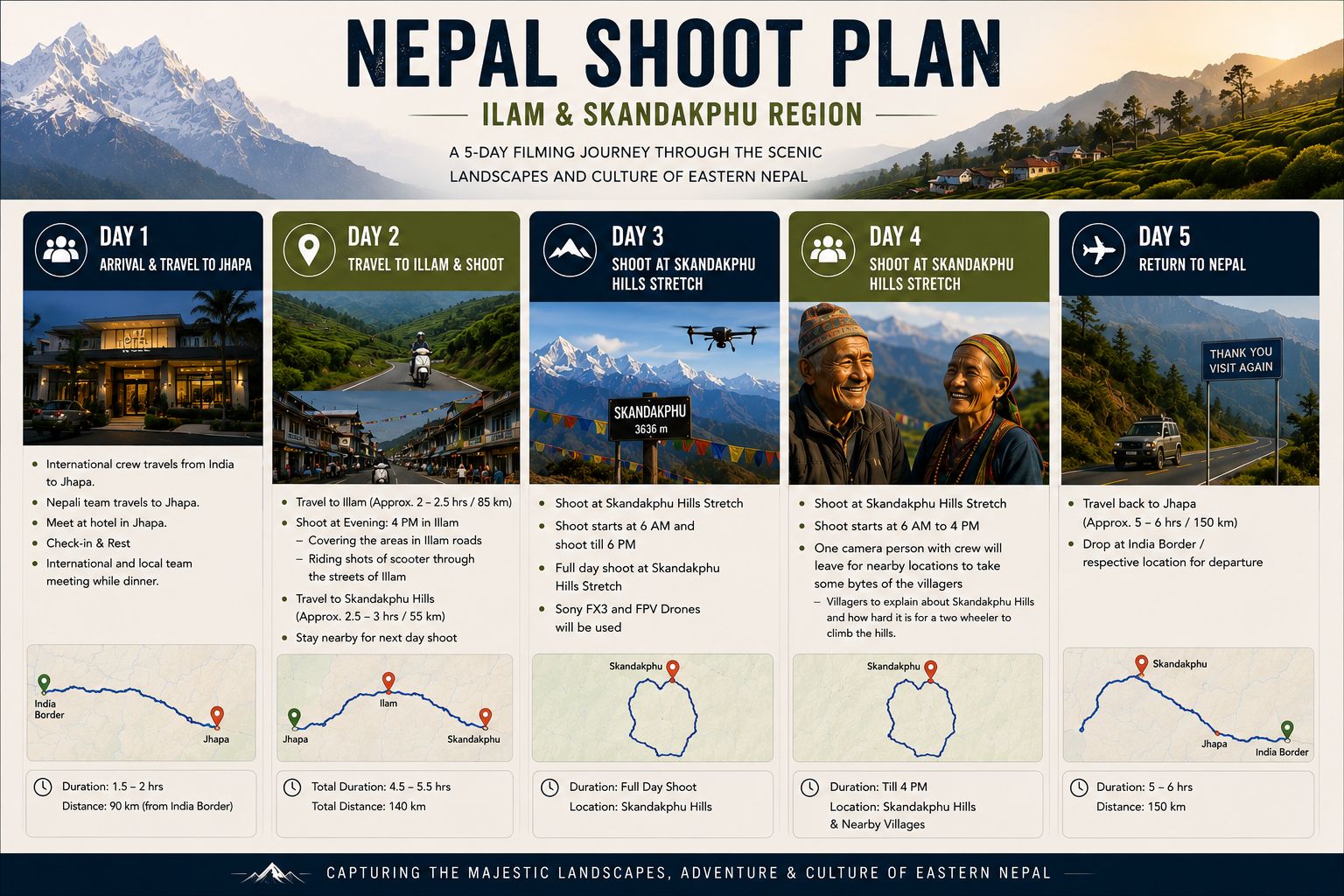
Nepal film production rates are most useful when the permit, crew and logistics assumptions are fixed before the scout. This handbook covers the working cost stack for a foreign production shooting in Nepal: MoCIT licence fees, conservation-area consent letters, drone-clearance costs, crew day rates by role, and the logistics envelope for shoots that reach Everest, Annapurna, Ilam, Sandakpur or the Kathmandu Valley. The full operational execution model sits at line producer Nepal. This page is the cost reference that budget conversations sit against. Rates quoted below represent the premium end of the band, indicative of Hollywood-standard commercial and feature briefs; mid-scale documentary, TV drama and independent productions typically negotiate materially below these figures depending on shoot scale, brief complexity and standing arrangements with the local counterpart.
The MoCIT permit stack and what each line costs
Foreign productions apply to the Ministry of Communication and Information Technology for the primary filming licence through a Nepali coordinator, with the Film Development Board filming procedure facilitating the application and additional authorities issuing location-specific consents. MoCIT’s current service schedule lists an NPR 15,000 licence fee plus an NPR 50 postal stamp. Confirm the published fee when filing.
Although Film Development Board guidance states that the ministry application can be completed within two working days, our working schedule normally allows 15 to 20 working days for the complete production-permission stack. Archaeology, conservation-area, restricted-location and drone approvals can extend that window.
Some local counterparts quote approximately USD 1,500 for accelerated filing and coordination. This is a production-service charge rather than a separate statutory permit or guaranteed government fast-track.
Pre-production line items
Pre-production budgeting and planning through the local counterpart runs around USD 1,200 for a mid-scale brief. Recce and location hunt, where the counterpart’s team scouts specific locations against the script and returns with permission-viability notes, typically bills USD 2,500. Roads-permit patterns depend on the shoot footprint: a shoot covering roughly 15 road stops through Ilam and Sandakpur with roads left open (no full closure) bills around USD 2,500 for the roads-permit filing and coordination.
Conservation area and national park location fees
Nepal’s protected areas (Annapurna Conservation Area, Manaslu Conservation Area, and Gaurishankar Conservation Area) carry a separate consent-letter fee outside the MoCIT permit. For non-SAARC productions, the consent letter is USD 1,500 per area; for SAARC-region productions, NPR 50,000; for Nepal-domestic productions, NPR 10,000. Aerial or drone filming inside these conservation areas carries an additional 25% surcharge on top of the consent fee.
Permissions across Ilam and Sandakpur depend on the exact road, forest, municipal and protected-area footprint. The quoted USD 3,600 should therefore be presented as a project-specific location and coordination estimate, not a universal National Park tariff. It does not include roads-permit fees, drone-permit fees, or crew day rates.

Drone permits and aerial operation costs
Foreign nationals must obtain temporary drone registration from CAAN and present the aircraft for inspection. Drone filming remains separate from the MoCIT licence and can additionally require Home Affairs, Defence, conservation, park or local approval depending on the aircraft, airspace and location. The figures below are project-planning estimates and should be reconfirmed against the final drone and location brief. Base drone-permit fees scale by drone weight, roughly USD 150 to USD 300 for drones under 2 kg and USD 400 to USD 800 for heavier setups. Temporary equipment import is a separate customs workflow based on the final inventory, declared values, security requirements and re-export schedule. Protected-zone drone-permit add-ons run around USD 2,500 depending on the specific park, forest or conservation footprint near Ilam or Sandakpur.
Drone operator day rate for an FPV or standard-drone specialist runs USD 400 per day. Full drone equipment kit hire (cameras, controllers, batteries, spare props) bills around USD 300 per day. High-altitude drone operations in the mid-Himalayan foothills require extra battery redundancy relative to temperate-climate shoots, since lithium-cell duty cycles compress with altitude and temperature swings.

Crew day rates by role
Hiring film crew in Nepal runs on a day-rate structure that scales with role, brief complexity and altitude. The following crew day rates represent the premium band typical of Hollywood-standard commercial and feature briefs shooting in Nepal, quoted in USD per person per day. Documentary, TV drama, and independent productions typically negotiate below these figures. Actual rates vary with brief complexity, altitude/remoteness of the shoot location, and standing arrangements the local counterpart holds with individual crew members.
All figures on this page are Celluloid Pact planning bands, checked September 2026, quoted in USD for crew, equipment, transport, locations and accommodation and in NPR where a statutory fee is published. Every line is quote-dependent and is reconfirmed against the final brief, crew list, location plan and shoot dates; exchange movements between USD and NPR are carried in the contingency.
| Role | Day rate (USD) | Notes |
|---|---|---|
| Line Producer | 1,000 | Full production coordination, budget management, permit-authority interface |
| UPM (Unit Production Manager) | 750 | Day-to-day unit coordination, crew scheduling, on-ground logistics |
| FPV / Drone Operator | 400 | Specialist aerial photography, altitude-adjusted battery protocols |
| Permit Liaison / Coordinator | 200 | MoCIT and location-authority filing coordination |
| Camera Assistant | 150 | 1st AC / focus, equipment prep, lens changes |
| Production Assistant | 120 | General runner, coordination support |
A 10-person working unit, a line producer, a UPM, two production assistants, an FPV drone operator, a camera assistant and a government liaison officer, complemented by two international-team members and a rider, is the standard footprint for a commercial or feature-supporting production. Larger feature-tier productions scale the crew depth substantially and would need dedicated grip, sound, lighting and art-department teams sourced through Kathmandu.

Vehicle, accommodation and food logistics
Ground transport
Nepal shoots reaching remote locations (Ilam, Sandakpur, Annapurna base camps, Everest base-camp trek routes) depend on 4-wheel-drive SUV convoys with local drivers. Crew SUVs (4-5 seat, includes fuel and driver on 24-hour standby) bill approximately USD 200 per day per vehicle. Client SUVs (typically higher-spec 4-seat with fuel and driver, 24-hour standby) run USD 350 per day per vehicle at the premium end; standard vehicles come in lower for less brief-specific setups. A standard 5-day multi-region shoot running the 10-person working unit needs three crew SUVs plus one client SUV in the movement plan.
Accommodation bands
Accommodation costs vary substantially by property tier and geographic region. Local hotels (used for the local-crew envelope, typically twin-share) run around USD 30 per room per night. Three-star hotels for international team members run USD 50 to USD 70 per night. Four-star runs USD 90 to USD 120. Five-star properties in Kathmandu, Pokhara, and Chitwan run USD 150 to USD 300. Remote-region accommodations (Ilam, Sandakpur, Annapurna and Everest trek route lodges) tend to fall in the local-to-three-star band with limited five-star availability outside major hubs. The upper accommodation bands (four and five-star) typically apply to Hollywood-standard briefs; documentary and independent shoots more often work with the local and three-star tiers.
Food and per diem
Local crew food and drink allowance, including drivers and support staff, runs approximately USD 25 per person per day. International team food and drink scales with the hotel tier: USD 45 to USD 65 per person per day is standard, depending on whether meals are hotel-restaurant or independent. Altitude shoots requiring lodge stays on the Everest or Annapurna trek routes typically move to a fixed per-day full-board rate through the trek-supporting operator.

Total shoot cost by production tier: a worked example
Consolidating the premium rate structure above into a worked example: a Hollywood-standard foreign production running the 10-person working unit for 5 days across Ilam and Sandakpur, using Sony FX3 with GM lenses plus an FPV drone rig, and coordinating pre-production and location permits through a local counterpart, lands at approximately USD 36,325 as an illustrative production subtotal, before international crew flights and temporary-import, customs-security and brokerage costs. Comparable documentary or independent-tier briefs at similar footprint typically land 30 to 45% below this figure.
| Budget category | Approx cost (USD) |
|---|---|
| Pre-production (planning, permits, recce, roads) | 13,800 |
| Production crew (Line Producer, UPM, drone op, assistants, liaison) | 13,700 |
| Vehicles, accommodation, food | 7,325 |
| Drone equipment hire | 1,500 |
| Illustrative subtotal | 36,325 |
Scale bands for reference at premium-tier rates: short-form commercials and Hollywood-standard branded content shoots run USD 20,000 to USD 40,000 for a 3 to 5 day shoot at similar crew depth. Lower-tier commercial and documentary briefs typically come in USD 12,000 to USD 25,000 for the same footprint. Longer, seven-to-fourteen-day multi-region documentaries and mid-scale feature-supporting shoots commonly run USD 60,000 to USD 120,000, and multi-week TV drama units USD 120,000 to USD 250,000. Feature-tier productions running Kathmandu-plus-Everest-plus-Pokhara footprints with dedicated department leads run USD 250,000 and up. Numbers scale with altitude: Everest base camp and Annapurna base-region shoots carry porter-guide overhead of approximately USD 30 to USD 50 per porter per day plus a certified trek-guide fee.
Kathmandu-based infrastructure vs remote-location shoots
Nepal shoots split cleanly between two operational profiles that drive different cost structures. Kathmandu Valley shoots generally require fewer remote-location and conservation tracks, while offering the country’s broadest crew, hotel and studio-space options. Rates on Kathmandu shoots stay close to the base bands quoted above. Remote-location shoots reaching Everest, Annapurna, Ilam, Sandakpur or the Terai belt carry additional cost lines that don’t appear on a Kathmandu-only budget.
Remote-shoot cost differentials
Fuel costs scale with distance from Kathmandu, and long-distance SUV movements to Ilam or the Everest-region road and trail gateways frequently double the daily fuel spend that a Kathmandu-only shoot would carry. Porter and trek-guide fees enter the budget for shoots requiring foot access to base camps: approximately USD 30 to USD 50 per porter per day, plus a certified trek-guide fee for productions filming above 3,000 metres. Cargo and equipment portage on trekking-only routes adds another USD 20 to USD 40 per porter per day depending on load. Weather-day contingency budgets should factor at 15 to 25% of the shoot envelope for altitude-sensitive brief classes given monsoon and winter closure windows on high-altitude access routes.
Studio and post-production availability
Kathmandu offers modest studio-space options for interior work and dedicated post-production suites for basic edit and colour finishing. Feature-tier productions typically export offline edits and post-production to Mumbai, Bangkok or Delhi post-houses given the deeper colour-grading and sound-design infrastructure available in those hubs. This routing is a common operational pattern rather than a Nepal-specific gap: the country’s production infrastructure is oriented toward on-location capture rather than in-country finishing.
Cost comparisons across sample brief types
The rate framework above translates into different total-cost outcomes depending on the brief type, shoot footprint, and crew scale. The comparison below sizes typical all-in budgets across four common production types with Nepal-shoot activity.
| Brief type | Shoot footprint | Crew scale | Approx budget (USD) |
|---|---|---|---|
| Commercial / short-form / travel-content | 3-5 days, single-region (Kathmandu or Ilam/Sandakpur) | 8-12 crew | 20,000 – 40,000 |
| Documentary / mid-scale feature support | 7-14 days, multi-region (Kathmandu + Pokhara + trek route) | 15-20 crew | 60,000 – 120,000 |
| TV drama / episodic unit | 3-6 weeks, extended-region Kathmandu + Pokhara + heritage sites | 25-40 crew | 120,000 – 250,000 |
| Feature production (theatrical release) | 6-10 weeks, full-country coverage including Everest / Annapurna | 50-80+ crew | 250,000 – 500,000+ |
Budgets scale non-linearly with altitude and remoteness: a documentary reaching Everest Base Camp for one shoot day can add USD 15,000 to USD 30,000 in porter, trek-guide, and altitude-permit lines relative to a same-length shoot staying in the Kathmandu Valley.

Common questions on Nepal production rates
How much does a MoCIT permit cost?
MoCIT’s current service schedule lists an NPR 15,000 licence fee plus an NPR 50 postal stamp; confirm the published figure when filing. Some local counterparts quote around USD 1,500 for accelerated filing and coordination, which is a production-service charge rather than a statutory fast-track. Conservation-area consent letters (Annapurna, Manaslu, Gaurishankar) add USD 1,500 per area for non-SAARC productions. Location-specific permits are quoted per project.
Are drone permits included in the standard filming permit?
No. Drone filming is cleared separately from the MoCIT licence, and the approval stack can involve CAAN, the ministries responsible for Home Affairs and Defence, and the relevant conservation, park or local authority depending on the aircraft and location. Base drone-permit fees are project-planning estimates: roughly USD 150 to USD 300 for drones under 2 kg and USD 400 to USD 800 for heavier setups, with protected-zone add-ons around USD 2,500 and a 25% conservation-area surcharge on the consent letter for aerial work.
What’s the standard permit processing timeline?
Film Development Board guidance states that the ministry application can be completed within two working days, but that is not the same as full shoot clearance. Our working schedule normally allows 15 to 20 working days for the complete production-permission stack, and archaeology, conservation-area, restricted-location and drone approvals can extend it. An experienced local counterpart familiar with repeat filings can keep the submission complete and reduce avoidable delays, although the authorities control the timeline.
Do rates change seasonally?
Crew day rates and vehicle rates stay broadly stable year-round. Accommodation rates spike in October-November and March-April peak trekking seasons, particularly in Everest and Annapurna trek-route lodges where availability tightens. Winter closures on some high-altitude access routes (December-February) constrain shoot planning for altitude-dependent briefs. Monsoon (June-September) affects road access to remote regions and adds weather-day contingency risk to any outdoor shoot outside Kathmandu Valley.
Using Nepal Film Production Rates to Build a Budget

Foreign productions engaging a Nepal-based line producer at the script-breakdown stage tend to size the actual net-cost outcome more accurately than productions arriving with a fixed budget target. The line producer maintains current crew quotations, vehicle availability and negotiated multi-day rates. Experience assembling complete MoCIT files helps prevent avoidable filing delays. Multi-day shoots typically unlock day-rate discounting on the crew and vehicle envelope that isn’t available to single-brief arrangements.
Nepal film production rates are a planning input, not a quote: the bands above are confirmed against the final brief, crew list, location plan and shoot dates. The Nepal-specific working model, MoCIT permits, crew assembly, altitude logistics and Himalayan location work, is covered on the line producer Nepal page linked in the opening.
