

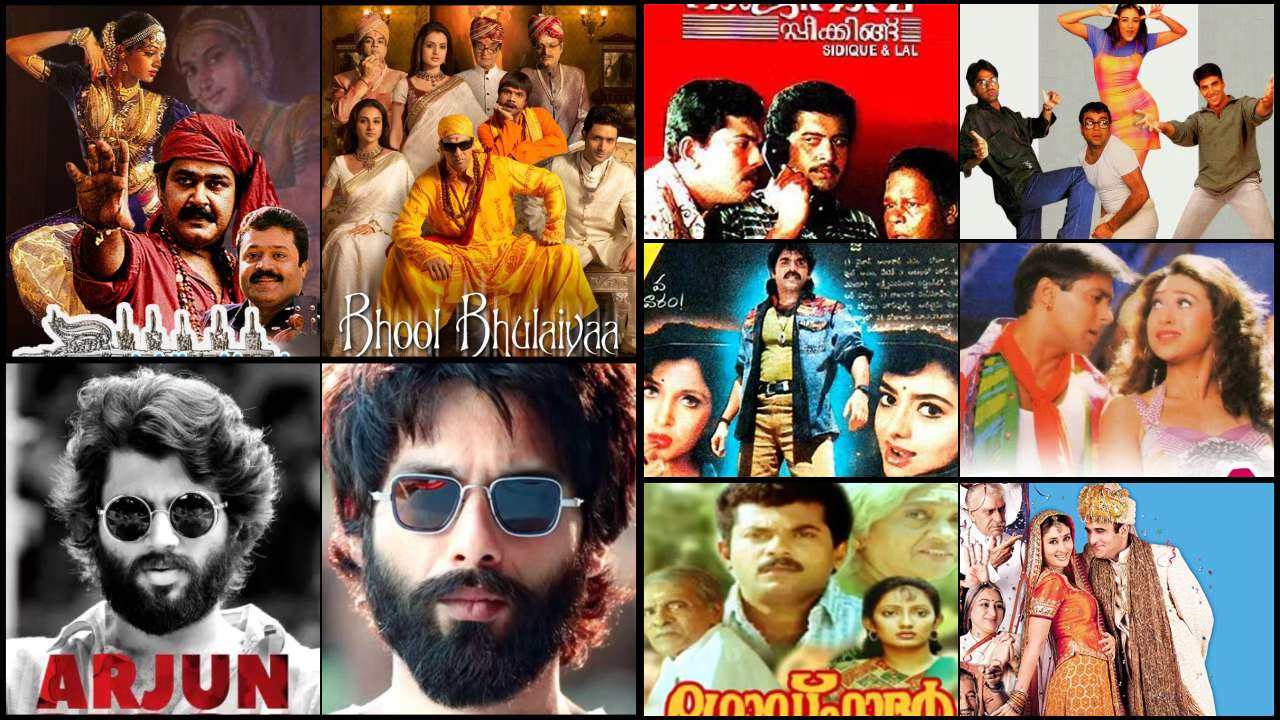
Remake rights work in India in 2026 is a layered commercial and legal practice. The Indian feature and OTT industry now runs one of the world’s highest-volume commissioning pipelines, and the remake market that runs alongside it, Hindi remakes of South Indian originals, Indonesian and Korean adaptations of Indian IP, Hollywood remakes of breakout regional features, Arabic-OTT licensing into the Middle East, has become one of the most active cross-border IP corridors in world cinema.
Celluloid Pact operates on the producer side of that corridor, closing remake rights deals across territories. The company brokered the Indonesian Drishyam adaptation Ayah, Aku Mau Cerita for Falcon Pictures, with the agreement including a Right of First Refusal clause that secured Indonesian remake rights for Drishyam 1, 2 and 3 in a single negotiation. That is what this page is about, the commercial mechanics of how an Indian remake rights deal actually closes, the legal framework underneath it, and the producer-side advisory layer that turns a signed agreement into a film that gets made. For the editorial and case-study layer on the craft of adaptation itself, see film remakes and adaptations.
The commercial scale of Indian remake rights in 2026
The economics of Indian remake rights have changed sharply in the last five years. OTT commissioning has pushed up both the volume of deals and the size of deal values, and the geographic spread of the rights buyers has widened well beyond the traditional Hindi-Hollywood corridor.India’s OTT ecosystem now commissions hundreds of original features and series annually across national and regional platforms. The volume has shifted the remake rights market in two ways: more Indian originals are being scouted for foreign-language adaptation than ever before, and Indian platforms are increasingly buying foreign-language IPs for Indian-language remake. Major streaming platforms increasingly use audience and metadata analysis to identify Indian regional features with cross-border remake potential.
Territory-by-territory fee bands
Indicative remake rights fee ranges by destination market: top-tier Hollywood remake acquisitions of breakout Indian properties can reach seven-figure USD territory, with backend participation negotiated separately and smaller independent adaptations closing materially below that level.
Chinese-language remake rights have priced into the mid seven-figure USD range for breakout Indian properties, with the Drishyam-derived Sheep Without a Shepherd (the Mandarin adaptation) standing as the commercial precedent through its widely-reported theatrical success.
Arabic OTT remake licensing into the UAE and Saudi markets prices in low to mid six-figure USD bands for top-tier South Indian or Hindi titles. Indonesian remake fees start at modest baselines for catalogue titles and scale materially higher for franchise IP. Korean, Spanish-language and other foreign-language remake fees are negotiated case by case and have widened significantly since streamer-driven demand started compressing traditional theatrical-led pricing models.

Where the remake rights in India deal volume sits today
Four corridors carry most of the live Indian remake rights deal flow. South Indian to Hindi remains the highest-volume domestic corridor, Tamil, Telugu and Malayalam originals travelling into Hindi. Indian to Indonesian has become the most active India–Southeast Asia corridor, with Falcon Pictures’ multi-deal slate the structural example. Indian to Hollywood is concentrated in fewer but larger deals, with Aashirvad Cinemas’s sale of Drishyam international rights to Panorama Studios (in partnership with Gulfstream Pictures and JOAT Films) the headline 2024–2025 transaction. Korean inbound IP into Indian languages has been growing steadily since the post-2020 K-drama crossover into the Indian streaming audience.
The legal framework, Copyright Act sections that govern
Every Indian remake rights deal rests on four specific sections of the Copyright Act, 1957. Knowing which section governs which part of the deal shortens the term-sheet cycle and reduces the negotiation surface area materially.
Ownership and assignment, Sections 14, 17 and 19
Section 14 vests the exclusive rights of reproduction and adaptation in the copyright holder. For the cinematographic film itself, Section 17 generally identifies the producer as the first owner of copyright, subject to the underlying rights position and any contractual assignments governing the source material. This is the most common source of confusion on first-time inbound deals. Remake rights in India sit inside Section 14’s bundle, reproduction, adaptation, and the derivative-work right that the remake agreement assigns or licenses.
Section 19 then requires every assignment to be in writing, signed, and specifying the rights assigned, the duration and the territorial extent. Oral or handshake remake agreements are not enforceable. Section 19 also defaults unassigned rights to revert to the assignor after five years unless the agreement specifies otherwise, a default that template-driven deals routinely miss.
Adaptation scope and moral rights, Sections 2(a) and 57
Section 2(a) defines adaptation broadly, remakes in another language, format conversions (film to series, film to musical) and substantial narrative reinterpretations all qualify. That breadth makes territorial and format definition critical during negotiation.
Section 57 gives the original author moral rights that survive any assignment of economic rights, the right to claim authorship and to object to distortions that would prejudice the author’s reputation. Many agreements address Section 57 concerns contractually through approvals, acknowledgements and adaptation-consent provisions from the original creative team, keeping legitimate adaptation choices clear of moral-rights objections in the remake territory.

Deal structure, the four layers of an Indian remake rights agreement
A complete Indian remake rights agreement typically runs forty to sixty pages of structured terms across four substantive layers. Each layer carries independent commercial weight and each is negotiated separately.
The option fee and the remake fee
The option is an upfront payment that buys the prospective remake producer the exclusive right to develop the property for a defined period, typically twelve to twenty-four months on Indian deals. If the option is exercised, the remake fee kicks in. The remake fee is the principal consideration the rights holder receives and is structured either as a flat sum, a tiered structure linked to language tier, or a hybrid arrangement. Option fees in the line producer India run modest by international standards; remake fees scale meaningfully with the source film’s commercial profile and the target market. Standard remake rights in India deal architecture pairs an option fee, typically refundable on remake greenlight, with the remake fee proper that triggers on production lock.
Theatrical and OTT revenue participation
Beyond the fee, most rights holders negotiate participation, a percentage of net theatrical and OTT revenue from the remake. Indian outbound rights deals typically settle between two and seven and a half percent of net producer share depending on the IP’s strength, the destination market’s box-office size, and whether the original creative team retains any consulting role on the remake. Participation is where seasoned rights holders make significant economics when the remake performs, Sheep Without a Shepherd’s USD 199 million Chinese gross is the working illustration of why this layer matters.

Right of First Refusal, the Drishyam case
A Right of First Refusal clause locks the remake producer’s position on sequels, prequels and franchise extensions. On the Indonesian Drishyam deal brokered with Falcon Pictures, the ROFR secured Indonesian remake rights for Drishyam 1, 2 and 3 in a single agreement, converting what would otherwise have been three separate negotiations over multiple years into one structural commitment up front. ROFR clauses materially change the long-term economics of franchise IP and are now standard on serious outbound remake-rights deals involving sequel potential. The Drishyam ROFR pattern remains the most cited reference point for sequel-and-derivative rights in any remake rights in India negotiation, the original Malayalam-Hindi-Telugu-Tamil sequence built ROFR clauses into every onward language adaptation.

Dubbing versus remaking, the distinction that catches producers out
A dubbed version retains the original cinematographic film and substitutes the audio track. A remake creates a new cinematographic film based on the underlying work. The two are legally distinct under the Copyright Act and require separate rights instruments. A dubbing rights licence does not imply a remake right and vice versa. This is the single most common source of post-signature dispute on South Indian outbound deals where dubbed-Hindi distribution happens routinely and the dubbing licence is sometimes mistakenly treated as covering Hindi-language remake production.

Celluloid Pact’s remake rights credit body
The company has developed a body of remake rights work in India that includes Single Slipper Size-7, Stree, Badhaai Ho and the Drishyam franchise, adaptation running across multiple languages and territories.
The most recent remake rights credit on the slate is Ayah, Aku Mau Cerita, Falcon Pictures’ Indonesian adaptation of Drishyam directed by Danial Rifki and releasing in Indonesian cinemas on 20 August 2026, the first Malayalam-origin feature remade in the Indonesian language and the deal that the Drishyam 1–2–3 Right of First Refusal clause referenced above was attached to.
The wider Drishyam franchise trajectory is the working example of what an Indian IP can do commercially when its remake rights are released territory by territory. The Mandarin remake Sheep Without a Shepherd took USD 199 million at the Chinese box office. The Hollywood adaptation is in development through Panorama Studios with Gulfstream Pictures and JOAT Films after Aashirvad Cinemas sold the international remake rights. The Korean adaptation was announced at the Cannes Film Festival in 2023. Additional territory adaptations continue to be explored across multiple language markets. The Indonesian release on 20 August 2026 is the next live milestone in the franchise’s outbound trajectory.
Engaging Celluloid Pact on a remake rights deal
The remake rights practice runs as producer-side advisory and structural partnership. The practice combines foreign-territory producer relationships, commercial structuring and production-side oversight that translate signed rights agreements into completed productions. Legal drafting, litigation and copyright-registration work sit with specialist entertainment law firms with whom we coordinate but do not substitute for.
Outbound brief versus inbound brief
On an outbound brief, an Indian rights holder looking to license their IP into a foreign-language territory, the advisory covers target-territory partner identification, commercial term-sheet structuring, walk-through of the four-layer deal architecture, ROFR positioning on sequels, and production-handoff oversight once the deal closes.
On an inbound brief, an Indian producer looking to acquire foreign IP for Indian-language adaptation, the advisory covers foreign rights holder outreach, due diligence on the underlying property and clearance position, language and territory definition (often the most sensitive single negotiation point on inbound deals), Indian-language adaptation planning and the operational layer that runs the remake production once rights are secured.
Lead times and what compresses the deal cycle
Outbound rights deal cycles typically run six to twelve months from first partner outreach to signed long-form agreement. Production in the destination territory typically begins another six to twelve months after signature.
Inbound deals on established foreign IPs can move faster when the rights holder already has agency representation. Unrepresented literary or independent-film IPs take longer. Three variables compress the cycle meaningfully: a clean underlying-rights position on the source property; a written term-sheet target from the rights-holder side at first contact; and a foreign-territory partner with the production capability to execute the remake at the budget tier the rights deal contemplates.
Briefing format
The shortest path to a working remake rights advisory engagement is a single-page brief covering four things: the property in question with confirmed underlying rights position; the target territory and language; the commercial range the rights holder is working with; and the production timeline expectations. From those four, a working framework, partner-identification plan and deal-structure proposal can be on the table within a working week. The full Celluloid Pact credit list, including the remake-rights work and the wider production slate, is available in our production portfolio.
