

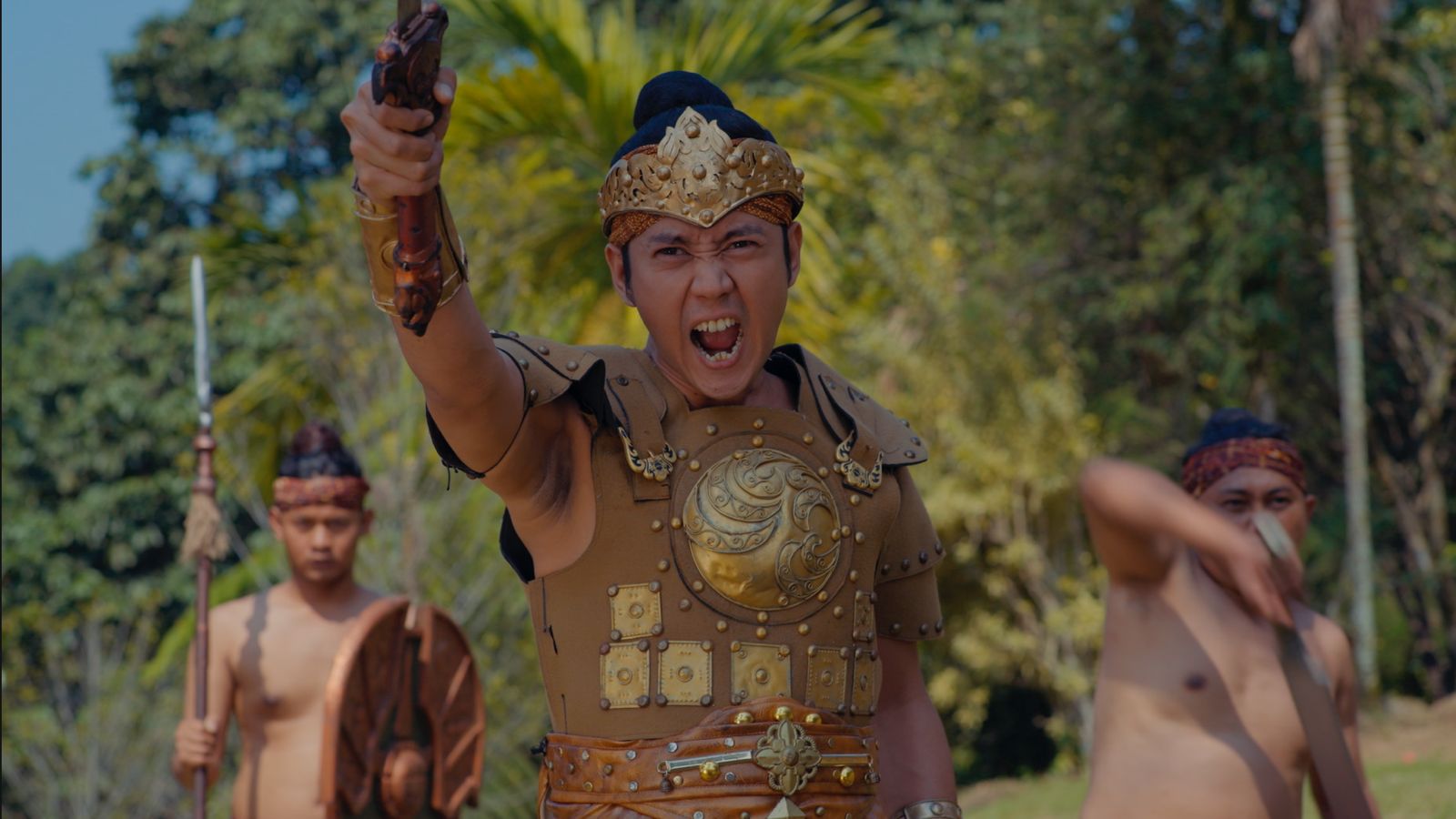
The Majapahit brief was a two-day, voiceover-led period dramatisation: one studio day in Jakarta and one exterior day in Bogor. The production combined court interiors, period wardrobe and props with outdoor scenes.
The shoot was delivered by the Celluloid Pact Jakarta production team, led by Widiyantoro.
This case study examines the decisions behind the shoot: redressing the studio set, selecting wardrobe and hero props, matching camera and audio equipment to the intended edit, and organising the move to Bogor. These were choices for this brief, not a standard package for every Indonesian production.
The Majapahit Brief and the Production Frame
Historical Brief and Register
Majapahit was the Java-based empire that dominated maritime Southeast Asia from roughly 1293 to 1517, centred on Trowulan in East Java. The brief drew on that Hindu-Buddhist Javanese court register, with keris ceremonial blades, palm-leaf lontar documents and a court hierarchy that the wardrobe and set dressing had to place on screen.
The format was a documentary-style dramatisation for online delivery. Voiceover carried the narrative, with on-camera performance providing texture. That format shaped the camera, sound and transport decisions described below.
Two-Day Schedule
Day one was the Jakarta studio: throne room, court chamber and close interior work with the court hierarchy in frame. Day two was the Bogor exterior: outdoor scenes in natural light, with the unit travelling out from Jakarta.

Production Preparation and Approvals
A production plan needs to account for the permissions, location access and immigration requirements that apply to the actual project. This case study does not establish a standard approval timetable for another shoot.
Art Department
Art was the largest single design area on the shoot. The throne, dais, canopy and chamber walls were designed as a modular dressing, so the studio could change between scenes through redressing rather than rebuilding.

Throne Set Redressing Across the Schedule
The dressing carried multiple scenes on day one by changing banners, floor cloths, prop groupings and hero pieces. When the throne room becomes a war-council interior, the throne stays, the banners change, the ceremonial blades move onto a stand and the palm-leaf documents shift onto a low table.

Wardrobe Rental
For this brief, the costume department used rented wardrobe. Total wardrobe cost was roughly IDR 15 million, approximately US$840 at the IDR 17,900 per US$1 conversion used for this project. That is a project figure, not a current exchange rate.


Hero Prop Hierarchy
Not every prop was rented. Pieces the camera would sit on for close-ups, including the throne, a set of ceremonial keris blades, an amulet worn by the lead and the palm-leaf lontar documents held in frame, were built or commissioned to a level that would carry a close shot. Background dressing that only read at wide-shot distance was rented or shared from stock.

Camera, Sound and Transport
Camera Choice for the Intended Delivery
The shoot used a Sony FX6 for the planned single-camera coverage. The package was selected for this production’s shooting approach and delivery requirements. A different brief would require a fresh assessment of camera, lenses, recording format and post-production needs.
Audio
The planned edit relied on voiceover rather than dialogue-led scenes. This production therefore used camera audio and one wireless microphone for the intended recordings. That choice should not be carried into another brief without checking its dialogue, ambient sound and post-production requirements.

Transport
Transport was planned around the personnel and equipment travelling to Bogor. The vehicle allocation reflected this shoot’s requirements rather than a standard unit size. The unit moved in four vehicles:
- one production vehicle
- one camera vehicle
- one grip and lighting van
- one crew shuttle
Why Jakarta and Bogor Fit This Brief
The brief combined studio interiors with an outdoor day, and both could be organised from a single Jakarta base: studio, art department and wardrobe sourcing in the city, and a drive-out to Bogor for the exterior scenes.

For production support on an Indonesian brief, see our line producer Indonesia page. For a brief that includes Bali, see line producer Bali.
Our Indonesia film production rates page provides further budget and rate information.
For a separate regional budgeting reference, see Vietnam production costs.
What This Project Demonstrates
The two-day shoot combined reusable studio dressing, rented wardrobe and a camera and audio package selected for the voiceover-led edit. Jakarta provided the production base for both the studio work and the move to Bogor.
