

A line producer Djibouti team holds the budget, schedule, contracts and reporting for international productions, while film fixers in Djibouti coordinate audiovisual filings, location access, local crew, equipment imports and daily logistics.
Djibouti sits at the Bab-el-Mandeb strait where the Red Sea meets the Gulf of Aden, on the Afar Triangle where the African and Arabian plates meet. It is geographically small but combines sub-sea-level salt flats, limestone-chimney moonscape, Red Sea coastline and French and Arabic linguistic registers, with a Horn of Africa position that can support East African production routes.
Lake Abbe carries the limestone chimney formations visually associated with the original Planet of the Apes (1968) and is a widely recognised Djibouti location. Lake Assal at minus 155 metres is the lowest point in Africa. Djibouti’s production geography clusters around Djibouti City, Lake Assal, Lake Abbe, Tadjoura and the Afar Triangle.
Film fixers in Djibouti and the line producer Djibouti network handle the filming authorisation and site-specific approvals, equipment imports, restricted-zone planning and the work-permit pipeline for foreign crew arriving via Djibouti-Ambouli International Airport. The permit, customs and visa procedure is set out once, in the permits section below.
Djibouti does not currently market a national screen-production cash rebate comparable to South Africa’s or Morocco’s; confirm any project-specific support before budgeting. What it offers instead is distinctive geological locations, French and Arabic operational languages on the production layer, a small local crew bench supplemented from Addis Ababa or Joburg, and a position from which Horn of Africa documentary, geopolitical feature and news work can route through Djibouti.
Line Producer Djibouti and Film Fixers: How the Local Production Layer Works
Djibouti’s production economy is small in volume but structurally well-defined: a single national filming authorisation, a short list of site-specific approvals that depend on the locations chosen, a crew bench concentrated in Djibouti City, and equipment that travels in. The line producer holds the budget, schedule and contracts against those realities; the fixers hold the ground.
Film Fixer Djibouti Support: Permits, Locations and Restricted Zones
Film fixers in Djibouti hold the permit filings, location access and restricted-zone planning that shape every shoot, and they settle the equipment route first, because professional gear enters on a temporary-import basis rather than a carnet. The authority stack a film fixer in Djibouti coordinates is short: the ANPC cinematography department for the filming authorisation, site custodians for cultural-site access, the district administration for inland Afar Triangle work, Afar community leaders for traditional-land filming, and the relevant clearance for aerial work or filming near military or airport-controlled areas.
Local fixers operate primarily in French and Arabic, with English as the working secondary language with international crews. Heads of department are typically rotated in from Addis Ababa, Nairobi or Joburg, with Djibouti-resident key positions concentrated around the Dhalinyaro film community in Djibouti City, and equipment freight commonly staged through Addis Ababa or Joburg.
Production Constraints: Crew, Rebate and Restricted Access
Three constraints shape pre-production. Key positions such as DP, gaffer, key grip and production designer are usually imported, so crew travel sits in the budget from the first draft. Aerial filming and work near military or airport-controlled areas require project-specific clearance and may be restricted, so the script’s aerial requirements are reconciled before commitment. And with no rebate to offset spend, the cost case rests on a small operational layer, closer to Tanzania or Ethiopia than to South Africa or Morocco.
Joburg and Addis Ababa routing for crew and equipment
Most international productions routing into Djibouti use Joburg or Addis Ababa as the staging base for crew assembly and equipment freight, with Ethiopian Airlines connecting Addis Ababa to Djibouti-Ambouli in around 90 minutes subject to the current schedule. Our South Africa filming support operates as the southern African staging base for schedules that extend to Djibouti, routing equipment and heads of department via OR Tambo onward connections; this suits longer multi-country sub-Saharan briefs where Djibouti is one leg.
Djibouti’s production zones, Djibouti City, Lake Assal, Lake Abbe, Tadjoura and the Afar Triangle
Djibouti’s geological and coastal landscape is the technical case for the country. A small production geography compresses sub-sea-level salt flat, limestone-chimney moonscape, Afar Triangle volcanic terrain, Red Sea and Gulf of Aden coastline, French colonial city architecture and Arab-Swahili port-town heritage inside a compact country where road distances between registers are short, subject to route and conditions.
Lake Abbe limestone chimneys, the Planet of the Apes association and sci-fi stand-in
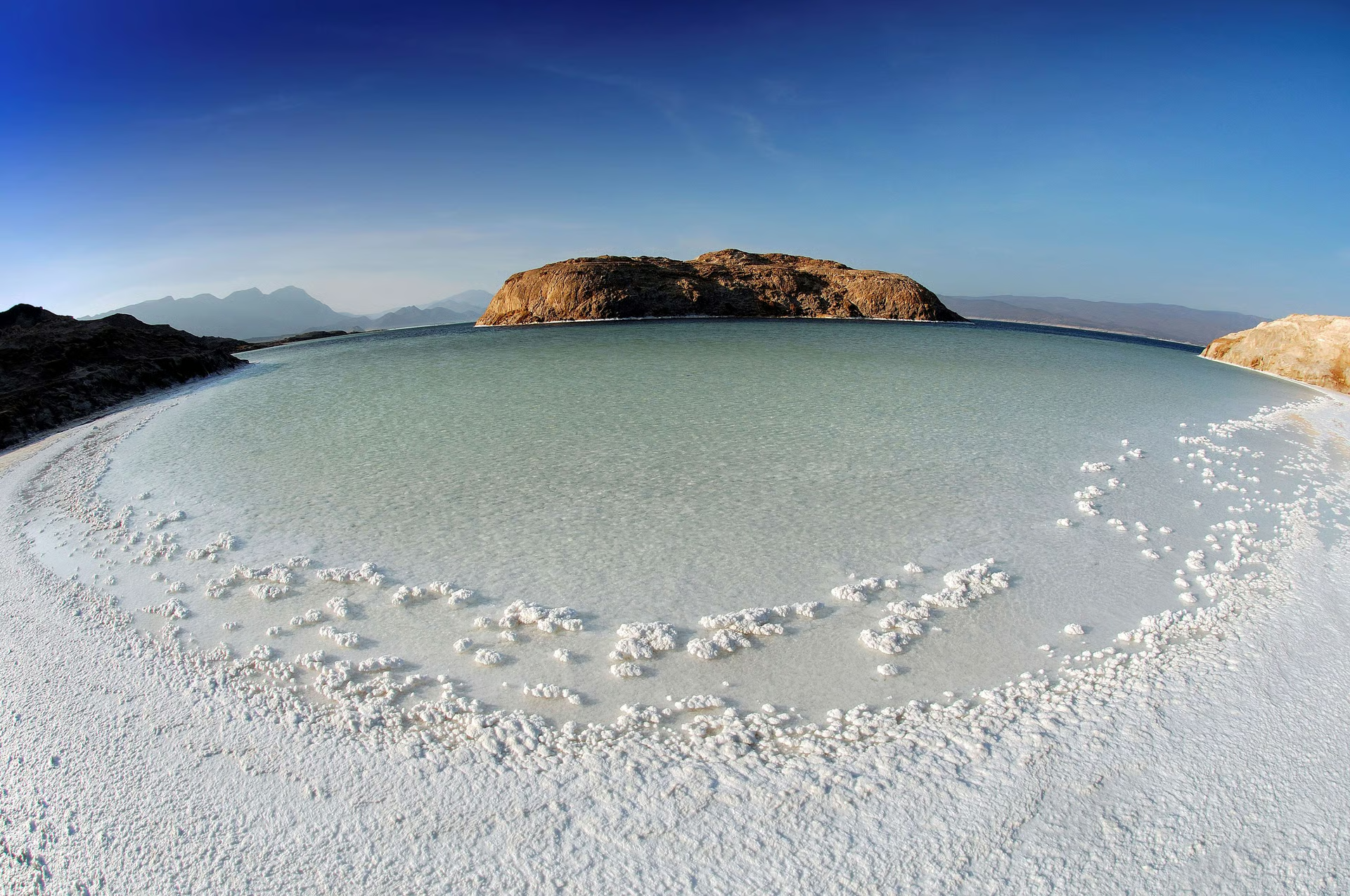
Lake Abbe sits at the south-western corner of Djibouti on the Ethiopian border. The lake is fed by the Awash River from Ethiopia and is famous for the limestone chimney formations that rise from the steaming alkaline crust. These chimneys, formed by mineral deposition from hot springs, deliver the visual register widely associated with the original Planet of the Apes (1968) and its dystopian Earth-as-apocalyptic-future framing. The location is a widely recognised Djibouti filming asset and continues to attract sci-fi, post-apocalyptic, primordial-Earth and documentary work where the geology itself is the subject. Access to Lake Abbe runs from Dikhil, a four-hour drive from Djibouti City over progressively rougher tracks, with 4WD essential and film fixers in Djibouti familiar with the Afar-region access protocols.
Lake Assal, sub-sea-level salt flats and the post-apocalyptic register
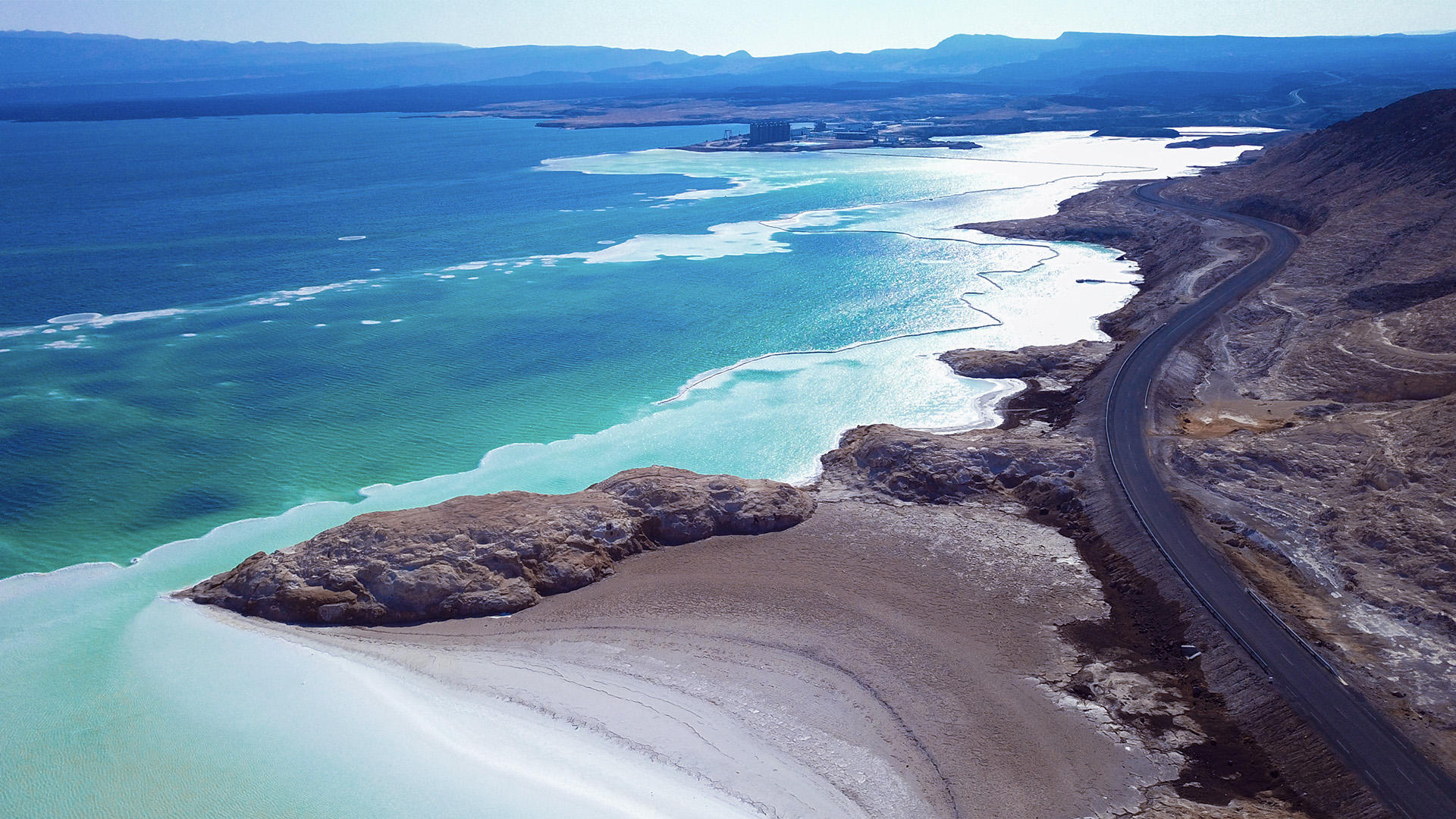
Lake Assal lies 120 kilometres west of Djibouti City in the Afar Depression. At minus 155 metres below sea level, it is the lowest point in Africa and the third lowest point on Earth after the Dead Sea and Lake Kinneret. The salinity exceeds 34 percent, making Lake Assal one of the saltest bodies of water on the planet, behind only Antarctica’s Don Juan Pond. The visual register is white salt crust, turquoise water, black basalt and ochre desert framing. The result is a direct stand-in for post-apocalyptic landscape, alien-planet sci-fi, ancient-Earth and any open-land brief that needs an environment with no human reference scale. The drive from Djibouti City to Lake Assal runs around 90 minutes on the RN9 road, with the salt flat itself accessible directly from the road.

Tadjoura, Maskali and Moucha islands across the Gulf of Tadjoura
The Gulf of Tadjoura cuts deep into the Djibouti coastline and forms the country’s main coastal register. Tadjoura town on the northern shore carries Arab-Swahili coastal heritage architecture, traditional white-washed buildings and a working port that has anchored regional trade for centuries. Maskali and Moucha islands sit in the Gulf, with Moucha hosting limited tourism infrastructure and Maskali running closer to wildlife and coral coverage. The Gulf delivers turquoise water, basalt cliffs and the Red Sea entry into the Gulf of Aden, where whale shark migration provides distinctive underwater work between October and February. Boat access to the islands runs from Djibouti City and from Tadjoura town, with the local film fixer coordinating the regional boat operators and coastal community access.

Djibouti City, the French colonial and Afro-Arab crossroads
Djibouti City carries the contemporary register and the historical layers that define the country’s urban identity. The European Quarter (Plateau du Serpent) holds French colonial architecture from the late nineteenth and early twentieth century. The African Quarter (Plateau du Marabout) carries the residential and market layer. The Place du 27 Juin anchors the central square. The Port of Djibouti is a major container facility for the region, while the Doraleh port handles bulk cargo and the multipurpose terminal. Djibouti-Ambouli International Airport (JIB) sits south of the city and handles all international air traffic. The city itself supplies the contemporary-African urban backdrop with French signage, Arabic call-to-prayer, multilingual operational layer and a distinctive cross-cultural register.

Ardoukoba and the Afar Triangle volcanic geology
The Afar Triangle is the geological junction where the African, Arabian and Somali tectonic plates meet, making Djibouti one of the few places on Earth where a continent is actively splitting. Ardoukoba is the youngest volcano in the country, erupted in 1978 and sitting near the southern edge of Lake Assal. The Goba volcanic area and the surrounding Afar Triangle deliver primordial-Earth, geological-documentary and Earth-formation-science registers for documentary work. Inland access to the Afar Triangle runs through Dikhil with 4WD support and local community coordination essential, since several Afar villages sit within the volcanic zones.

Filming Permits in Djibouti: Authorities and Restricted Zones
Djibouti’s cinematography framework assigns filming authorisations to the cinematography department of ANPC, the National Agency for the Promotion of Culture. Separate location, district, security, military-airspace, aviation and customs approvals may apply according to the brief. This is the one section of the page that sets out the procedure; the rest of the page refers back to it.
Filming Authorisation Through ANPC and Site-Specific Approvals
Under Decree 2023-142, the cinematography department of ANPC holds the filming-authorisation function; the Ministry of Communication separately confirms its responsibility for audiovisual regulation. As an office planning checklist rather than published authority guidance, applications are prepared with a script synopsis, shoot location list, equipment manifest, crew list with passport-and-nationality breakdown, and a local sponsor letter from a Djiboutian production service. Lead times are not published by the authority and are confirmed per project, with longer windows where military-airspace clearance, sensitive-zone access or restricted-area requests stack on top. ANPC authorisation is coordinated alongside the applicable site-specific approvals; the line producer in Djibouti runs both tracks in parallel during pre-production.
Restricted airspace and military-base proximity
Significant airspace and several coastal and inland zones around military installations and Djibouti-Ambouli International Airport carry filming restrictions. Aerial filming, drones in particular, and any work near military or airport-controlled areas require project-specific clearance and may be restricted within specified perimeters. The line producer in Djibouti flags the airspace stack at the briefing stage so the production scope and the script’s aerial requirements are reconciled before commitment.
Equipment imports, temporary admission and customs brokerage
Djibouti is not listed in the current ICC ATA Carnet directory. Professional equipment should therefore be planned through a temporary-import procedure confirmed with Djibouti Customs and the appointed local customs broker. A carnet used for export or transit in another participating territory does not establish carnet acceptance in Djibouti. The equipment list, declared values, any deposit or guarantee requirement, re-export conditions and clearance timing at Djibouti-Ambouli International Airport are confirmed with customs and the broker before dispatch. Vehicles for production use route under their own temporary-import permits.
Visa stack, e-visa platform and crew work permits
Where the eVisa route applies, crew entry is processed through Djibouti’s official eVisa platform. Processing times are confirmed with the sponsoring partner for the shoot dates. The applicable visa, work-authorisation route, sponsor and filing period must be confirmed for each nationality and crew role before travel. Bilateral arrangements for visa-exemption or visa-on-arrival exist for a small number of passports but change periodically, so the line producer confirms the current Djiboutian Ministry of Foreign Affairs guidance per crew nationality at briefing stage rather than assuming any standing exemption.
Djibouti in the East African production corridor
Djibouti’s role in the regional production economy rests on its Horn of Africa positioning, its geological range, the French-Arabic operating register, and the local production industry that Lula Ali Ismaïl and her contemporaries have built over the past decade.

Dhalinyaro and the contemporary Djibouti production industry
Dhalinyaro (2018), directed by Lula Ali Ismaïl, was the first feature film produced entirely within Djibouti and a milestone in Djibouti’s locally produced cinema, with recognition at the Carthage Film Festival and a screening at the BFI London Film Festival. The small Djibouti-resident crew community that has grown around that work supplies the local key positions available to visiting productions.
Horn of Africa stand-in role and geopolitical access
Djibouti’s strategic positioning makes it the gateway for Horn of Africa documentary, geopolitical feature, news and investigative work. Productions covering Somalia, Yemen across the Bab-el-Mandeb strait, the Red Sea shipping route, and the East African political-economic corridor often base in Djibouti for access and security reasons. Cross-territory stand-in roles extend to other arid coastal registers where the geology and the production-cost equation align, with Djibouti standing in for parts of the Arabian Peninsula and the Red Sea coast where those primary territories are inaccessible.

Engaging a line producer in Djibouti
The shape of a Djibouti schedule is set at the briefing stage. The variables that matter are which locations the script implies, whether Lake Abbe access requires the four-hour Dikhil drive and 4WD logistics or whether the schedule sits closer to Djibouti City and the Gulf, whether aerial work is needed and whether clearance is realistic, and the crew nationalities and equipment list that drive the visa and customs tracks. Lead time from script lock to first shoot day is set per project against those variables rather than a standard figure.
The pairing model for line production in Djibouti runs as a regional production head holding the contract and the schedule, with a line producer in country handling day-to-day execution across authorisation coordination, community access for inland work and on-the-day liaison with the district administration. A line production company in Djibouti can hold both functions on a smaller shoot, while larger productions separate the contract-and-schedule role from day-to-day fixing. For how Djibouti compares with other African bases on permits, crew and cost, see our filming in Africa guide.
