

A line producer Portugal team holds the budget, schedule, contracts and reporting for international shoots across Lisbon, the Algarve, Madeira and Porto, while film fixers in Portugal coordinate municipal permits, locations, local crew, equipment and daily logistics. Portugal sits on the western edge of the EU production-incentive map, within a few hours’ flight of London and central Europe. Recent international productions, House of the Dragon at Monsanto and Netflix’s Damsel in the Douro Valley, have renewed the country’s reputation as a working base for English-language shoots. Film fixers in Portugal have handled international brand and streamer projects across this window, and a film fixer in Portugal on the ground turns a distant location into a working shoot floor for teams routing through Lisbon or the Atlantic corridor.
Portugal’s 2026 incentive framework and what a line producer in Portugal handles
Engaging a line producer in Portugal at prep, not one month before principal photography, is what keeps the ICA application on the right side of the review calendar. Since 2026 the incentive framework is SCRI.PT, administered by ICA through RIPAC, with a medium-budget track at 30% and a large-scale track at 30% on the first €2 million and up to 25% above, and higher rates for spend incurred in Madeira, the Azores and low-density territories. The rules, thresholds and claim sequence are covered on our Portugal film incentives page; here the line producer’s role is to coordinate the application, which the eligible applicant submits through ICA, and to align the eligible-expenditure budget with the schedule.
This page is for producers and line producers planning a Portugal shoot that crosses more than one production region, Lisbon and Sintra in the centre, the Algarve cliff coast in the south, and Madeira’s volcanic Atlantic terrain. The workflows below reflect current production practice as the post-2026 rebate framework beds in across the mainland and the autonomous regions.
Line Producer Portugal and Film Fixers: How the Local Production Layer Works
Portugal’s draw is geographical and institutional at the same time. Geographically, the country compresses a usable range of looks inside a small footprint, Moorish hilltop palaces near Lisbon, Atlantic cliff coast in the Algarve, volcanic mid-Atlantic landscape in Madeira, terraced river valleys in the Douro. Institutionally, Portugal offers a 30% production incentive, and line production in Portugal runs the Câmara Municipal permit chain in each of Lisbon, Cascais and Sintra, with municipal windows planned as office estimates of around a week for standard applications. Add an English-fluent crew and senior line producers who have carried international streaming productions since 2018, and Portugal becomes a workable jurisdiction for multi-region shoots.

What the Portugal fixer layer actually handles
The term “fixer” gets used loosely in conversations about filming in Portugal. Film fixer Portugal work on the ground covers a defined sequence: scouting and presenting locations against a script’s needs, securing the right municipal permits through the local Câmara, coordinating with the regional film commission (Lisboa Film Commission in central Portugal, Algarve Film Commission in the south, Madeira Film Commission for the autonomous region), assembling a local crew at the right scale, handling cash flow and ATA carnet customs for equipment moving in and out, and managing the day-to-day liaison between the visiting team and Portuguese authorities.
The work bridges what a line producer does in the planning phase and what a production manager does on set, and film fixers in Portugal cover both roles for compact briefs. Film fixers in Portugal handle the Câmara municipal permit cycle and the supporting documentation for the incentive application as a single integrated team.
Fixer vs line producer vs production service company
A fixer typically operates as a single point of contact with a network. A line producer takes financial responsibility for the production budget and signs vendor contracts. A production service company (sociedade de produção) is the legal entity that submits the incentive application to ICA, issues invoices, and holds the contractual responsibilities assigned to it. On smaller commercial shoots one person plays all three roles. On a feature or limited series with local spend above €500,000, they should be separate functions even if the same firm provides them, keep the brief and the bank reconciliation in different hands. Keeping the distinction clear means an invoice that does not reconcile with a permit fee, or a crew payment missing from the incentive file, is caught early.
Portugal’s main filming regions, Lisbon, the Algarve, and Madeira
Filming in Portugal clusters around three regions, each running through its own institutional layer, crew base, and seasonal window. Producers planning multi-region shoots should map the route before locking budgets, Lisbon to Faro is three hours by road and a 45-minute flight; Lisbon to Funchal is a 90-minute flight only. Each region has its own film commission and municipal permit track; the national incentive application sits above all three.
Lisbon and the central region, Sintra, Cascais, Tagus

Lisbon is the working base for most international shoots in mainland Portugal. The historic quarters, Alfama, Baixa, Bairro Alto, supply the looks producers come for; Sintra sits forty minutes northwest and supplies the fantasy register with the Pena Palace, the Moorish Castle, and the gardens of Quinta da Regaleira. Cascais and Estoril, also forty minutes from Lisbon on the Atlantic coast, cover Bond-era casino glamour. Permits across the central region route through the Câmara Municipal de Lisboa with the Lisboa Film Commission acting as the coordinating desk for productions. For a deeper breakdown of permits, the incentive interface in Lisbon, and the central-region crew base, the dedicated Lisbon film permits piece sits alongside this overview. Film fixers in Portugal working the Lisbon corridor maintain standing relationships with Cascais, Sintra, and Lisbon Câmara film cells, three jurisdictions running on parallel timelines.
International productions engage production companies in Lisbon for Câmara Municipal permits, embassy-district access for diplomatic-quarter shoots, and the Sintra-Cascais-Tagus routing that anchors most central-region feature work.
The Algarve, Faro, Lagos, Sagres, the cliff coast

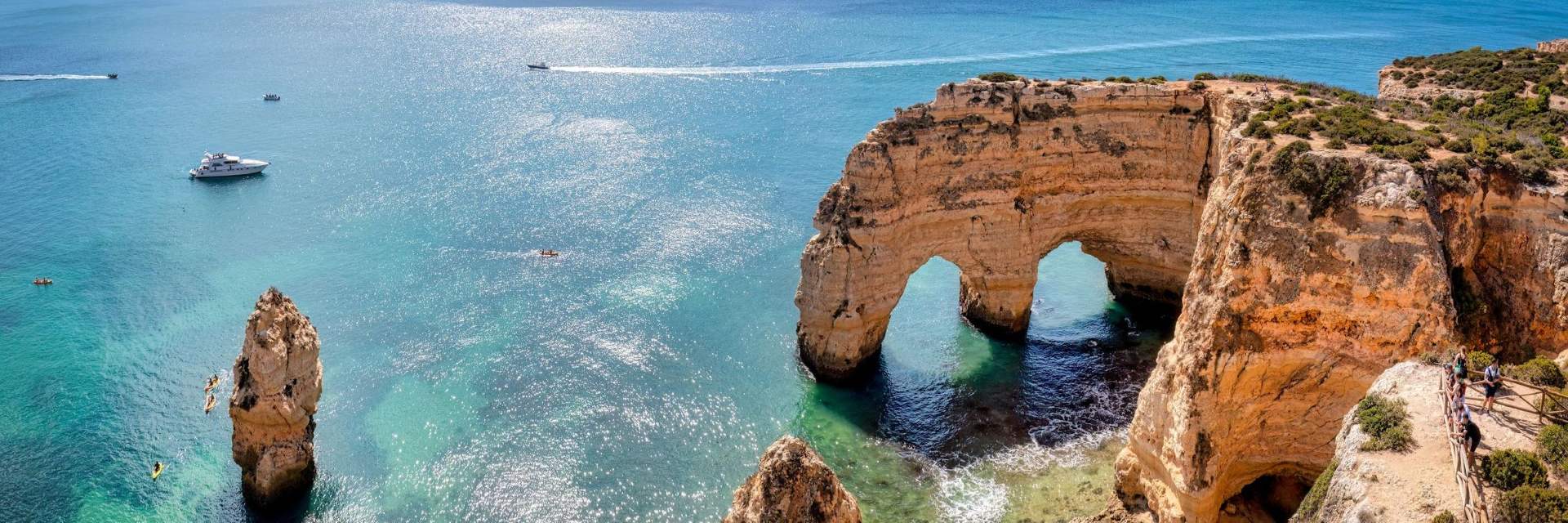
The Algarve runs along Portugal’s southern coast for roughly 200 kilometres, from the Spanish border at Vila Real de Santo António in the east to Sagres at the south-western tip. Faro is the region’s capital and the gateway airport (FAO); Lagos delivers the limestone cliff coast at Ponta da Piedade; Sagres holds the wind-battered cape where the Atlantic and Mediterranean lines visually merge. Albufeira and Tavira fill out the white-village register. Productions come for Mediterranean stand-in coast at European-rebate pricing, the Algarve covers what southern Italy or Croatia cover at higher rates and with longer permit windows. A line producer Portugal team working the Algarve coordinates the Faro, Lagos, and Sagres municipality permits separately, each has its own form and lead-time band.
Municipal Filings and Cliff Access
The institutional layer is denser than the Lisbon track. Permits route through each municipality’s Câmara, Faro, Loulé, Lagos, Albufeira, Tavira each operate independently. The Algarve Film Commission, based in Faro, acts as the regional coordinator above the municipal layer, with the Loulé Film Office running a sub-municipal facilitator role for projects landing in that municipality. Productions covering more than one Algarve municipality should expect parallel permit tracks, the line-production layer keeps them synchronised against the shoot schedule. International productions engage production companies in the Algarve for coastal-municipality permits, Faro-Lagos-Sagres logistics windows, and the Atlantic-cliff scheduling that anchors most cliff-coast and underwater work.

Madeira, volcanic Atlantic terrain and the autonomous-region uplift
Madeira is the Atlantic island production base, a 90-minute flight from Lisbon, 700 kilometres off the African coast, and a constitutionally autonomous region of Portugal. The terrain is volcanic and dramatic: cliffs falling straight into the Atlantic, basalt headlands, sub-tropical laurisilva forest in the interior, and the levada water-channel paths that thread through the mountains. Productions use Madeira for stand-in coverage where stories need ocean isolation, mid-Atlantic geography, or a fantasy-scale volcanic landscape without trekking to Iceland. Madeira briefs move through a separate regional film office rather than the mainland ICA desk. The territorial uplift is confirmed against the low-density and autonomous-region designations early rather than at the filing stage.

The institutional difference is significant. Madeira runs its own Film Commission under the Regional Secretariat for Tourism and Culture, a regional government layer that does not exist on the mainland. Permits route through the Câmara Municipal do Funchal for the capital, with smaller municipalities (Câmara de Lobos, Calheta, Santana) handling their own.
Incentive Routing for the Autonomous Region
The autonomous-region status also carries the higher RIPAC rate: eligible spend incurred in Madeira or the Azores is reimbursed at 40% on the medium-budget track and at 30% on the large-scale track, rather than the mainland 30% and 25% respectively. The higher rate attaches to eligible expenditure classified as incurred in the relevant territory; the applicant confirms the treatment of payroll, equipment, travel, accommodation and location costs through the eligible-expenditure budget and supporting records rather than assuming that every cost tied to an island shoot day receives the regional rate.
International productions engage production companies in Madeira for Câmara Municipal do Funchal permits, autonomous-region incentive routing, and the volcanic-coast scheduling that anchors most Atlantic-isolation feature work.
Portugal Filming Permits, Customs and Production Services
Three institutional layers govern every Portugal shoot. At the municipal layer, each Câmara Municipal issues the actual filming permit for public-space shoots in its jurisdiction. At the regional layer, the territorial film commission, Lisboa, Algarve, or Madeira, coordinates between projects and the municipalities, and offers location guidance, vendor introductions, and informal facilitation. At the national layer, the Portugal Film Commission (PIC Portugal) sits as the gateway for foreign productions, with the Instituto do Cinema e Audiovisual (ICA) administering the national incentive. The production-services layer has to navigate all three without making any of them feel bypassed.
Municipal permits, three-region reality
Public-space filming activity in Portugal requires a municipal permit administered through the Câmara Municipal in each jurisdiction, with the regulatory framework applied regardless of crew size on most public-space shoots. For Lisbon, standard permits typically issue within a few working days of submission against an administrative fee plus area-occupation charges, with the exact rate and turnaround confirmed against the current Câmara Municipal de Lisboa schedule at briefing stage. Algarve municipalities are planned at roughly a week for standard permits as an office estimate, with the Loulé Film Office often shortening that window when engaged early. Madeira’s Funchal Câmara typically runs a similar window. Productions wanting fee exemption, granted when the project “serves the best interests of the municipality”, need to file fifteen business days ahead with a full project folder including synopsis, script, crew CVs, financing, and the cultural angle the application leans on.
ICA, Portugal Film Commission and Regional Film Commissions
Above the municipal track sits the Instituto do Cinema e Audiovisual (ICA), the national film body that runs the SCRI.PT incentive, and the Portugal Film Commission (PIC Portugal), which acts as the national-level entry point for foreign productions. The regional commissions, Lisboa Film Commission, Algarve Film Commission, Madeira Film Commission, plus Filmaporto in Porto, coordinate between municipalities and projects on the ground. For productions running multi-region schedules, the eligible applicant submits the incentive application to ICA, with the line producer coordinating the file, not through any single regional commission. The regional commissions remain useful for location guidance and vendor introductions throughout pre-production and the shoot itself.

ATA carnets, drones, weapons, and customs
Portugal accepts ATA carnets for temporary equipment imports, the standard route for international shoots arriving through Humberto Delgado Airport (LIS) in Lisbon, Faro Airport (FAO) for Algarve shoots, or Funchal Airport (FNC) for Madeira. As Portugal is in the EU, productions arriving from another EU member state move equipment freely without a carnet. Drone operations route through ANAC (Autoridade Nacional da Aviação Civil) and require flight authorisation for restricted zones, most of central Lisbon, sections of the Algarve coast, and large parts of Madeira’s airspace require advance clearance. Weapons (including practical firearms used as props) require a Public Security Police (PSP) permit and a local armourer of record. Sensitive items including pyro go through a separate authorisation track filed alongside the municipal permits.
Crew, Incentive Coordination and Engaging a Line Producer in Portugal
Film production services in Portugal, full-service versus line-producer-only engagement
For Portugal, film production services in Portugal typically means one of two procurement shapes. Full-service contracts route through a Lisbon or Porto-registered service company that coordinates the incentive application with ICA (Instituto do Cinema e do Audiovisual), filming permits through Lisbon and Algarve municipal offices, crew and vendor booking, ATA Carnet routing through Lisbon Portela, and end-to-end shoot execution. Line-producer-only engagements are narrower, the international company retains more of the vendor management, casting and permit oversight in-house, and the Portuguese line producer holds budget and scheduling accountability under the engagement.
For a single-region Lisbon commercial or Algarve documentary brief, engaging a single Portuguese line producer with local municipal relationships is often the most efficient path. For multi-region schedules combining Lisbon urban work, Algarve coastal, Madeira volcanic and Douro valley heritage, or for feature briefs claiming the incentive with a Madeira or Azores block, the full-service film production services route absorbs coordination overhead and may reduce duplicated coordination versus parallel individual engagements.
Cost structure: film production services in Portugal are quoted as package rates combining line-producer day rate, coordinator and production-management support, permit filing fees across municipalities, incentive administration where applicable, and a modest production-service margin. Studios bookings at Lisbon-area facilities route through service companies with existing relationships; independent Portuguese line producers partner with service entities for larger-facility work rather than direct.
SCRI.PT Incentive Summary and Line Production Services in Portugal

SCRI.PT (Decree-Law 57/2026) is the funding programme introduced in 2026, folding Portugal’s previous cash rebate and cash refund into RIPAC, which runs two tracks that cannot be combined: medium-budget support at 30% and large-scale support at 30% on the first €2 million and up to 25% above, with higher rates for eligible expenditure incurred in Madeira, the Azores and low-density territories. The eligible applicant submits the application to ICA; the line producer in Portugal coordinates the eligible-expenditure budget, the schedule and the supporting records behind it.
Thresholds, eligible-expenditure rules, the cultural test, assessment timelines and the payment sequence sit on the incentives page linked above. The point that matters on this page is that support is paid after the expenditure is documented and reviewed, so the line producer builds the gap between spend and payment into the cash-flow plan.
Seasonal scheduling across three regions
Each production region has its own seasonal rhythm. Lisbon’s prime window runs April through June and September through October, long light hours and the Tagus light DPs come specifically for. July and August are workable but hot and tourist-heavy, and Sintra access tightens with visitor volume. The Algarve flips slightly: the cliff coast holds usable light almost year-round, but peak-summer access at Lagos and Albufeira gets choked by tourism. November to March on the Algarve gives clean, low-tourist conditions with Mediterranean-style daylight. Madeira’s window is the most stable of the three, sub-tropical temperatures hold roughly year-round, with the trade-off that Atlantic weather fronts can compress shoot days unpredictably between October and February. Productions covering all three should plan for a shoulder-season schedule, typically March to June, that catches each region in usable light without peak tourist pressure.
Film crew in Portugal, equipment houses and Lisbon-Porto-Madeira sourcing
The crew base is deepest in Lisbon for feature and high-end TV work, with Porto carrying a strong secondary bench for series and commercial work, Faro-Algarve running a smaller second-tier bench, and Madeira maintaining a specialist island-based crew layer that knows the volcanic terrain and the weather windows it imposes. Key positions, DOP, first AD, production designer, location manager, sound mixer, are bilingual Portuguese-English on most senior tickets, with the senior bench having worked through recent foreign features under both the current and the earlier incentive framework. English-fluency is the operational norm in Lisbon and Cascais; Algarve and Madeira run more in Portuguese with English-fluent leads. For multi-region shoots, senior line producers in Portugal coordinate the core team from Lisbon and bring local supporting crew aboard at each regional unit base.
Foreign-HoD rotation is the standard model on the largest features, the Portuguese first AD, production designer and location manager carry the local-knowledge and municipal-relationship load, while the DOP, director and post HoDs are often imported. On commercial and TV work the local bench is sufficiently deep to source a complete unit locally. Specialist coverage includes aerial via ANAC-licensed drone operators, underwater units working out of Algarve and Madeira, and period-design crews trained on the Manueline and Pombaline architectural detailing that Portuguese heritage demands.
Regional Secondaries and Inter-Island Logistics
Arri Alexa packages (Mini LF, 35), Sony Venice and Red lines are available through equipment houses including MovieMakers, Tóbis and Filmaco. Grip and lighting cover most production scales; specialist underwater or large-scale SFX leads tend to fly in from London, Madrid or Paris and pair with local crews underneath. Post-production has expanded sharply since 2020, Lisbon now carries a working colourist bench and several VFX shops sized for episodic work. For Algarve and Madeira shoots, gear rental typically routes through Lisbon-based houses with transport to the regional unit base; the regional kit footprints are smaller and oriented to local production needs.

Portugal Production Service Companies and ICA Registration
A line production company in Portugal is the operational layer between the foreign producer and the Portuguese permitting, banking and incentive framework. RIPAC support is paid to the eligible beneficiary with Portuguese tax presence. An inbound production may establish an eligible Portuguese company or branch, or engage a Portuguese executive producer that applies as the local beneficiary. Either way the Portuguese side needs ICA registration, an audit history that satisfies the verification process, VAT registration, and the municipal-relationship depth across Lisbon, Algarve and Madeira that lets the production move between regions without losing schedule traction. The service company submits the SCRI.PT application as the eligible applicant, keeps the eligible-expenditure register, manages the audit submission and receives the support on behalf of the production.
CPLP Co-production Routing
Portugal runs through the CPLP (Comunidade dos Países de Língua Portuguesa) Lusophone framework, which makes Portuguese production companies a natural routing layer for co-productions involving Brazil, Mozambique, Angola, Cape Verde, São Tomé and Príncipe, and Timor-Leste. Productions extending the Lusophone Atlantic corridor to the equatorial islands route through our Film Fixers In São Tomé and Príncipe team for the Direcção do Património Cultural permit chain, Roça plantation access and Lisbon-Luanda cargo routing.
A Portuguese service company with CPLP experience opens Brazilian financing structures, Mozambique location work and the wider Lusophone market that a UK or French equivalent cannot replicate, foreign producers typically engage through a service-production agreement rather than equity co-production for incentive-only work, with co-production treaties reserved for projects that need CPLP routing or European MEDIA fund access. Producers weighing Portugal against Bulgaria, Czech Republic, Hungary and Spain for stand-in fit and incentive routing cross-reference these options against our filming in Europe stand-in registers coverage before locking the corridor.
SCRI.PT Application and Financial Audit
Capacity discipline matters. Senior service companies carry only a handful of inbound features at a time, incentive filing cycles, municipal permit calendars across Lisbon-Algarve-Madeira, and ICA audit timelines all run in parallel against principal photography. Briefing the service company before the budget locks, rather than at the permit stage, is the difference between a clean rebate disbursement and a delayed audit.
| Region / authority | Standard permit (office planning estimate) | Restricted-location permit (office planning estimate) | Notes |
|---|---|---|---|
| Lisbon Câmara + Film Commission | 5-7 business days | 10-15 business days | Faster for pre-approved historic zones |
| Cascais / Sintra Câmara | 5-10 business days | 15-20 business days | Palace of Sintra needs cultural-heritage sign-off |
| Algarve municipalities (Faro, Lagos, Sagres) | 7-10 business days per Câmara | 15 business days | Parallel filings, cliff-access permits handled separately |
| Madeira regional film office | 7-10 business days | 15-20 business days | Levada paths and volcanic-terrain locations need environmental clearance |
| ANAC (drones) | 10-15 business days | 20+ business days for controlled airspace | Operator certificate must be current |
| PSP (weapons / stunts) | 15-20 business days | 25+ business days | Custody chain plans required with application |
Engaging a Line Producer Portugal Team
Portugal schedules typically lock or unlock at the briefing stage. Send the script or treatment, a target shoot window, a rough crew size, the locations you have in mind (or the locations the script implies, we can suggest across all three regions), the equipment level you’re planning, and the budget bracket. By the first feasibility pass, the permit timeline, regional logistics, and likely incentive path should already be visible, including whether part of the shoot can route through Madeira or the Azores for the regional rate. Engaging a Portugal line producer early in the budget cycle compresses the SCRI.PT documentation timeline and locks crew bandwidth against the production window.
Our film production practice in Portugal runs across Lisbon, Sintra, Cascais, the Algarve, Madeira and Porto, handling municipal permits, regional commission coordination, ICA filings, crew assembly, and multi-region scheduling for international shoots. We’re particular about which productions we take on, capacity is finite and we want to be the right fit for the shape of the shoot.

Sequencing Brief to Shoot
Filming in Portugal rewards prepared productions. The municipal windows are short, the incentive framework is now settled under SCRI.PT, and the regional rate in Madeira and the Azores changes the calculation for shoots that can move eligible spend there, but every part of the equation depends on the permit calendar, the incentive filing, and the multi-region logistics being mapped before principal photography begins. That’s what the local fixer ecosystem is for.
