

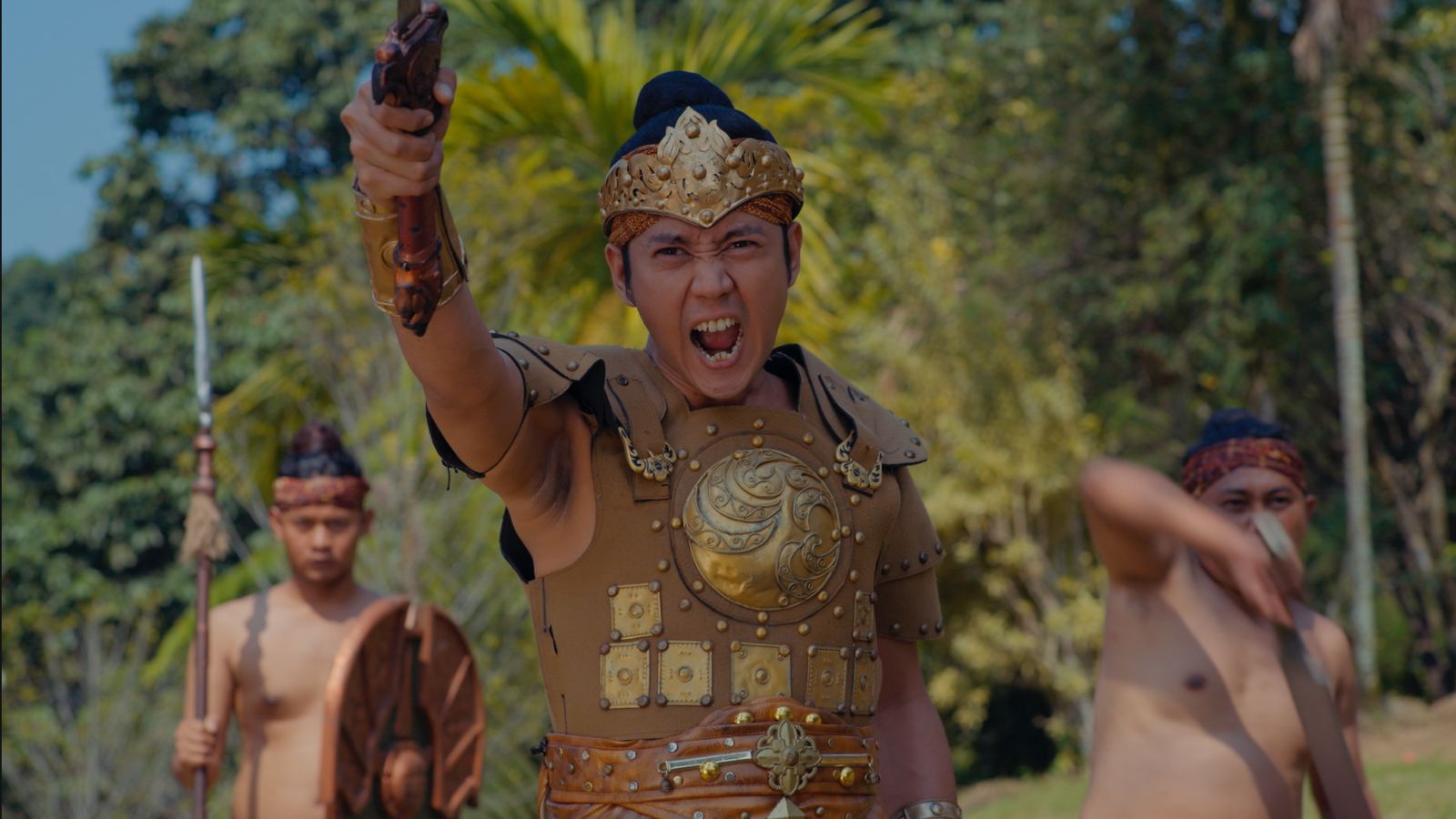
The Majapahit brief was a two-day art-led period piece: one Jakarta studio day and one Bogor exterior day, delivered against a documentary-style edit register with background dialogue rather than recorded performance. Foreign brief, Indonesian counterpart, historical subject, compact schedule. Everything hard about the job sat in prep, not in the shoot floor.
This is the production leadership case study for that brief. Not the itemised budget, which is published elsewhere for producers who want to see every line item negotiated in Indonesian rupiah. This is the decisions layer above the numbers: how the historical brief was interpreted, why the throne was dressed once and used across the entire schedule, why the camera package was Sony FX6 rather than Arri Alexa, and what a foreign producer weighing a Jakarta shoot can lift from the way this one landed. Producers with a Javanese, Sumatran or studio-interior brief work with a line producer Indonesia; producers whose brief lands coastal, tropical or on the temple heritage register work with a line producer Bali.
Every choice below was tested against a single question: would this decision hold up if the schedule doubled, if the format shifted from documentary to drama, or if the client asked to see the working? The point of publishing is to show that a compact period brief in Indonesia is deliverable at scale not because rates were cut, but because the design discipline in prep concentrated the budget on what carried the frame, and pruned what a longer schedule would have needed but two days did not.
The Majapahit brief and the production frame
Majapahit was the Java-based thalassocratic empire that dominated maritime Southeast Asia from roughly 1293 to 1517, centred on Trowulan in East Java, and the period brief we worked from was rooted in that specific historical register. This is not a generic Southeast Asian period frame that could as easily play as Khmer or Cham; it is a Hindu-Buddhist Javanese court aesthetic, with keris ceremonial blades, palm-leaf lontar documents, and a courtly hierarchy that the wardrobe and set-dressing had to place on screen accurately enough that the historical register held.
Historical brief and register
The brief we received was a documentary-style dramatisation for online delivery. Voiceover would carry the narrative spine; on-camera performance would carry texture. That single format decision shaped every downstream call: the sound package could drop from a scripted-drama kit to on-board camera audio plus one wireless microphone; the camera package could work as a single mirrorless cinema body rather than a two-camera A-cam and B-cam build; the cast tiering could spread across five main leads plus supporting, featured and extras without needing individual dialogue coaching or performance rehearsal.

Two-day schedule and the shoot geometry
Day one was Jakarta studio: throne room, court chamber, close interior work with a court hierarchy on frame. Day two was Bogor exterior: outdoor scenes with heritage-appropriate landscape, natural light, and a shorter unit convoy for the drive-out. The geography choice was deliberate. Bogor sits inside a workable production radius from central Jakarta and offers landscape registers that read as period without importing anywhere else, which meant the crew mobilisation did not need a second base camp or overnight logistics for a compact brief.
Backward planning from the Ministry permit calendar
For a foreign brief in Indonesia the permit calendar is what sets the shoot date, not the other way around. The C14 film visa is mandatory for foreign film crews entering to work and is secured before arrival. The national film permit is issued by the Ministry through its film directorate, applied for through a registered Indonesian production company as counterpart, and reviewed in a weekly Ministry meeting with a working turnaround of about seven days after that review, plus ten to fourteen additional days for the visa itself. Applications for a shoot of this scale need to file six to eight weeks before the intended dates. Prep is planned backward from that review calendar.
Design discipline in the art department
Art was the largest single design decision on the shoot, and where a compact brief is either saved or lost. The single most valuable move we made was collapsing what would have been two pre-set days into one by designing the throne and chamber dressing to redress rather than rebuild between scenes. On a period subject that discipline is worth more than any rate negotiation because it removes an entire prep day from the production spine.

Throne set redressing across the schedule
The throne, dais, canopy and chamber walls were designed as a modular dressing that carried multiple scenes across day one by swapping banners, floor cloths, prop groupings and hero pieces rather than striking and rebuilding. When the throne room becomes a war-council interior, the throne stays, the banners swap, the ceremonial blades reposition on a stand, and the palm-leaf documents shift onto a low table. Set-dressing time between scenes drops from a rebuild slot to a redress slot, which is measured in minutes rather than hours.
Wardrobe rental through the Indonesian theatrical chain
Period wardrobe is where a Jakarta shoot has a genuine structural advantage. The Indonesian theatrical and film wardrobe rental market carries deep court, warrior and civilian period stock, and a competent costume designer rents the vast majority of a brief like this rather than making pieces. Total wardrobe on the Majapahit shoot ran to roughly 15 million rupiah, roughly USD 840 at the 17,900 rupiah conversion the shoot was built on. Making the same wardrobe from scratch would have cost several multiples of that and consumed prep weeks that the schedule did not have.

Hero prop hierarchy
Not every prop was rented. Hero pieces that the camera would sit on for close-ups — the throne itself, a set of ceremonial keris blades, an amulet worn by the lead, palm-leaf lontar documents held in-frame — were built or commissioned to a level that would carry a close shot. Background dressing that would only ever read at wide-shot distance was rented or shared from stock. The discipline is a hierarchy: hero close-up quality, mid-ground rental quality, background stock quality. Applying that ladder ruthlessly is what keeps a period art budget from becoming an infinite line.
Camera, sound and unit sizing
The technology-side decisions on this brief were counter-intuitive if the assumption is that a cinema build always earns its own weight. For a documentary-register delivery with background dialogue, the mirrorless cinema route through a Sony FX6 was the right call, and the sound rig was reduced to on-board camera audio plus one wireless microphone. Both decisions removed crew and kit that a scripted drama would need. Making the wrong call in the other direction would have carried a large-format cinema camera and a full four-person sound department for a delivery that could not use either.

Why Sony FX6, not Alexa or Venice
The Sony FX6 delivers a 4K image that grades cleanly for online distribution, sits inside a body a single-camera operator can move fast, and rents at a fraction of an Arri Alexa Mini LF or Sony Venice 2 daily rate. The trade-off is a cinema look that reads slightly different from a large-format sensor at very close focal distances, which for a documentary-style dramatisation is invisible in delivery. On a scripted feature with theatrical release the calculation reverses. Matching the camera to the delivery, not to the crew’s habitual preference, is the discipline.
Ambient audio and the removed sound department
Background dialogue with voiceover-carried narrative allowed the sound rig to drop from a scripted-drama kit to on-board camera audio plus a single wireless microphone. In one decision that removes a boom operator, a sound recordist, a multi-channel recorder, a wireless lav pack and a script supervisor tracking sync. On a two-day compact schedule those cuts are safe. On a scripted drama with recorded performance, none of them are. Any producer weighing this trade-off should ask the edit team first whether the format actually delivers with ambient-only capture; if the answer is unsure, the sound department comes back.

Four-car convoy versus nine
Unit sizing scales downstream from the crew count and the equipment order. A leaner crew and a smaller camera build meant the shoot moved on a four-car convoy — one production, one camera, one grip and lighting van, and one crew shuttle — instead of the nine-vehicle convoy a full unit would carry. Fuel, tolls, driver day rates and parking coordination all compress accordingly. For a Bogor drive-out day where the road out of Jakarta is dense, a smaller convoy also moves faster and arrives at call time reliably, which for outdoor natural-light work is the difference between shooting the day’s schedule and losing an hour to traffic.
Jakarta as base, Bali as alternative, Vietnam as comparison
The choice of Jakarta as base for the Majapahit brief was not automatic. Bali is Indonesia’s other major production base and would have carried its own advantages: proven English-language crew depth, straightforward international travel, a heritage register that reads on-camera. It also would have carried a peak-season premium and an additional logistics stack that a compact period shoot does not need. Comparing the two side by side, and against a peer Southeast Asian destination in Vietnam, clarifies why Jakarta was the working choice.

Jakarta studio and crew depth
Jakarta carries the deepest working crew bench in Indonesia. Sound stages, rental houses, art departments, wardrobe rental networks and rigging teams all cluster around the city, and a compact shoot can staff and equip locally without importing anything. Cost of living translates through to lower daily rates than Bali carries once seasonal peak is applied. And the Bogor drive-out gives period exteriors within a workable radius of the studio base, which means the shoot did not need to plan overnight logistics or a second base camp.

Bali as alternative and when it turns expensive
Bali is the Indonesia destination most international producers know first, and for good reason. A shoot that needs coastal, tropical or temple registers reads as authentically Balinese in a way a Jakarta studio cannot fake. But Bali costs move sharply during peak tourist windows, accommodation baseline for crew is materially higher than Jakarta, and logistics for a Jakarta-based rental house crew to travel to Bali adds a transport and per-diem layer that a same-base shoot avoids. For a period court subject where the register was Javanese rather than Balinese, and where the studio interior was more than half the schedule, Jakarta was the right base. Where Bali does win is on coastal, tropical or Balinese-temple registers that a Jakarta studio cannot fake, and on English-language crew depth that is deeper in Bali than in Jakarta for international briefs.
Vietnam as peer Southeast Asian comparison
Vietnam is Indonesia’s most direct Southeast Asian peer for cost-controlled international briefs. The Hanoi and Ho Chi Minh City production ecosystems carry comparable crew depth, similar equipment rental bands, and a permit calendar that runs on a similar six-to-eight-week backward-planning discipline. For a period brief the register is different — Vietnam reads as Indochinese court or Cham heritage, not as Hindu-Buddhist Javanese Majapahit — but for a producer weighing a compact Southeast Asian shoot on cost grounds, benchmarking Indonesia against film fixers in Vietnam is the direct working comparison at similar crew-rate depth.
The cost delta between Jakarta, Bali and Vietnam for a compact brief
The working delta between the three, held against the same two-day compact brief, is roughly this. Jakarta studio and Bogor exterior comes in at the tightest total, both because rental houses, art department and wardrobe rental are all clustered inside the same city, and because the crew day-rate baseline is below Bali off-peak. Bali on the same brief typically runs fifteen to twenty-five per cent higher off-peak and can push toward thirty-five per cent higher during peak tourist windows, driven by accommodation and freight logistics rather than by crew rates on their own.
Vietnam on a comparable Hanoi or Ho Chi Minh City brief lands close to Jakarta on crew and equipment but adds a permit-timing layer that runs to a similar six-to-eight-week backward-planning window. For a producer weighing where a compact Southeast Asian period brief should land, the deciding factor sits less in the crew rate than in whether the historical register is Javanese Hindu-Buddhist (Jakarta wins), coastal or tropical (Bali wins), or Indochinese court (Vietnam wins). The right base is the register match, not the raw rate delta.
What a foreign producer can lift from this brief
A case study is only useful if it produces transferable calls. Four lift naturally from the Majapahit brief. The first is the design-versus-build hierarchy: for any period subject, ask which pieces the camera sits on and treat everything else as rental. The second is format-first equipment sizing: match the camera and sound package to the delivery format, not to the crew’s default preference. The third is backward planning from the Ministry review week, not forward from the shoot date. And the fourth is counterpart selection based on standing relationships with the film directorate and location authorities, not on lowest price quoted.

Reading these decisions against the numbers
The itemised working budget for this brief — every crew fee, equipment rental, location line, cast tier and catering rate — sat inside a working budget spreadsheet the production ran to. That spreadsheet answers what the shoot spent. This page answers why it spent it there. Producers weighing an Indonesia brief benefit from reading both together because the numbers only make sense once the design decisions above them are visible.
Where a bigger brief lands
A two-day compact shoot is a specific point on a much longer curve. A ten-day scripted drama would carry a full sound department, a two-camera build, a script supervisor, additional grip and lighting, and would move on a major convoy. Working-benchmark rate bands across departments, camera bodies, location fees and post-production for shoots on that longer scale sit on our Indonesia film production rates page.
What holds across the curve is the shape. Prep discipline pays back more than shoot-floor negotiation. Format-matched technology sizing pays back more than gear preference. Counterpart selection based on relationships pays back more than counterpart selection based on quote. A foreign brief that respects those three principles lands in Indonesia inside a compact window at a compact budget, and a brief that ignores them stalls at the Ministry review or blows the schedule at the shoot floor.
