

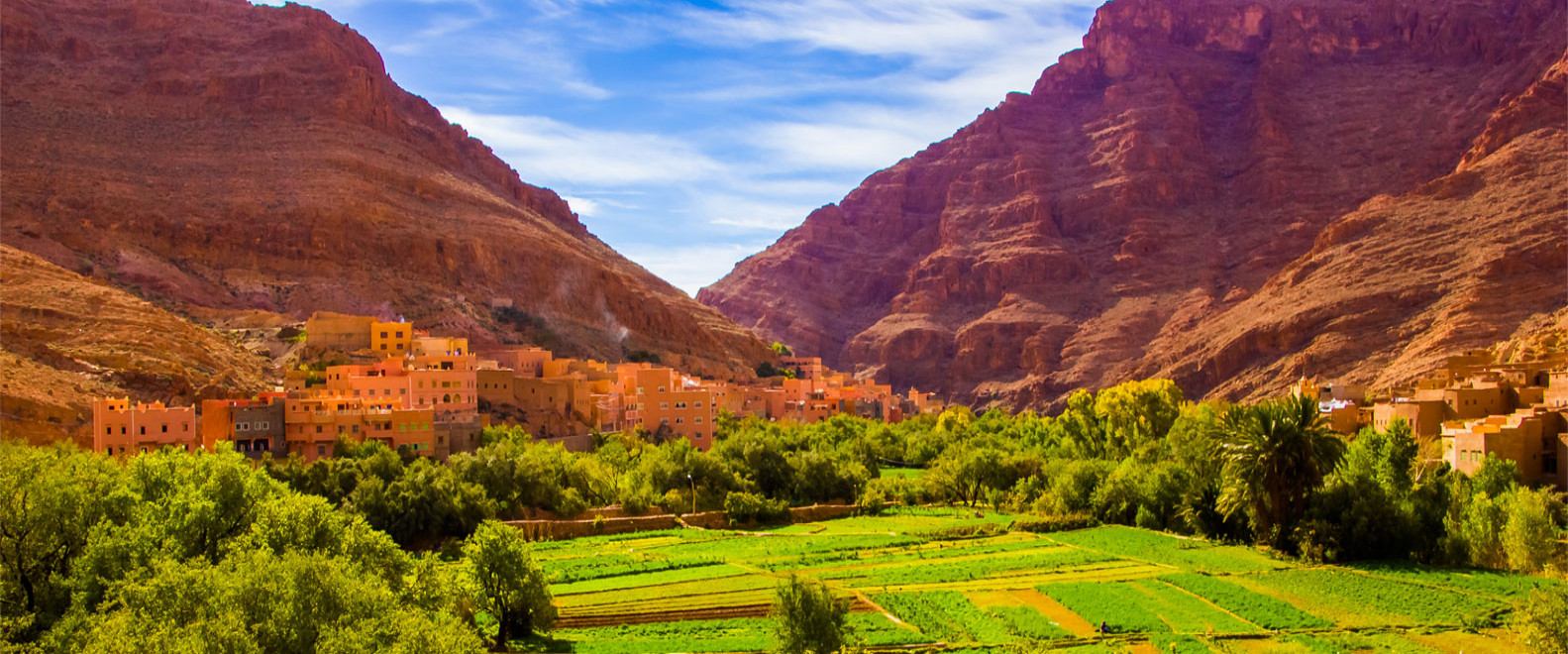
Ouarzazate is the production capital of southern Morocco and the standing-set anchor of our wider line producer Morocco network. Engaging a film fixer in Ouarzazate covers Atlas Studios bookings, Aït Benhaddou heritage-committee permits, the southern kasbah location stack, and the cross-country Sahara routing that defines almost every Ouarzazate-anchored brief. International productions land at Atlas Studios and CLA Studios at the edge of town, work through the kasbah belt to the east, and stage Sahara sequences at Merzouga four hours further out.
Productions such as Lawrence of Arabia helped put southern Morocco on the international filming map; later projects including Gladiator, Babel, Kingdom of Heaven, Game of Thrones and Dune cemented Ouarzazate’s status as a global production hub. The infrastructure that sits around the studios, crew houses, equipment rental, animal handlers, period vehicle stocks, exists because foreign productions have been arriving here for half a century. This page is a working reference for producers planning Ouarzazate filming: the studios, the locations, the permit layers, and how to engage a local fixer to run the corridor.
Why Ouarzazate works as Morocco’s production capital
Geography did most of the early work. Ouarzazate sits south of the High Atlas at the boundary between Morocco’s irrigated north and the pre-Saharan south. The light is dry and consistent for most of the year. The landscape reads as Egyptian, biblical Levant, Roman North Africa, or generic ancient Middle East depending on dressing. Add fifty years of foreign productions training a local crew base, and you get a production hub that few other African production centres have matched.
Atlas Studios, the working backbone

Atlas Studios is the larger of the two production lots in Ouarzazate. The studio runs a large desert campus with permanent standing sets covering Egyptian temples, Tibetan monasteries, Roman amphitheatres, Biblical-era streets, and Middle Eastern markets. International productions rent the sets directly, often with light dressing changes rather than full builds. The studio also operates as a logistics base, production offices, dressing rooms, generators, and a workshop facility for fabrication and set extension are all on-site.
Most foreign productions filming in this production belt stage their main base here. The lot includes two large sound stages, open-air sets that can absorb dressing changes, a costume and props depot used by international rentals, and on-site catering scaled for hundred-plus crews. Producers arriving for a Roman or biblical brief usually book Atlas first and build their schedule outward from the standing sets.
CLA Studios, additional capacity and overflow

CLA Studios opened in 2004 and serves as the second production lot in town. It runs differently from Atlas, more flexibility on custom builds, smaller standing-set footprint, and a working relationship with Italian and French productions that have based here repeatedly. When Atlas is booked for a major feature, CLA absorbs commercial shoots and series work. For productions running back-to-back blocks across both studios, the local fixer handles the scheduling handoff.
Crew base depth grown over fifty years
Most departments fill locally in Ouarzazate. Production designer, art director, set decoration, prop, costume, gaffer, key grip, sound recordist, all available with international experience and feature credits. The historical pipeline running from Lawrence of Arabia through Asterix and Obelix to the recent Dune productions trained successive generations of Moroccan HODs and second-tier crew.
Specialised stunts, certain DP roles, and high-end colourists are still sometimes brought in from Europe or the US, but the question is now which 20% of the crew comes from outside, not 80%. Within Morocco, the Ouarzazate crew base feeds into a broader Moroccan crew network that runs across Casablanca, Marrakech, and the Atlantic region, multi-region shoots usually pull HODs and key technicians from two or three of these bases on the same schedule.
Locations around Ouarzazate: Aït Benhaddou, kasbahs, Merzouga
The studio lots are only one part of why productions choose Ouarzazate. The locations within driving distance of town give the corridor its real cinematic range, UNESCO heritage, working kasbahs, palm oases, and the proper Saharan dune fields a half-day east. Most multi-day shoots base in Ouarzazate and day-trip out to these locations.
Aït Benhaddou, the UNESCO ksar

Aït Benhaddou is the most recognisable single location in southern Morocco. The fortified ksar climbs a hillside about twenty minutes west of Ouarzazate and has hosted productions ranging from Lawrence of Arabia (1962) through Gladiator, Kingdom of Heaven, Game of Thrones, and Prince of Persia. It is UNESCO World Heritage-listed and inhabited, a small number of families still live within the walls, which means the permit process is layered. The Centre Cinématographique Marocain clears the production overall; a separate Aït Benhaddou committee approves the dates and scope; resident families are compensated when shooting touches their homes. Productions that book the ksar without committee approval get turned away at the gate.
The kasbah belt south of the Atlas

Beyond Aït Benhaddou, the corridor south through Skoura, Kelaat M’Gouna, and Tinghir is dense with smaller kasbahs and ruined fortresses. Several are privately owned and can be hired for filming with one or two days of notice and a location fee. The Todgha Gorge and Dadès Gorge sit on the same route, both bookable for car commercials and music videos where the canyon walls are the picture. Skoura sits forty minutes east of Ouarzazate and is dense with palm groves and earthen kasbahs, Kasbah Amerhidil is the largest and most filmable. Kelaat M’Gouna, an hour further, hosts the May rose festival and a kasbah belt extending into the Dadès Valley.
Tinghir and the Todgha Gorge sit ninety minutes beyond that, the gorge walls rise 160 metres and the road threads the canyon floor. Productions running multi-location shoots through the desert south usually base in Ouarzazate and day-trip; longer blocks may move to Tinghir or Erfoud for a few days to cut the drive. The southern road is paved end-to-end and accommodates trucks; the only constraint is daylight hours.
Merzouga and the Erg Chebbi dunes

Merzouga is where the Sahara properly begins. The Erg Chebbi dune field rises out of the hammada plain about four hours’ drive east of Ouarzazate, with the village of Merzouga at its western edge. The dunes run roughly 50 km long and reach 150 metres at the tallest. This is the southern route’s go-to location for sci-fi desert sequences, biblical Saharan crossings, and aerial dune work.
The road in is paved and accommodates trucks; lodging at Merzouga and Hassi Labied scales from ten-room riads to larger kasbah-hotels that can host a full unit. Camel handlers, 4×4 drivers, and trained desert guides all source locally. The Berber families operating the kasbah-hotels have worked with international productions since the 1990s, most understand call sheets, safety protocols, and the way a Western unit moves through a sand environment. Sand removal from camera gear is a daily ritual; bring redundant bodies and dust covers at twice the city-shoot rate.
Permits, logistics, and what trips Ouarzazate productions
The southern route’s permit structure overlays CCM clearance, location-specific authorities, and customs filings for inbound equipment. Productions arriving for the first time underestimate how the multiple layers interlock. The Ouarzazate-based production manager threads all of them on a single timeline.
CCM clearance and the Aït Benhaddou committee
Every foreign production needs CCM clearance, the Centre Cinématographique Marocain reviews the script, the shoot plan, and the crew list, then issues the national filming authorisation. CCM review runs two to four weeks for standard production; politically sensitive material, religious content, or anything filmed in restricted zones extends the timeline. Aït Benhaddou requires a parallel file with the site’s permit committee, which can add another week or two depending on the date window and how heavily the production touches resident areas.
Build both timelines into the schedule with two-week buffers. Ouarzazate-based fixers maintain ongoing relationships with both the CCM caseworkers and the Aït Benhaddou committee secretary, sequencing helps. Submissions that land in the queue alongside an existing relationship file are reviewed faster than cold first-contact filings.
Equipment customs and ATA carnets
Equipment imports run via ATA carnet, filed with the producing country’s chamber of commerce before crew departure. Casablanca airport customs stamps the carnet in and out. For productions basing in Ouarzazate, the customs clearance can happen at Casablanca or at the Ouarzazate Aérodrome, the latter accepts charter aircraft and is the faster route for equipment-heavy crews who want to bypass the Casablanca-to-Ouarzazate truck transfer. The Ouarzazate-based fixer coordinates the broker. For productions filming Aït Benhaddou exteriors only, a partial carnet listing for the location-day equipment can move faster through Ouarzazate Aérodrome than the full crew package through Casablanca, useful when shoot dates are tight.
Drone clearance and weapons
Drone filming over Aït Benhaddou, the kasbahs, and the desert south requires civil aviation clearance and, for sensitive zones, a security escort. Weapons used as props need a Ministry of Interior file with serial numbers and a local armourer of record. Both authorisations file in parallel with the CCM submission; allow four weeks from filing to approval. Drones arriving in Morocco without prior clearance are confiscated at customs, no exceptions.
Seasonal weather and the desert window
The Ouarzazate shoot window is relatively predictable. October through April delivers daytime temperatures in the 15-22°C range with reliable light and minimal weather risk. May through September the south pushes above 40°C, crew physical performance drops, daylight is long but unforgiving, and the desert work loses its visual softness. The Aït Benhaddou tourist flow peaks in March-April and October-November; off-peak weeks give the production more roped-off access. Ramadan dates shift across the Gregorian calendar, check the Hijri overlay against your dates.
Day-rate framing and the 30% rebate
Ouarzazate generally prices below Marrakech for crew and below European hubs across the board. Atlas Studios day rates for sound-stage rental run lower than equivalent European studios by a comfortable margin; standing-set fees vary by set and exclusivity needs. Animal handlers, period vehicles, and specialised crew rates remain competitive even after the rebate calculation, Morocco’s 30% cash rebate on qualifying spend further improves the effective rate when the production’s local-spend ratio is high.
A working benchmark for first-time productions planning Ouarzazate filming: typical feature shoots in the corridor run 25 to 60 days depending on scope, with the studio block at the front and location work moving outward to Aït Benhaddou, the kasbah belt, and Merzouga in sequence. Commercial shoots compress to four to ten days. Documentary blocks land in the middle. Pre-production runs three to six weeks ahead for standard scope, longer for sensitive content. The fixer’s calendar dictates everything, without a permit timeline locked at briefing, no other line of the budget is reliable.
One operational note from previous productions: the drive between Ouarzazate and Merzouga is scenic but it takes crew off their A-game for a half-day. Productions running the full Marrakech-to-Sahara route should build in one rest day per long transfer, or shift crew via charter from Ouarzazate Aérodrome where the budget allows. Animal welfare on heritage and desert shoots is monitored by regional and municipal authorities and the production’s own welfare officer. The area receives increasing scrutiny from both local authorities and international productions, and productions that arrive without documented welfare procedures may face delays.
Engaging Celluloid Pact for Ouarzazate filming
We run line production and fixer engagements in the Ouarzazate region with crew and permit specialists based locally, supported by our wider film fixers in Morocco team for cross-region scheduling and multi-zone briefs. The first conversation is a short call to understand the production, the shoot dates, and the locations the script implies. From that call we produce a preliminary budget framework in MAD and USD, a permit timeline against your dates, and a crew availability snapshot.
Line producer Ouarzazate, scope and engagement
A line producer Ouarzazate engagement runs from script breakdown through wrap. The line producer takes financial responsibility for the budget, signs vendor contracts with Atlas Studios, CLA, the Aït Benhaddou committee and the kasbah-belt location owners, and is named on the CCM 30% rebate filing as the Moroccan-registered party. On a smaller commercial shoot the line producer doubles as fixer. On a feature with local spend above the 10 million MAD threshold the functions separate, with the production-service company holding tax, VAT and audit obligations to CCM at wrap.
Film fixer Ouarzazate, the operational layer
A film fixer in Ouarzazate runs a defined operational sequence on every international shoot: script breakdown against the Atlas Studios, CLA, Aït Benhaddou and Merzouga location map; scout coordination with the studio operations team and the Aït Benhaddou heritage committee; CCM filing for the production permit; ATA Carnet routing through Casablanca or Ouarzazate Aérodrome; private kasbah-owner negotiation along the southern route; crew assembly from the Ouarzazate base supplemented from Marrakech or Casablanca; and on-the-day liaison with CCM, the heritage committee and the local police. Film fixer Ouarzazate work carries distinctive expertise in the southern-corridor logistics that no other Moroccan base offers at the same density.
Our scope across the corridor
We cover the CCM filing, Aït Benhaddou committee submission, ATA carnet coordination, location agreements with private kasbah owners along the southern route, crew assembly from the Ouarzazate base, and equipment rental brokering with Atlas Studios and CLA. For multi-region shoots running between Marrakech, Ouarzazate, and the Sahara, we handle the Marrakech–Ouarzazate–Sahara handoff and crew transfer days.
Send the script or treatment, a target shoot window, a rough crew size, and the locations the script requires. We come back within a few working days with a feasibility note covering availability, permit lead times, regional logistics, rough cost framing, and an indication of where the 30% rebate might land. Once the brief is locked, our Morocco line production operation handles permit sequencing, vendor onboarding, and multi-region scheduling out of bases in Marrakech, Casablanca, and Ouarzazate.
Ouarzazate rewards prepared productions. The studios are bookable, the locations are real, the crew is deep, and the permit chain is solvable when it’s worked from day one. That’s what a well-run Ouarzazate production office actually delivers. The southern Morocco production zone has been resilient through political shifts, currency moves, and pandemic disruption, productions that landed in 2020 and 2021 still got their permits and finished their blocks.
The institutional layer is mature. For first-time productions weighing Ouarzazate against alternatives in the wider Mediterranean, the deciding factor is usually the breadth of stand-in value: few other locations let you cover Egyptian pharaohs, biblical Levant, Roman conquest, and Saharan crossings within a two-hour driving radius. The studio infrastructure and the local crew bench make that breadth bookable on production timelines. Productions running multi-territory MENA work that combine Moroccan studio-base routing through Ouarzazate with cross-corridor production in Saudi Arabia, Jordan, Egypt or Tunisia reference our MENA filming permits operational guide for the cross-jurisdiction permit and cost-stacking framework.
