

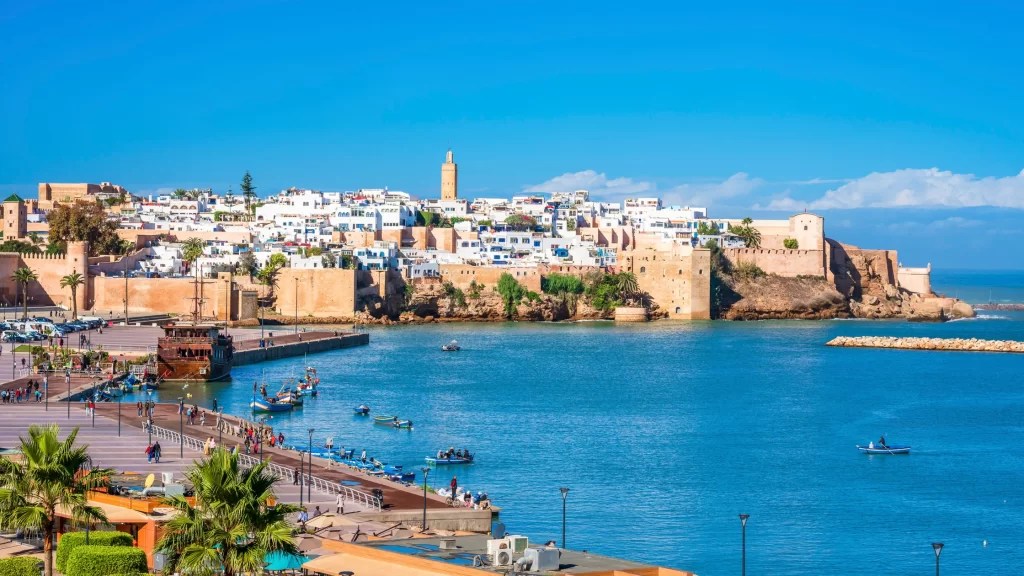
Morocco filming locations combine Atlantic cities, walled medinas, Atlas passes, studio backlots and Sahara dune corridors within one national route. Casablanca anchors contemporary urban production, Marrakech opens the medina and Atlas approaches, Fes and Essaouira provide historic urban frames, and Ouarzazate connects purpose-built studios with Aït Benhaddou and the southern desert. This guide compares the regions by visual use, season, access, crew base and multi-region routing.
For many MENA briefs, Morocco is the benchmark against which the rest of the corridor is measured. Jordan offers Petra and Wadi Rum, and Egypt offers major studio infrastructure, but Morocco’s advantage is that producers can combine medinas, Atlantic ports, mountains, soundstages and Sahara environments within a single production framework.
What follows is the working reality of filming in Morocco: the major filming locations from Marrakech through Casablanca, Fes, Essaouira, the Sahara and the northern alternatives, the medina-district permit logic at the heritage sites, and the briefing-stage decision on when Jordan, Tunisia or Egypt might fit the brief instead.
How Morocco’s Location Regions Fit Together
Camera crew in Morocco scale from a two-camera operator pair for documentary work through to forty-plus technician units for major feature productions, drawing on an established production-services base built across the region since 2019. What makes the country a single-brief location is that its regions fit together on one schedule: Casablanca as the commercial and customs hub, Marrakech as the international gateway, Ouarzazate as the soundstage anchor, and and the spread from Fes and Essaouira through the Sahara covering a wide range of visual briefs.
Morocco’s production history includes Lawrence of Arabia, The Last Temptation of Christ, Gladiator, Spectre, Men in Black: International, Game of Thrones and Gladiator II. That sustained production record has helped build crew and studio capacity around Casablanca and Ouarzazate.
Visa, equipment customs and crew movement
Morocco offers visa-free entry for many major passport holders for short stays, although nationality-specific requirements should always be confirmed before travel. ATA Carnets work for film equipment under Morocco’s customs framework. Productions arriving in Morocco with the carnet from their home-country chamber of commerce clear customs through the standard temporary import process at Casablanca Mohammed V (CMN) or the regional airports.
Movement between Morocco’s regions combines road transfers with domestic flights where current schedules allow. Casablanca remains the principal arrival hub, while Ouarzazate or Errachidia can shorten particular southern routes. Confirm the available air sectors against the production dates before locking the schedule.
Multi-region scheduling, Casablanca and Marrakech as operational base
Most multi-region Morocco productions anchor either Casablanca or Marrakech as the working base. Casablanca holds the corporate-services centre, equipment houses, post houses, customs administration, embassy coordination, financial services for the rebate filing. Marrakech functions as the international-facing creative base, the production-services companies, the location scouting depth across the Atlas region, and the proximity to Ouarzazate. Productions rotating between Tangier in the north, Fes and Meknes in the central plateau, Essaouira on the Atlantic, Ouarzazate in the south, and the Sahara at Merzouga or M’hamid coordinate the schedule through one of these two bases. Productions assembling crews in Marrakech draw from a deep local pool, gaffers, focus pullers, sound recordists, and grip teams have rotated through the Atlas Studios pipeline for two decades.
Morocco’s major filming locations
Most Morocco schedules are built around seven distinct location groups. Marrakech anchors the medina-and-palmery tier. Casablanca and Tangier supply the contemporary-urban and Mediterranean-port tiers. Fes carries the oldest medina and the traditional-architecture tier. Essaouira holds the Atlantic walled-port frame. Ouarzazate and Atlas Studios anchor the studio base. The Sahara at Erg Chebbi and M’hamid covers dune work. The northern alternatives, Chefchaouen, Volubilis, the High Atlas, supply specialist environments for productions whose script needs them.

Marrakech, medina, palmery, Jemaa el-Fnaa, Atlas foothills
Marrakech anchors most international productions’ Morocco shoot list. The city splits across four working tiers, the UNESCO-listed medina with its souks, riads and traditional residences; Jemaa el-Fnaa, the central square that carries the iconic Marrakech daytime-to-nighttime transformation; the palmery and Hivernage districts that supply the colonial-luxury and Atlas-foothill foregrounds; and the Atlas Mountains south of the city that open onto the southern landscape. A typical Marrakech leg absorbs four to seven shooting days for a mixed brief covering both the medina-souk frames and the palace-or-palmery sequences.
Permits for the medina route through the Marrakech city council alongside CCM, with additional protocol layers for the most-visited sites, the Bahia Palace, the Saadian Tombs, the Koutoubia Mosque exterior. Shoots inside the souks coordinate with the merchant community and the local councilor for the relevant arrondissement; the heritage-protocol layer scales with the production footprint.
Casablanca and Tangier, contemporary urban and Mediterranean port
Casablanca holds the contemporary-urban tier with the Hassan II Mosque, the Atlantic corniche, the Habous quarter, and the commercial-skyline backdrop the city provides for modern Morocco-set productions. The city also runs the embassy circuit, the equipment-house density and the customs gateway for any Morocco brief. Casablanca’s exposure across Spectre and a steady stream of contemporary-Morocco productions has built the working protocols across the most-requested locations. Camera crew in Morocco for Casablanca commercial work routes through the city’s TV-production base, equipment houses, post facilities, and casting agencies all sit within the city’s central business corridor.
Tangier on the Mediterranean coast covers the European-North African transit setting, the Strait of Gibraltar backdrop, the medina perched above the port, and the colonial-era international-zone heritage. Productions filming the Bourne or Mission Impossible style of Mediterranean-port transit work often pick Tangier over Essaouira’s Atlantic walled-port aesthetic, different ocean, different visual coding, different geographic narrative.

Fes Medina, Traditional Crafts and Borj Nord
The Fes medina represents the country’s most extensive traditional-medina filming environment. The Fès el Bali medina runs to roughly 220 hectares, with Fès Jedid adding about 60, for a UNESCO-listed property of around 280 hectares of dense Islamic-architecture lanes, souks, madrasas and residences, one of the region’s most extensive living historic medinas, UNESCO-listed since 1981. Productions filming Fes work through narrow car-free lanes that constrain crew and equipment footprint to a fraction of what other Moroccan medinas accommodate.
The Chouara Tanneries, the Al-Attarine and Bou Inania Madrasas, the Borj Nord viewpoint over the medina basin, and the surrounding artisan quarters carry the most-requested Fes frames. Permit coordination runs through the Fes city council alongside CCM and the Ministry of Culture for heritage-site filming. Productions typically schedule Fes for three to four shooting days within a Morocco brief, sequenced with Meknes (45 minutes away) and Volubilis (one hour) for productions whose script crosses the central-plateau landscape.

Essaouira, Atlantic walled port, Astapor in Game of Thrones
Essaouira on the central Atlantic coast carries Morocco’s walled-port setting. The 18th-century ramparts, the working fishing harbour, the Skala de la Ville bastion and the medina behind the walls anchor a distinctly coastal Moroccan visual that Marrakech and the southern oases cannot supply. Game of Thrones used the Skala bastion as Astapor, the Slaver’s Bay city, across multiple episodes, embedding the location in the international production memory. Othello, Kingdom of Heaven and a long list of period productions have filmed at Essaouira since the 1950s.
The Essaouira shoot calendar runs around the wind season, the alizé trade winds blow strongest between April and August, making outdoor production logistically harder during peak summer. October through May offers the cleaner shooting window. Permits coordinate through the Essaouira municipality alongside CCM, with the medina merchant community engaged for the souk and bastion-adjacent work.

Ouarzazate and the Atlas Studios corridor
Ouarzazate operates as Morocco’s soundstage backbone and the dedicated production-services centre for the entire southern Morocco brief. Atlas Studios and CLA Studios provide the working soundstage capacity, with the surrounding kasbahs, the Drâa Valley, the High Atlas passes and the southern landscape supplying the backlot terrain. Productions filming Ouarzazate-anchored briefs typically route through Atlas Studios and the surrounding production-services ecosystem, which covers the studio-side coordination, the Aït Benhaddou UNESCO heritage-site permits, the southern-kasbah location stack and the multi-day cross-country routes that productions filming Gladiator, Game of Thrones, Lawrence of Arabia or Black Adam have used; the standing sets and desert location work are covered in our Ouarzazate filming guide. Productions with desert dawn calls commonly stage crew in Ouarzazate, where the Atlas Studios base can house department heads close to the set.
The decision on whether to anchor Ouarzazate or treat it as a destination leg depends on the brief. Productions whose script lives substantially in soundstage construction or southern-kasbah terrain anchor Ouarzazate; productions running Marrakech-and-medina-heavy briefs use Ouarzazate as a three-to-five day southern leg. The drive from Marrakech crosses the Tizi n’Tichka pass, a four-hour route that doubles as a location scout in itself.

Sahara, Erg Chebbi at Merzouga and M’hamid dune corridors
The Moroccan Sahara splits across two main dune corridors. Erg Chebbi at Merzouga in the east, accessed via Errachidia or the Ouarzazate-Tinghir route, supplies the dramatic high-dune visual most international productions target. Erg Chigaga and M’hamid in the south, accessed via Ouarzazate and Zagora, provide an expansive Sahara with traditional Berber-nomad framing. Both locations carry their own logistics overheads: water, fuel, sand-resistant equipment housing, and crew accommodation that ranges from luxury desert camps to basic auberge infrastructure depending on the production scale.
The shoot window runs October through April for the temperate dune work. July and August carry peak heat with daytime temperatures regularly above 45°C that compress practical shooting hours to early morning and late afternoon only. The permit framework for Sahara work routes through the regional prefectures alongside CCM, with off-road access beyond the marked routes coordinated through the relevant authorities and confirmed for the specific route.
Chefchaouen, Volubilis and the northern alternatives
The northern alternatives carry specialist settings for productions whose script needs them. Chefchaouen, the hill town in the Rif Mountains, supplies a distinctive blue-painted Rif hill-town setting that has anchored fashion campaigns, music videos and indie features. Volubilis on the central plateau provides Morocco’s Roman-antiquity tier, with the third-century archaeological site running through the relevant Ministry of Culture heritage authority. The High Atlas mountains, particularly the Toubkal massif south of Marrakech, supply the snow-and-mountain terrain for productions whose script needs altitude or seasonal coverage Morocco’s lower elevations cannot provide.
Productions with niche-frame requirements route these northern alternatives as one-to-three day destination legs within a Morocco brief. None of them sustain the same length of production schedule that Marrakech or Ouarzazate justify, but each supplies a frame the southern locations cannot replicate.
Location Access in Medinas, Heritage Sites and the Sahara

Morocco’s filming permits run on a layered framework. CCM issues the national filming authorisation and separately administers foreign-production support. Municipal, regional and heritage authorities handle location-specific clearances, while medina access may also require coordination with the affected traders and local stakeholders. Each layer carries its own lead time, and the layered calendar is what the local production partner manages alongside the CCM authorisation filing.
Productions considering the national cash rebate should model it separately from the location route. The current rate, Morocco-spend threshold, eligible-cost classification, application stages and payment timing are covered in our Morocco film incentives and rebates guide.
Medina district permits, Marrakech, Fes, Essaouira
The medina districts carry a different permit logic from the modern Moroccan city centres. The lanes are car-free, the merchant community is sensitive to disruption, and the heritage-protocol layer scales with footprint and frame disruption. Productions filming inside the Marrakech, Fes or Essaouira medinas coordinate through the local council, the merchant association for the affected lanes, and the relevant heritage authority, typically several separate stakeholder relationships that need to align before the shoot day.
The lead time for medina permits runs longer than the standard CCM cycle, often several weeks for productions that need lane closures or a significant crew footprint, confirmed for the specific route. The merchant-association engagement happens earlier, with the local production partner confirming the current stakeholders and filing route for the affected lanes before the location application is submitted.
Heritage and UNESCO sites, additional clearance
Aït Benhaddou, the Fes medina, the Marrakech medina, Essaouira’s medina, Volubilis and Meknes carry UNESCO World Heritage status that adds the relevant Ministry of Culture heritage authority clearance layer to the standard CCM and city-council framework. The heritage-site application runs in parallel with the CCM dossier, files with the relevant Ministry of Culture heritage authority, and clears on its own review timeline. Productions that lock the script around any of these sites open the heritage application well ahead of the shoot to avoid downstream schedule slippage.
Building a Multi-Region Morocco Location Route
Building a Morocco route is a pre-production exercise across the layered permit framework, the location coordination over multiple regions, and the crew and equipment logistics a multi-city brief requires. As a planning guide, a complex multi-region brief typically runs several weeks of pre-production and a single-location shoot rather less, each confirmed against the actual route.
From Location Shortlist to Shoot Route
A Morocco route runs on a pairing model: a Casablanca or Marrakech-anchored line producer holding the schedule, the budget and the CCM-level coordination, paired with field execution across locations, the medina merchant communities, the Ouarzazate studio coordination, the Sahara community engagement and the heritage-site protocols at the UNESCO locations, alongside crew booking and equipment cross-hauls between bases. The local production team prepares the CCM and location files to the published requirements and tracks each approval against the production schedule. That execution and the fixer and producer services sit with our film fixers in Morocco desk.
When Jordan, Tunisia or Egypt fit the brief instead
Morocco competes against Jordan, Tunisia and Egypt within the Middle East corridor for the heritage-and-desert briefs. Jordan’s edge sits in Petra’s specific heritage frame and Wadi Rum’s red-rock desert that Morocco’s beige Sahara cannot replicate. Productions weighing a Wadi Rum frame against Erg Chebbi route through Jordan for the desert-specific decision rather than rebate arithmetic alone.
Tunisia carries the Star Wars Tatooine heritage at Matmata and Tozeur; for productions whose Tatooine-coded desert frame fits the Tunisian sites better, our Tunisia work covers that section of the corridor. Egypt fits productions anchored on major studio infrastructure or specific Egyptian heritage; for a script built on the Pyramids, Karnak, Luxor or studio standing sets, Cairo often wins the framing decision. These are visual-fit choices; the fiscal terms of each territory sit on its own incentives guide.
Multi-region Morocco scheduling
A typical multi-region Morocco brief routes from Casablanca arrival through Marrakech for the medina and palmery legs, south to Ouarzazate for the studio and southern-kasbah work, east to Erg Chebbi or south to Erg Chigaga for the Sahara, north to Fes for the traditional medina, and west to Essaouira for the Atlantic walled-port frames. Casablanca and Marrakech each carry three to five days. Ouarzazate absorbs five to ten days for studio-anchored briefs. The Sahara legs run three to five days. Fes lands at three to four. Essaouira at two to four. Tangier or Chefchaouen as optional northern legs add another two to four days.
The complete corridor brief lands at fifteen to twenty-five days for a major Morocco-anchored production. Single-region briefs compress to one or two weeks. The permit calendar runs in parallel with the shoot calendar as a planning allowance, with the rebate dossier, heritage-site applications, city-council permits and medina merchant coordination each opened on their own lead time and confirmed for the actual route rather than on a fixed week-count. The local production partner coordinates across these timelines. Productions covering Morocco filming locations within the broader MENA permit landscape, combining CCM applications with cross-corridor routing through Saudi Arabia (Film AlUla heritage zones), Jordan (RFC framework) or Tunisia (CNCI alongside Morocco), reference our MENA filming permits operational guide for the seven-territory operational framework.
