

A line producer Morocco team holds the budget, schedule, contracts and reporting for international features, series, documentaries and commercials, while film fixers in Morocco coordinate locations, local crew, equipment and daily field logistics. The approved Moroccan executive-production company signs and lodges the CCM filming-authorisation file and carries the applicable local production obligations. Celluloid Pact runs that structure end to end with project-matched local partners across Casablanca, Marrakech and Ouarzazate; recent work includes a Golden Goose fashion ad film serviced on location in Dakhla, on the southern Atlantic coast.
Morocco has drawn foreign productions since the 1960s: Lawrence of Arabia, The Last Temptation of Christ, Gladiator, Babel and Game of Thrones all shot here. Productions return for usable desert and biblical-era landscapes within driving distance of established studios, a national cash rebate for productions that meet its eligibility rules, and weather windows that fit international shoot calendars.
For briefs that are location-led rather than crew-led, including heritage zones, desert circuits and coastal towns, our Morocco filming locations page covers the country location by location. This page explains how a Morocco production is structured, how the regions execute, and how the CCM filming-authorisation workflow runs for international features, series, documentaries and commercials.
Line Producer Morocco: Production Structure and Local Execution
Celluloid Pact has worked across Morocco and the MENA region since 2019. A Morocco production runs on four layers, and assigning each function explicitly keeps the budget, contracts and compliance responsibilities traceable.
- Celluloid Pact: the international brief, budget oversight and reporting to the production.
- The Moroccan executive-production company: the approved local entity that signs the local contracts, lodges the CCM filming-authorisation file and carries the applicable local tax, VAT and reporting obligations.
- The line producer: budget, schedule and vendor approvals across the shoot.
- The fixers: location work and daily field coordination.

Celluloid Pact works with project-matched Moroccan executive-production partners across Casablanca, Marrakech and Ouarzazate. The proposed company and its current CCM approval status are identified during scoping, before the production contracts locally, so the partner fits the script, the locations and the shape of the shoot rather than a single fixed roster. The CCM confirms that foreign executive production is performed through companies holding the relevant international executive-production approval, and it is that approved company, not Celluloid Pact or a fixer personally, that signs and lodges the filming file. The current framework is set out in the CCM executive-production rules.
A line production company in Morocco holding the relevant CCM approval can provide all three functions, with the local-entity, budget-control and field responsibilities kept explicit. Foreign executive production is reserved for companies holding the applicable CCM approval, so the executive-production role always sits with such a company rather than with an individual. The production-support scheme’s MAD 10 million Morocco-investment threshold is one of that scheme’s eligibility tests; it does not determine how the production roles are contracted. On a larger feature the executive-production company carries the local obligations while the line producer holds the budget and vendor approvals, whether one firm supplies both or they sit with separate parties. If a permit is challenged or a customs item disputed, the entity named on each filing responds to the relevant authority.
Foreign producers engage a local executive-production company for three structural reasons. The CCM filming authorisation is lodged by an approved Moroccan executive-production company rather than by the foreign producer directly. A Moroccan-registered company is required to hold the local tax and VAT compliance and sign the local contracts. And an experienced local company knows the documentation each authority requires and the order approvals must be filed in, which reduces errors and avoidable delay; that familiarity does not alter the formal approvals, which remain at the discretion of the CCM and the relevant authorities. The production-support (rebate) application is a separate procedure with its own applicant, eligibility rules and file, set out in the CCM foreign-production support procedure; the approved local company’s role in the filming authorisation does not by itself make it the support applicant.
The reason to settle the structure up front is that the filming authorisation and the local contracts attach to the approved local entity, and any production-support application is prepared as a separate file with that structure already in place. A production that leaves the executive-production company undefined until prep discovers late that the entity lodging the local file is also the one that should have signed the local contracts and held the spend from the start, and retrofitting that is where qualifying spend may become harder to substantiate. Defining the layers at scoping keeps the international-facing planning and the local execution in the right hands, with one point of accountability into the production.
What Film Fixers in Morocco Handle
The term “fixer” gets used loosely. On the ground it covers a defined sequence: scouting and presenting locations against a script’s needs, coordinating the required applications and approvals in the right order, assembling a local crew that fits the scope, coordinating the customs and field information for equipment moving in and out, and managing the day-to-day liaison between the visiting team and Moroccan authorities. The work bridges what a line producer does in planning and what a production manager does on set. A well-run film fixer in Morocco hands over a permit calendar at the briefing stage, not a week before the shoot.

A good handover reflects that sequence. At the briefing stage the fixer should present a location shortlist matched to the script, a permit calendar with the CCM file and any site-specific committees mapped against the shoot dates, a crew plan scaled to the scope, and a customs plan for the equipment moving in and out. On the ground, the same team keeps the permit sequence intact as locations shift and supplies the field information behind local payments; the line producer controls the cash flow and the approved company executes the local payments and contracts.
The three roles stay distinct even when one firm provides them. A fixer is the single point of contact with a network behind them; the line producer controls the budget, the schedule and vendor approvals; the approved executive-production company signs the local contracts, issues invoices, lodges the filming-authorisation and local-execution file, and holds the contractual and filing responsibilities assigned to it. On a feature especially, the brief and the bank reconciliation belong in clearly separated hands so that an invoice which does not reconcile with a permit fee is caught early.
Regional Execution: Casablanca, Marrakech, Ouarzazate and Destination Legs
Morocco’s filming geography clusters around a few regions, each with its own dominant looks, permit authorities and crew base. Film fixer Morocco work is regional: fixers specialise by territory, so the partner for a Casablanca commercial is rarely the partner for an Ouarzazate period feature. Map the route before locking budgets: driving times between regions are long, and several pairings are separate production legs rather than same-day moves.
The country is large, and the distances shape the plan more than newcomers expect: as office planning estimates subject to route, traffic and weather, Casablanca to Ouarzazate is a full-day road transfer through the Atlas passes, and Marrakech to Fes a comparable cross-country move. A multi-region schedule is sequenced around those transfers, with the line producer holding the master calendar so a move between regions does not eat a shoot day.
Morocco also works as a regional anchor. Casablanca is the air and port gateway for onward legs, while Tangier, on the northern coast, sits a short sea crossing from southern Spain, so an Andalusian leg is planned as a separate northern-port or air connection rather than a same-calendar move. For a brief that extends onto an Egyptian leg, our Line Producer Egypt team handles the Cairo base and the Ministry of Culture permit chain.
Casablanca, Rabat and the Atlantic stretch
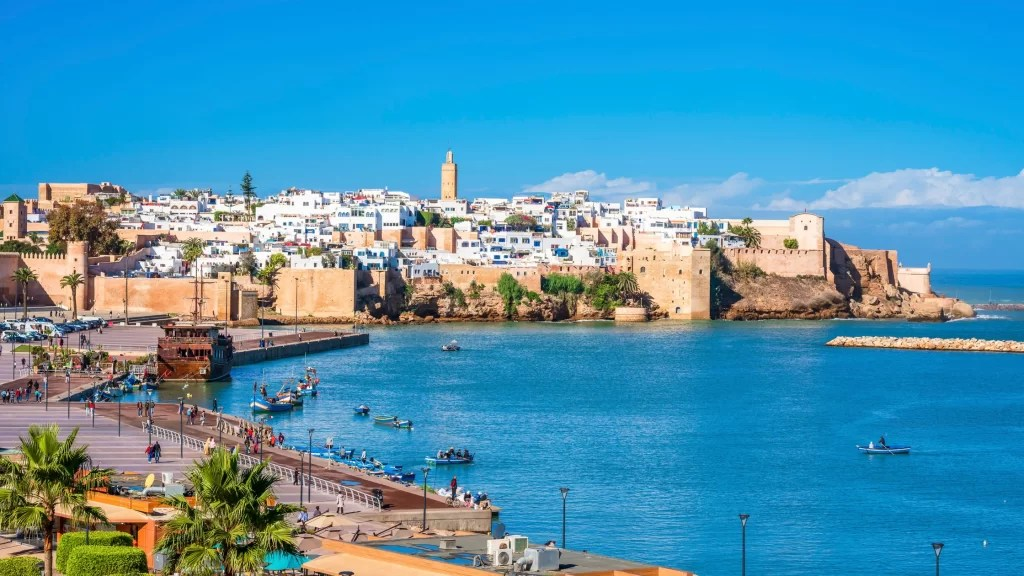
Casablanca is the country’s production base: a substantial share of the national crew and equipment-rental base, and the international airport that carries the gear in. Visiting commercial shoots tend to base here, and the city reads as mid-century Mediterranean modernism on camera. Rabat carries the capital and government look, and Tangier the port and gateway feel, both north up the coast. Essaouira sits south on the same Atlantic edge, its fortified ramparts standing in for Astapor in Game of Thrones.
Beyond the airport and crew depth, Casablanca concentrates the country’s equipment-rental and post infrastructure, and its French-protectorate architecture, port and industrial locations give a register the cities north and south do not. Commercial and corporate work tends to run entirely from here.
Marrakech and the Atlas approaches
Marrakech is the main city of central Morocco and a common production base. The medina supplies the souk and palace looks, the Atlas foothills start roughly an hour south, and hotel infrastructure outside the walls houses large crews. Ouarzazate lies about four hours away over the Tichka Pass (office planning estimates, subject to route, traffic and weather), so a Marrakech-to-Ouarzazate move is planned as an overnight or a separate production leg, not a same-day shooting move.
Inside the walls, riads double as residential cover sets, and the souks, tanneries and palaces carry the permit rhythm a Marrakech fixer navigates daily. Outside them, the transport and hospitality base houses large international crews, which is why visiting units commonly base here.

Ouarzazate, Aït Benhaddou and the desert south

Ouarzazate is the main production town of southern Morocco, and a line producer Morocco engagement routed through it carries the Atlas Studios and CLA Studios booking relationships plus desert-location logistics south of Aït Benhaddou, covered in depth in our Ouarzazate filming guide. Atlas and CLA Studios hold standing sets for Egyptian temples, biblical streets, Roman amphitheatres and Middle Eastern markets. Aït Benhaddou, the UNESCO-listed ksar roughly twenty minutes away by road, has played Yunkai in Game of Thrones and many other ancient cities. Erg Chebbi dune locations lie near Merzouga, about a half-day east as an office planning estimate subject to route, traffic and weather. This corridor is where Morocco most often stands in for the Middle East, the biblical Levant and North African historical periods.
Ouarzazate-based crews have period-feature and action experience, along with the armourers, stunt coordinators and animal handlers that desert period work depends on; availability is confirmed for the shoot dates.

Fes, Chefchaouen and Essaouira destination legs
Fes is the older, denser medina, narrower and more vertical, harder to bring trucks into; productions come for medieval European, Levantine or pre-modern Arab-world coverage. Chefchaouen, about four hours northwest as an office planning estimate, is the blue city in the Rif foothills, a narrow use case but unmistakable when the brief calls for it. Essaouira, on the Atlantic coast, is a separate coastal leg used for windswept fortress and harbour sequences. Each is planned as a distinct leg with its own travel and logistics rather than shuttled from a single base.

CCM Filming Authorisation, Customs and Special Approvals
Every foreign production filming in Morocco needs a clearance from the Centre Cinématographique Marocain (CCM), the national regulatory body. The CCM reviews the script, the shoot plan, the crew list and any sensitive content, then issues the filming authorisation. Location-specific permissions and other administrative approvals are separate tracks that sit alongside it and are filed with the relevant authorities. The approved Moroccan executive-production company prepares, signs and lodges the application; fixers supply the location and field documentation that goes into it.

CCM process, lead times and what to submit
For foreign productions, the CCM states 15 days for feature films and for television films, television series and sitcoms, except series exceeding 120 minutes, which carry a 30-day window. The published windows are 7 days for medium-length films, shorts, fiction documentaries and clips; 3 days for advertisements and institutional films; and 21 days for documentaries and reports. The foreign television-programme checklist does not state a general processing window.
Local and site permissions can extend the overall preparation period beyond the CCM window, so build the file early. The submission for a foreign feature includes a script and synopsis in Arabic or French, the shoot schedule, foreign and local crew lists that meet the Moroccan technician quota, and the executive-production company’s filing as the local responsible entity. The official requirements are published in the CCM filming-authorisation rules. Aït Benhaddou, being UNESCO-listed and inhabited, requires additional site and heritage coordination alongside the CCM clearance.

The published period begins after submission of a complete application, and incomplete files cannot be processed, as stated in the CCM filming-authorisation rules. The site-specific permissions that sit alongside the central authorisation may extend the overall schedule.
The CCM reviews the full script as part of the authorisation, so the complete material should be disclosed and reviewed at submission rather than a partial synopsis. Brief the local partner transparently and early; a scene that turns out to be more sensitive than it first appears is easier to address during the filing stage than on set, where it can affect access to a location mid-shoot.
ATA carnets, customs and special approvals
Morocco is listed in the ICC ATA Carnet directory and accepts ATA carnets for temporary equipment imports, the standard route for cameras, lenses, lighting and grip. Carnets are filed with the producing country’s chamber of commerce before departure and stamped in and out at customs; gear that does not stamp out triggers a duty assessment, and the local company handles the customs-broker side.
Sensitive categories, drones, pyrotechnics and prop weapons, run on separate authorisation tracks filed in parallel with the CCM submission. Each carries its own conditions and lead time, and the specific authority and documentation are confirmed with the local partner for the final brief, since they vary by category, site and content. The CCM file also carries repatriation undertakings signed by the Moroccan and foreign entities, and the accreditation authorising the Moroccan company to act for the foreign producer, so those documents are prepared alongside the carnet rather than after it.
Crew, Equipment and Seasonal Scheduling
Morocco has one of North Africa’s more established local crew bases. International productions have trained local heads of department since the 1980s, and most departments, camera, grip and electric, art, costume, make-up and locations, can now be filled in-country at international working standards. Some specialised roles, certain stunts, and occasionally a DP or colourist, still come in from Europe or the US.
For a feature-scale shoot, the local partner holds the head-of-department shortlist across production design, art, set decoration, props, costume, hair and make-up, grip, gaffer, sound and assistant directors. International-standard camera, lighting and grip packages are available in-country, with the desert-south stock concentrated around the Ouarzazate studios and the rest around Casablanca. The Ouarzazate corridor also keeps stables of horses, camels and trained handlers for period work, a legacy of decades of historical productions.
Crew concentrates around the three bases, and the local partner routes crew calls through the one closest to the shoot day. Casablanca holds a strong urban-and-commercial bench; Marrakech carries feature-experienced DPs, gaffers and key grips, subject to availability for the shoot dates, alongside the hospitality and transport to house large crews; Ouarzazate holds a period-feature and action crew base to confirm for the shoot dates. Boom and second-AC roles are routine local hires, while first AC and focus puller on high-end packages, and certified rigging gaffers, are sometimes brought in depending on the production. Crew agreements are handled through the local partner.
Specialist departments draw from the combined national pool, with aerial and camera-support crews concentrated around the main bases. For a specialism a given brief runs thin on locally, an underwater unit, a helicopter operator or large-scale SFX rigging, productions commonly bring a department lead in and pair them with local crew underneath. Regional location managers arrange crew accommodation to the scale of the unit, and for shoots crossing the Atlas, plan crew-transfer days into the schedule.
The saving that matters most on a Morocco budget is structural rather than a line-item discount. A mature local crew and standing infrastructure remove the need to fly in and house full departments, and the Ouarzazate corridor’s props, animals and period stock mean historical work does not start from zero. Those are the levers a line producer models first, before the rebate, because they change the shape of the budget rather than just its bottom line.

The national programme is a 30% cash rebate on eligible local spend for productions that meet its rules: at least MAD 10 million in tax-exclusive production expenditure invested in Morocco and at least 18 shooting or set-construction days in the country. The production applies before filming; the payment claim and final expenditure file follow production, and payment can take up to 180 days after the commission’s decision on a complete file. The full mechanics, thresholds and payout detail sit on our Morocco film incentives and rebates reference. Split spend into local-qualifying and international-non-qualifying buckets from day one, and plan cash flow around the payout gap.
Shoot windows split cleanly. October to April is the usual window for desert work, when daytime temperatures in the south are comfortable for crews and the light is usable; through the summer the south is very hot, so working hours, heat-safety measures and rest planning are built into the schedule, while coastal Morocco holds a moderate window for much of the year. Ramadan moves about ten days earlier each year on the Gregorian calendar and affects crew availability, working hours and some location access, so build the schedule with the Hijri calendar in view. Shoot lengths vary widely by format and by how many regions the schedule touches, and pre-production typically runs several weeks ahead, longer where permits are complex.
Engaging a Line Producer Morocco Team
International producers usually approach Morocco in one of two shapes: an individual line producer Morocco engagement, or a full-service executive-production contract. Both work; the choice depends on the size of the international company and how many territories the schedule touches inside Morocco. For a single-region brief, a commercial locked to Marrakech or a documentary focused on Fes, one line producer with the relevant regional experience is usually the most efficient route. For a multi-region brief across Marrakech, Ouarzazate, the Sahara and the coast, the executive-production route absorbs the coordination overhead better than running three or four parallel engagements.
The practical test is how many territories the schedule touches and how much parallel activity the local partner is running that week. A single locked region rewards the lean route; a corridor that crosses the Atlas and the coast rewards the executive-production structure, which carries the coordination overhead as a single line rather than as friction between separate arrangements.
A line producer in Morocco engagement on an international feature or streamer typically covers the CCM application inputs and follow-through, with the approved company signing and lodging the file, regional, municipal and site-authority coordination, day-rate negotiation with Moroccan heads of department, equipment-vendor coordination and approval, ATA carnet routing through the port of entry, animal and vehicle services for period work, cultural liaison for medina and heritage-site access, and on-set supervision through wrap and post hand-off. The line producer holds scheduling and budget accountability across the shoot, with regional fixers reporting into that structure.
Regional specialisation inside Morocco matters more than in most single-region countries. A Marrakech fixer carries the medina access, the palace and madrasa permit tracks and the riad networks; a Casablanca fixer works the protectorate architecture, port and industrial locations and the equipment-and-post base; an Ouarzazate fixer works the standing-set access, the Aït Benhaddou heritage clearance and the Draa Valley and dune territory. On a multi-region shoot the line producer holds the master schedule with a fixer per territory delivering execution locally, so corridor logistics are budgeted and tracked rather than absorbed as overruns.
The shape of a Morocco shoot is set at the brief stage. Engaged at treatment stage, line production in Morocco builds the economics against the CCM rebate window rather than reverse-engineering compliance after the schedule locks. Send the script or treatment, a target shoot window, a rough crew size, the locations you have in mind, the equipment level, and the budget bracket. We respond with a feasibility note covering availability, permit lead times, regional logistics, rough cost framing, and where the rebate might land.
The approvals are layered, the distances are long and the desert window is seasonal, so the permit calendar, the crew bench and the regional logistics are mapped before principal photography. That is the work local film fixers in Morocco carry. For how Morocco compares with other African bases on permits, crew and cost, see our filming in Africa guide.
