

Jordan production schedules usually divide between Petra heritage work, Wadi Rum desert filming and the Amman urban and studio block. The Royal Film Commission is the central facilitation point for foreign productions, while the relevant heritage, customs, aviation, security and location authorities retain their own approvals. Film fixers in Jordan coordinate those tracks with crew, equipment and location logistics under one production schedule.
This page covers the commercial execution layer: what a line producer in Jordan controls, how the fixer coordinates Petra, Wadi Rum and Amman, local crew and equipment, production budgets and Jordan’s current cash rebate of 25% to 45%. The Jordan film permits companion covers the authority-by-authority procedures and lead times.

Why Jordan Works as a Filming Destination
For foreign productions, Jordan offers a combination that very few jurisdictions in our Middle East line producer coverage hold simultaneously: dramatic and varied terrain inside a small geographic radius, a centralised permitting authority, a politically stable working environment, and a cash rebate of up to 45% that is meaningfully claimable rather than ornamental.
The RFC advantage, what the Royal Film Commission does for foreign productions
The Royal Film Commission – Jordan was established in 2003 and is a public, financially and administratively autonomous organisation. Its function for foreign productions is operational, not promotional. It is the central facilitation point between a production and the line ministries, the Department of Antiquities, the Petra Development and Tourism Region Authority, ASEZA, the Ministry of Tourism, the Ministry of Interior and the Civil Aviation Regulatory Commission (CARC).
The RFC is the central facilitation point for foreign productions. The local production-services company submits the core production file through the RFC, which coordinates with the relevant authorities. Heritage, customs, aviation, security and location bodies retain their respective approval responsibilities. The Royal Film Commission is accessible at film.jo.
Foreign productions submit through the portal first, Filminjordan@film.jo is the RFC production desk. Film fixers in Jordan with recent RFC filing experience keep the file cycle moving, so a complete, well-prepared submission avoids the delays a cold-start application runs into.
The RFC also administers Jordan’s cash-rebate programme. Jordan operates a tiered rebate from 25% to 45% of qualifying local spend: 25% on productions spending USD 250,000 to 1 million, 30% on spend of USD 1 million to 10 million, and 35% to 45% on spend above USD 10 million subject to a cultural-test uplift scored against 120 possible points. The cap sits at USD 5.25 million per project, with up to 15% of qualifying post-production expenses performed in Jordan able to enter the eligible-spend calculation, and a 10% advance payment (capped at USD 100,000) available against a bank guarantee.
Rebate tiers and payout timing
The rebate is not automatic, submission must precede principal photography, a verified spend audit follows, and the programme provides a post-audit payment framework, but timing depends on a complete audited file, final approval and the current programme terms. A line producer in Jordan confirms the current tier structure at briefing stage against live RFC guidance, since the framework updates periodically. Previous rebate-filing experience helps the production maintain the required contracts, payroll evidence, invoices and audit trail from prep through wrap.
Line producer Jordan and RFC coordination
International productions engage the line producer Jordan operational layer for RFC facilitation, cross-ministry permit coordination, Bedouin community location agreements at Wadi Rum, Petra archaeology authority access, and the cross-corridor scheduling that links the Amman base to the southern desert and the Aqaba Red Sea zone.

Location palette, what each of the major locations is good for
The country fits into a small footprint, which is its operational advantage. A unit can shoot Wadi Rum at dawn and be on the Dead Sea by sunset, roughly four hours of road time. The location set we are most often asked about:
Petra is the sandstone canyon city carved into rose-coloured rock, Treasury, Monastery and Siq as the recognised set pieces. It works for ancient civilisation, lost city and ruin-revealing storytelling. Crowd management is the dominant operational constraint.
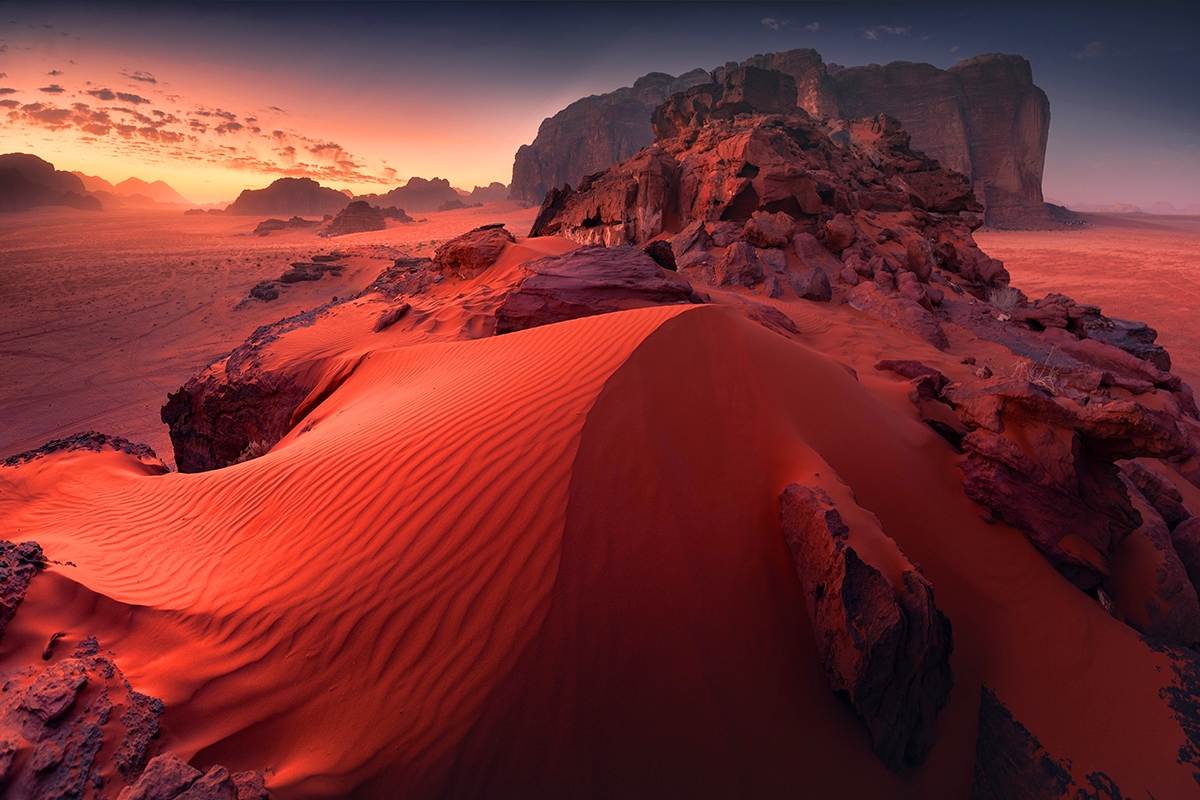
Wadi Rum is the 720-square-kilometre desert of red sand, sandstone mesas and granite mountains in southern Jordan. It has been the standing visual reference for Mars, the desert frontier and ancient Middle Eastern landscapes for over six decades. Access is coordinated with the local Zalabia and Zawaida Bedouin communities through ASEZA.
Aqaba is the Red Sea port and the only coastal city, fishing villages, port infrastructure, underwater shoots, with Saudi Arabian, Egyptian and Israeli coastlines visible from the same shoreline. It works for contemporary Middle East port, contested-border and naval visuals.
The Dead Sea is the lowest point on Earth at minus 430 metres elevation. The salt formations and white shoreline work for surreal and post-apocalyptic visual languages. Amman is the working modern city, with embassy districts, the Roman Theatre, and contemporary urban environments, while Wadi Musa functions as the principal staging base for Petra productions. Little Petra, fifteen minutes north of the main site, holds smaller carved facades and works as an alternative when Petra is constrained. Amman-based fixers handle the Petra-Wadi Musa staging base coordination, the scheduling that connects the southern heritage block to Amman and Aqaba, and the Bedouin guide relationships that most southern-desert location access relies on.

Stand-in value, where Jordan doubles for other geographies
For productions whose budget will not stretch to shooting in the location their script is actually set in, Jordan does double-duty work that few other jurisdictions can match in a single country.
Wadi Rum doubles as Mars more convincingly than any other terrestrial location, the red sand and iron-oxide rock match NASA reference imagery on a long lens. The same desert doubles as ancient Arabia and the deep Sahara. Productions running Jordan alongside Egypt, Morocco or the wider region layer their schedule against the MENA filming permits and cost playbook. Productions setting their story in the Sinai, the Hejaz, Nabatean Petra or any pre-Islamic context can usually shoot Jordan rather than the territory the script names. Cross-border briefs that pair a Jordan block with a Sinai or Cairo leg route through our Egypt line producer team on the Egyptian side.
Petra and Little Petra work as Biblical terrain, lost-city storytelling and any sandstone-carved civilisation. The carved facades read on camera as a built environment no production designer could afford to construct. Aqaba’s port stands in for any small Red Sea or Persian Gulf working harbour. What makes Jordan unusual is that all of these stand-in environments sit inside a country where the RFC coordinates the permits centrally, few comparable centralised systems exist elsewhere in the wider Gulf.
What a Film Fixer in Jordan Actually Does
There is significant variance in what people call themselves film fixers in Jordan. The role we describe here is full-service, the same scope of work a line producer would handle in a more formalised market, covering pre-production setup, on-set coordination and the ongoing coordination with the RFC. For a compact international brief, the film fixer Jordan function combines location access, local coordination and RFC filing support under the line producer’s schedule.
Pre-production, permits, scouts, budgeting and crew
The pre-production phase is where the value of a Jordan-experienced fixer is highest, because the permit chain compresses quickly once dates are committed.
Permit work begins the moment a draft script and a location list exist. The RFC requires the script for review, the location list with proposed dates and any drone or stunt elements specified. Public-location facilitation, heritage access, protected-area filming and drone operations run on different approval timelines; the line producer sequences them against the production schedule, while the current authority-specific planning ranges remain on the Jordan film-permits page.
Location scouts are the second deliverable. A fixer with a Jordan track record will already have a calibrated set of locations photographed against time of day, access road, distance from unit base, and seasonal or permit constraints. Recces with the production designer and director cover the prioritised set rather than starting from a tourism brochure.
Budgeting in Jordanian Dinars is the third element. The JOD is pegged to the US Dollar at approximately 0.709 JOD per USD, which gives stability, but line items are local, per-diem rates, crew day rates, accommodation, vehicle hire, location fees, heritage-site deposits. A Jordan fixer holds calibrated benchmarks for each line and pushes back on vendor quotes priced for inexperienced foreign productions. Crew assembly is the fourth: Jordan’s working crew base is smaller than the production volume the country now hosts, so the strongest heads of department are committed in advance.

On-set coordination, language, protocol and vendors
Once the unit is on the ground, line production services in Jordan shift the on-set work of the fixer to translation, vendor management and protocol.
The working language on most international productions is English, and most senior Jordanian crew are bilingual. The translation work is therefore not basic communication, it is the layer of cultural protocol that does not translate. How to ask a Bedouin elder for dawn access to a specific dune, how to handle a Petra ranger’s prayer-break request, how to negotiate shooting hours during Ramadan or Friday prayer, this is the soft work the fixer carries.
Vendor management is the harder layer. Equipment hire, vehicles, catering, accommodation, security, heritage-site fees, remote-area fuel, all involve vendors with varying experience of international production cash flow. The fixer holds the relationship, takes the call when a vendor pushes back, and prevents the production team from burning relationships they will need on day six of the shoot.
The third on-set layer is the running interface with the police and ministry representatives attending the shoot. Heritage sites typically have a ranger or antiquities officer present. Their authority is real. The fixer briefs them in advance, manages the on-day coordination and resolves access disputes before they reach the director.
RFC liaison, how the fixer runs the file through the shoot
The RFC coordination runs through the entire production, not just the permit phase. Once the shoot is underway, the RFC remains the escalation channel for any issue touching the line ministries, a location change, a stunt not in the original submission, a drone day extension, an extras call exceeding the cleared volume.
The fixer holds the running file. Scope changes go through the fixer to the RFC desk and back through the relevant ministry. Most are routine; a few are not. The gating function the RFC plays is what prevents the production being shut down mid-shoot.
The rebate file is the other RFC track. The fixer maintains documentation of qualifying local spend throughout the shoot, receipts, contracts, payroll evidence for Jordanian crew, vendor invoices in the required format. The audit happens after the shoot, and a file built well during production is what makes the rebate payable rather than disputed.
Our production work in Jordan runs from Amman, with RFC submission, Petra Ministry of Tourism windows and Wadi Rum tribal coordination handled as one continuous schedule rather than three separate shoot windows. Film fixers in Jordan run pre-production as a parallel-track operation, permits at the RFC, scouts on the ground, crew shortlists locked in against the green-light date, and on the floor carry the Arabic-to-English interface for vendors, the local-protocol guidance for crew, and the equipment runner relationships each shoot day depends on.
Permits, Logistics and What Trips Productions Up

Jordan’s filming permits run through the Royal Film Commission as the central facilitation point, with Petra permitted via the Petra Development and Tourism Region Authority and the Department of Antiquities, and Wadi Rum through its protected-area authority and the Bedouin community layer. The full permit stack, permit ownership and lead times, Petra’s shooting-hour windows, the Siq and drone rules, and airport equipment customs, is set out in detail on the Jordan film permits page. On the money side, what matters is that the film fixers in Jordan run all of these tracks in parallel so the schedule holds.

Common mistakes, what first-time productions get wrong
Five mistakes recur across productions arriving in Jordan for the first time.
Jordan participates in the ATA Carnet system. Where a Carnet applies, the production should prepare an accurate general list and confirm representation, inspection, port-of-entry handling and re-export requirements with the Jordanian customs broker and local production partner before dispatch. Equipment or routes outside the applicable Carnet procedure require a separately confirmed temporary-admission process.
The second is drone registration. Drones arriving without the required import and flight approvals may be detained or refused entry. Confirm the aircraft documents, operator credentials, flight plan and CARC requirements before travel.
The third is casting local extras without RFC sign-off. Local casting touches labour law, social security registration and tax treatment. Extras booked through informal channels and paid in cash create a rebate audit problem later. Casting agencies the RFC has worked with handle the documentation correctly.
The fourth is underestimating lead times during peak demand. Submissions in the second half of the year, during peak shooting weather, can run longer than the standard window. Filing early is not optional. The fifth is shooting at heritage sites without a ranger or antiquities officer present. The officer is part of the permit. Productions that try to start without them are stopped, regardless of how far they have travelled.

Crew Rates, Budget Framework and How to Engage
Day rate benchmarks for Jordan crew in USD and JOD
The following are Celluloid Pact indicative supplier estimates for 2026, not published tariffs. Final rates depend on the brief, crew tier, shoot duration, location footprint and equipment package. The benchmarks below reflect what local heads of department and operational crew quote for international productions.
A line producer in Jordan is quoted against the prep, shoot and wrap scope rather than a universal public day rate, with the specific figure confirmed against the live brief at briefing stage. A production manager runs between 400 and 600 USD per day, carrying the day-to-day scheduling, vendor coordination and operational decisions. A production assistant runs between 80 and 150 USD per day, depending on language, driving capability and prior international set experience.
A local director of photography with international credits runs between 800 and 1,500 USD per day, with the upper end held by the strongest names in the pool. First AD, sound recordist, gaffer and key grip rates sit between 300 and 600 USD per day for experienced operators.
These figures exclude equipment, vehicles, accommodation and per-diems. An illustrative full-unit production day in Wadi Rum, covering crew, 4×4 vehicles, camera and lighting package, location fee and Bedouin coordination, typically lands between USD 18,000 and 30,000 before above-the-line costs; these are full-unit day estimates, not crew day rates. A comparable full-unit day in Amman, with no special location access, is meaningfully lower, USD 10,000 to 16,000.

Line producer Jordan, production service companies and international productions
International productions typically engage a Jordanian-registered production-services company for local contracting, tax compliance, vendor payments and RFC coordination. Projects applying for the rebate must confirm the eligible applicant structure before principal photography. The company holds local tax compliance, signs vendor contracts with Jordanian suppliers, manages cash flow through the schedule, files the RFC rebate application before principal photography and reconciles the audited spend after wrap. Most Amman-based companies work multi-region briefs across Petra, Wadi Rum and the Aqaba Red Sea zone.
On smaller commercial and documentary shoots, one operator typically provides the line producer and film fixer functions, working through an eligible Jordanian-registered company that holds the production-services role. That solo operator is who most producers actually mean when they search for film fixers in Jordan for a compact brief. On feature productions and longer multi-region blocks the three functions sit with separate parties: line producer Jordan holds budget and day-to-day execution, the film fixer holds location access and RFC permit choreography per region, and the production service company holds the legal entity that rebate, tax and audit obligations attach to.
Film crew in Jordan and Amman-southern desert crew sourcing
Film crew in Jordan concentrate around Amman, with Wadi Musa and the Petra-Wadi Rum southern corridor supplying the regional specialist bench. The Amman crew base operates primarily in Arabic and English, with international-feature exposure built across the Lawrence of Arabia, Indiana Jones and the Last Crusade, The Martian, Aladdin, Dune, Rogue One and Moon Knight production cycles that have anchored Jordan’s stand-in geography. The Amman bench is supplemented by regional Bedouin location specialists and the southern-desert vehicle and logistics layer Wadi Rum shoots require, with cross-border coordination available when a schedule extends into Saudi Arabia.
Specialist departments draw from across the country: aerial crews based primarily out of Amman with drone licensing through the Jordanian Civil Aviation Regulatory Commission, underwater crews concentrated around Aqaba and the Red Sea, period-design departments with deep Hellenistic, Roman and Nabataean heritage specialism, and Bedouin community liaison specialists who anchor most Wadi Rum production work. Camera crew Jordan engagements typically run through the Amman-based operational network, with crew calls structured around the cross-ministry RFC permit cycle and the regional Bedouin community coordination timelines.

Production companies in Jordan and the foreign-producer engagement layer
Production companies in Jordan operate primarily out of Amman, with the Wadi Musa and Aqaba clusters anchoring southern-desert and Red Sea coastal production work. Foreign producers engaging film production services in Jordan typically select production companies based on Jordanian registration and recent RFC production history, international-feature track record (the Mars-stand-in features routing through Wadi Rum, the biblical and Levantine period work routing through Petra and Amman, and the recent streaming-series and studio-feature slate), Bedouin community location-access experience, and capacity to handle multi-region schedules from Amman into Petra, Wadi Rum, Aqaba and the Dead Sea corridor. The Jordan production-company structure builds on experience preparing complete RFC submissions and the Ministry of Tourism institutional framework, with the Amman-based companies typically holding the cash-flow infrastructure and the cross-ministry coordination and supplier networks the operational shape requires.
How to engage Celluloid Pact for Jordan line production
We operate fixer and line production engagements in Jordan as our standing operational model, not an opportunistic add-on. The first conversation is a short call to understand the production, the shoot dates and the locations the script requires. From that call we produce a preliminary budget framework in JOD and USD, a permit timeline against your dates, and a crew availability snapshot.
If the brief fits and the dates work, Jordan production services move into full pre-production, RFC submission, location scouts, crew assembly and vendor onboarding, with corridor scheduling and Bedouin liaison handled out of the Amman base.
To open a Jordan production, send us the script or treatment, shoot dates, location references, crew size, equipment and drone requirements, and the intended incentive spend. We come back with a preliminary budget framework in JOD and USD, a permit timeline against your dates and a crew availability snapshot.
