

Film fixers in Dubai coordinate Dubai Film and TV Commission (DFTC) filming permits, locations, local crew, equipment and daily logistics across Downtown, Marina, Bur Dubai and the desert, while a line producer Dubai team holds the budget, schedule, contracts and reporting for the shoot. Abu Dhabi, Sharjah and the other emirates follow their own permit routes and are covered by their specialist guides.
Dubai brings together three production geographies inside one emirate: a modern high-rise skyline, a heritage quarter around the Creek and a protected desert reserve. For a production company running cross-border work, that proximity changes how a shoot is budgeted, how the schedule is built and how the fixer brief is structured; much of the feature, OTT and brand work we have routed through the emirate has used at least two of those bands inside a single shoot window. This guide is part of our Film Fixers in Middle East production work, and the UAE film incentives, crew rates and permits reference carries the Abu Dhabi rebate structure and the wider UAE crew-rate and permit detail.
This piece walks through the DFTC permit route, the three location bands (skyline, heritage, desert), how the other emirates connect, and how an India-led production runs a Dubai shoot with a Dubai-based line producer and fixer team holding the ground.

Dubai Film and TV Commission and the line producer Dubai permit route
The Dubai Film and TV Commission is the filming-permit authority for the emirate. Every commercial shoot, feature, short film, OTT episodic, branded content, music video or documentary needs a DFTC permit before cameras roll on a public or private location. DFTC liaises with other Dubai authorities as part of that process, but under the DFTC terms and conditions the applicant remains responsible for location consent, visas and any additional approvals the shoot requires. International productions appoint a UAE-licensed production company, which obtains the permit and the appropriate work or business visas for the crew, per the DFTC filming guidance.

Which authorities a Dubai shoot can touch
A Dubai shoot can touch several authorities beyond DFTC depending on what is in the schedule. Dubai Police for crowd control, road closures, weapon props, stunts or uniformed-personnel impersonation; the Roads and Transport Authority for metro stations, tram corridors, traffic diversion and road-side rigging; the General Directorate of Residency and Foreigners Affairs for entry and work status; Civil Defence for fire, pyrotechnics or smoke effects; Dubai Customs for equipment entry; and the civil aviation authorities for aerial work. Which of these apply, and who files for them, is confirmed with the licensed production company for the location list.
Published periods and what depends on the application
DFTC publishes up to 25 business days for script approval on its DFTC script-approval page. Location and permit timing after that depends on the application: the locations requested, the activity, the owner consents involved and the other authorities that need to sign. We build the timetable from the location list rather than from a standard period, and start the script-approval step as early as the schedule allows.
Where the fixer and the line producer sit in the DFTC route
Film fixers in Dubai are the production-side counterpart to the DFTC process. A film fixer in Dubai builds the location list, sizes the crew breakdown by shooting day, prepares the sub-permit sequence and holds the owner and venue conversations before submission. The line producer Dubai team holds the budget, the schedule, the vendor contracts and the reporting line to the producer, and on complex jobs the fixer also acts as the line producer’s location liaison, running recces, locking owner permissions on private buildings and coordinating with security teams at venues such as DIFC, the Palm or Atlantis.

Script review, sensitive content and the DFTC portal
The DFTC portal is the application gateway, with a structured workflow covering the UAE-licensed applicant, script or storyboard review where required, location-by-location permit processing and permit administration. Content review is part of the application, and productions with material in sensitive categories flag it at first submission so the review runs inside the timetable rather than after it.
Downtown, Marina and Bur Dubai, the skyline-to-heritage band
The most filmed corridor in the emirate runs from the Burj Khalifa cluster through DIFC, along Sheikh Zayed Road to Marina and JBR, then folds back through Bur Dubai’s heritage quarter and the Creek. The whole stretch fits inside a compact filming corridor, which is what makes a multi-look Dubai shoot feasible inside a tight schedule.
Burj Khalifa, Downtown, DIFC and Marina
Downtown Dubai anchors the Burj Khalifa observation-deck sequences, the fountain plaza, Sheikh Mohammed bin Rashid Boulevard and the Dubai Mall exterior. Each of these sits inside a private-venue structure, so the DFTC permit is necessary but not sufficient: the venue’s own filming office signs a parallel agreement, usually with a separate location fee. DIFC carries the corporate-office and rooftop look that finance-set thrillers, brand campaigns and OTT drama use. Marina and JBR are where yacht sequences, beachfront talent walks and contemporary-skyline establishing shots land, with separate owner consents for beach work versus promenade work. The Museum of the Future, off Sheikh Zayed Road near Emirates Towers, gives the corridor its near-future hero exterior.
International productions engage production companies in Dubai for DFTC permits across Downtown, DIFC, Marina and Business Bay, Burj Khalifa observation-deck and skybridge access, and the scheduling that links Dubai locations to any Abu Dhabi studio work handled under Abu Dhabi’s own route.

Bur Dubai, Al Fahidi and the Creek
Bur Dubai is the pre-skyline Dubai that period and heritage productions favour. Al Fahidi historical neighbourhood, the Bastakiya quarter, retains the wind-tower architecture, lime-plaster facades and narrow lanes that work for any pre-1980s setting. The Creek, with its abra crossings and dhow harbour, is the most efficient way to land an old-trading-port look inside the emirate. Heritage filming here sits under the DFTC permit with cultural sign-off from the relevant heritage authority, so the timing and the location fee are confirmed for the specific site and crew size.
Old souks, Deira Gold, Spice and Meena Bazaar
Deira’s stretch of the Creek runs the Gold Souk, Spice Souk and Perfume Souk, while Bur Dubai’s Meena Bazaar holds the textile lanes that double convincingly for a subcontinental market scene. Souk filming can remain operationally dense after the required permissions and location consents are identified: narrow lanes restrict equipment access, the light is unforgiving at midday, and shopkeeper coordination matters as much as any official sign-off. We typically shoot souks early or late in the day, with a fixer working the lane in advance to brief stall owners on the window.

Desert and conservation areas, DDCR, Margham, Al Qudra
The desert sits east of Downtown, with drive times depending on the band and the traffic. There are three operating zones to know: the Dubai Desert Conservation Reserve, the Margham and Al Qudra open-desert belt, and the dune fields near the Abu Dhabi border where a location pin can fall under the neighbouring emirate’s authority.
Dubai Desert Conservation Reserve
The Dubai Desert Conservation Reserve (DDCR) is a protected area east of Dubai. Filming inside the reserve requires the reserve’s own approval on top of the DFTC permit, and reserve access, environmental conditions, vehicle limits, night-shoot restrictions and timing are confirmed directly with the reserve for the production. We use DDCR when a brief specifically calls for untouched dune morphology and the reserve’s wildlife setting; for any shoot that needs more vehicle flexibility, the open-desert band is the better fit.
Margham, Al Qudra and the open-desert belt
Margham and Al Qudra hold the open-desert work that does not need the conservation framing: vehicle sequences, larger crew counts, action choreography and expansive dune-crest hero shots. Access conditions, location fees, vehicle use and night work are confirmed for the selected land, municipality and DFTC permit; none should be assumed from the location type. The deeper dune fields towards the Abu Dhabi border sometimes trigger a parallel Abu Dhabi application depending on the exact location pin.
4×4 logistics, heat management and crew welfare
Desert filming is less a permits problem and more a crew-welfare problem. Temperatures climb past 45 degrees in summer, camera sensors thermal-throttle, batteries drain faster, and moving stunts are scheduled before late morning or pushed to the evening. We move equipment in 4×4 convoys with redundant water, shade for waiting crew and a medical-grade ice supply for any heat-stress event; crews flying in for desert days are briefed ahead on hydration, and call sheets carry shade rotations through the sun exposure.
Aerial filming and drones
A DFTC filming permit does not by itself clear aerial operations. Commercial drone work also requires the applicable operator, security and operational approvals published by the GCAA, with separate stages and periods on the GCAA commercial-drone requirements, alongside the Dubai-level aviation and location approvals for the specific flight; helicopter work runs through the operator and the relevant aviation authorities. DFTC does not itself clear the complete drone stack, so aerial approvals are started early and confirmed for the operator, the airspace and the dates.

The other emirates, Abu Dhabi, Sharjah and the mountain band
Productions that need both downtown Dubai and Abu Dhabi sequences hold two permit routes in parallel, because each emirate runs its own. Abu Dhabi has the marquee venues for large-scale luxury sequences, Sharjah holds an extensive heritage quarter, and Ras Al Khaimah holds the mountain-and-wadi landscape that Dubai itself does not provide. A line producer Dubai role on a multi-emirate brief is to hold each authority’s timeline in parallel without letting any of them slip the master schedule.
Abu Dhabi
Abu Dhabi runs its own filming-permit route through its film commission, with twofour54 as the media-zone and studio partner rather than a second Dubai permit authority. Sequences such as the Fast and Furious 7 work at Emirates Palace and Etihad Towers were permitted on the Abu Dhabi side, and sites like Sheikh Zayed Grand Mosque carry their own application protocol on top. The Abu Dhabi rebate, procedure and studio detail sit on the UAE guide linked above.
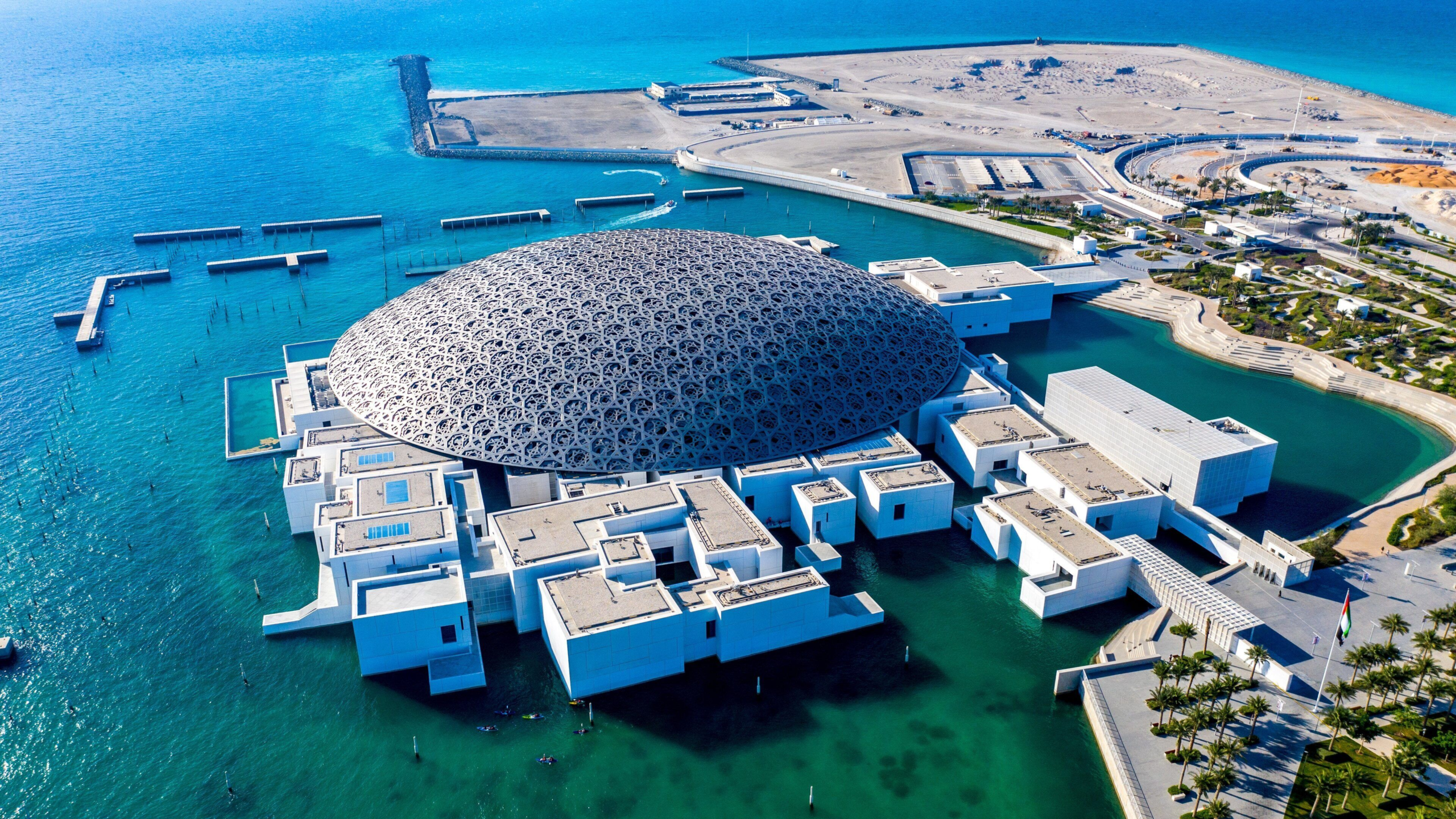
International productions engage production companies in Abu Dhabi for that emirate’s permits, twofour54 and Yas Island studio infrastructure, Saadiyat Island and Louvre Abu Dhabi access, and the desert-corridor scheduling behind much of the contemporary and luxury commercial work on the emirate.
Sharjah and the Northern Emirates
Sharjah operates a well-preserved heritage quarter, the Heart of Sharjah restoration project, alongside the Al Noor Mosque, the souk corridor and a coastline used as a Gulf stand-in for productions that need the period look without the Dubai skyline. Filming permissions in Sharjah run through the relevant emirate and location authority, with heritage-property consent confirmed per site. Ajman and Umm Al Quwain are occasionally used for crew accommodation when central Dubai hotel rates spike in peak season.
International productions engage production companies in Sharjah and the Northern Emirates for those emirates’ permissions, heritage-property access at the Heart of Sharjah, and the corridor routing into Ras Al Khaimah and Fujairah when the brief requires mountain or east-coast coverage.
Hatta, Ras Al Khaimah and the mountain band
For mountain, wadi and rock-formation work, Hatta, a Dubai exclave in the Hajar range, and Ras Al Khaimah’s Jebel Jais corridor are the two options. Hatta sits under the Dubai permit route despite the geographic separation; Ras Al Khaimah permissions run through the relevant emirate and location authority. The band lets a production land a non-desert, non-skyline look without leaving the UAE, useful when the brief calls for visual variety inside a compressed calendar.

Dubai as the operational base for MENA productions
Dubai functions as a staging point for productions covering the MENA production corridor, including Saudi Arabia, Jordan, Oman or Egypt on the same calendar: air connectivity, free-zone company structures, ATA Carnet customs and an established production-service ecosystem make it a practical place to assemble crew and equipment before deploying into the country-specific shoot block. Each destination then runs its own permit, customs and entry requirements.
Equipment staging and ATA Carnet routing through Dubai
The UAE accepts the ATA Carnet, and Dubai International Airport handles carnet-endorsed film equipment through Dubai Customs under the Dubai Customs temporary-admission guidance. Clearance time depends on the completeness of the carnet and inventory, the broker and the cargo route, and is not guaranteed to a fixed period. Every customs territory controls its own import route, so onward legs to Saudi Arabia, Jordan, Oman or Egypt are cleared under each country’s own carnet or temporary-admission rules rather than arranged from Dubai. Free-zone bonded-warehouse options can hold equipment between shoot blocks, subject to the zone’s conditions.
Banking, finance and cash flow
The UAE banking system and its free zones support the multi-currency accounts and production-finance arrangements that international productions use. Cross-corridor productions commonly run their regional cash flow through a UAE-registered production-service company, with in-country partners holding the local float in Saudi Arabia, Jordan or Egypt; the account structure, transfer timing and compliance requirements are set with the production’s bank and advisers for the project.
Air connectivity and crew rotation
Emirates, Etihad and flydubai operate a dense route network with regular connections to Riyadh, Jeddah, Amman, Muscat, Cairo, Doha, Beirut, Casablanca and Tunis. Crew rotation through Dubai allows productions to bring HoDs and key crew in from London, Mumbai, Paris or Los Angeles, hold them through pre-production briefing and equipment checks, then deploy them onward. Regional production-service companies often maintain Dubai-resident crew that can supplement in-country crew on Saudi, Jordan and Oman shoots.
Why Jordan, Saudi Arabia and Oman shoots stage through Dubai
Jordan productions filming Petra, Wadi Rum or Amman commonly stage pre-production and equipment routing through Dubai before the Amman leg, working with our line producer Jordan team on the Jordanian permits. Saudi productions covering AlUla, NEOM, Riyadh or the Red Sea coast often stage international crew and equipment through Dubai, with Saudi licensing, customs and any Film Saudi application handled by the Saudi applicant. Oman productions filming Muscat, the Hajar Mountains or the Empty Quarter route through Dubai on the regular connections. In each case Dubai is the assembly point; the destination’s own authorities govern the shoot.
How an India-Led Production Runs a Dubai Shoot
The working model for an Indian production unit shooting in Dubai pairs the India-side producer with a Dubai-based line producer and fixer team. The India side owns the creative, the cast, the DOP and the budget; the Dubai-side line producer holds the DFTC application through the licensed production company, the local crew, equipment vendors, hotels, transport and on-ground contingencies. The split can reduce unnecessary travel for paperwork and separates Dubai-side production costs from post-wrap closeout and delivery costs.
Mumbai-to-Dubai pipeline, cast, DOP, fixer
Indian leading-man and leading-woman shoots in Dubai have shaped the city’s reputation as a high-profile production territory, and the pipeline is consistent: principal cast and key creative HoDs fly out of Mumbai; film fixers in Dubai assemble UAE-resident crew (camera assistants, gaffers, grip, sound, art-department support), equipment, transport and accommodation. For inbound Indian OTT episodics, we often route the DOP and director from Mumbai with a hybrid local-plus-travelling camera department, depending on whether the shoot needs a specific body or lens set that is faster to ship than to source locally.
Our line producer in India network handles the production-company side of the pipeline when the brief originates with an Indian studio: cast booking, DOP attachment, India-side coordination and the Mumbai-Dubai equipment movement that follows.
Customs, ATA Carnet and equipment movement
The customs side is where equipment-heavy Dubai shoots either run smoothly or lose a day. We brief the production on carnet structure well before principal, with the inventory list, serial numbers and gear photographs prepared at the origin end and checked in parallel by the Dubai-side broker. A carnet raised in India is issued through the Federation of Indian Chambers of Commerce and Industry, endorsed on departure and presented to Dubai Customs on arrival; the fixer pre-briefs the broker and holds the inventory so the gear reaches the vendor or hotel with the least delay the route allows. The production should confirm with its insurer that UAE activity, equipment and the carnet inventory are covered.
Cast and crew entry and work status
Entry and work status for cast and crew depend on nationality, role and duration. Tourist entry is not a substitute for the work or business visa a paid production role requires; the appropriate visa is obtained through the UAE-licensed production company for each passport and role, on the timeline that GDRFA processing requires for the project. Processing time is confirmed for each passport, role and application, and the entry timeline is held against the master shoot calendar from the first schedule draft.
Dubai and UAE production service companies, film crew and the legal-entity layer

Production service companies and international productions
Film production services in Dubai sit at the centre of an international production landing here, and the UAE-licensed production service company handles the legal-entity layer: it holds local tax and VAT compliance under the UAE VAT framework, signs vendor contracts, sponsors the DFTC permit and the crew visas, manages cash flow through the schedule and carries the audit obligations any incentive filing imposes. Line production services in Dubai wrap around that company layer. The company is typically registered in a Dubai free zone or on the mainland, and where a schedule includes Abu Dhabi, the Abu Dhabi entity requirements are met through that emirate’s own route.
The production service company carries scope distinct from the line producer and the film fixer. The line producer holds budget control and day-to-day execution across the schedule; the film fixer holds location access and the DFTC permit choreography; the production service company holds the legal entity that the permit, VAT, vendor contracts and any incentive audit attach to. On a single-emirate commercial or ad-film shoot one operator can carry all three roles. On a multi-emirate or Gulf-region brief, the entity structure is set per project with the production’s advisers rather than assumed.

Film crew in Dubai and the UAE, Gulf crew sourcing
Film crew in Dubai and the UAE concentrate around two principal benches, Dubai and Abu Dhabi, anchored by Dubai Studio City and twofour54 alongside a freelance network built over two decades of commercial, feature and franchise volume. Coverage runs across cinematography, gaffing, key grip, production design, sound, art department and post-production supervision, with particular experience on luxury commercial, automotive and contemporary feature work. The Mumbai-to-Dubai pipeline supplies an additional layer of Indian crew, with the short flight keeping cross-country crew movement practical.
Specialist departments draw from across the Gulf: aerial crews based mainly in Dubai and Abu Dhabi operating under GCAA requirements, underwater crews on the Gulf and Fujairah coasts, stunt crews with franchise experience from Mission: Impossible, Fast and Furious and Star Trek shooting blocks, and production-design departments used to high-end commercial work. Camera crew Dubai engagements typically run through the licensed production service company, with crew calls structured around the studio and location calendar.
Production companies in Dubai and the foreign-producer engagement layer
Production companies in Dubai operate mainly out of Dubai Media City, Dubai Studio City and the free zones, with the wider cluster extending into Abu Dhabi. Foreign producers engaging production companies in Dubai typically select on DFTC track record, multi-location experience, the depth of crew the company has direct access to, and its ability to work the Abu Dhabi route when the schedule includes that emirate. Film production companies in Dubai have built depth on franchise volume, luxury commercial production for global brands, and the Bollywood and Indian OTT pipeline that anchors a steady shoot calendar.
The UAE-licensed production company signs the foreign-producer contract, takes the agreed commercial responsibility for the schedule, submits the permit and relevant crew-entry applications, and holds the contracted in-country compliance responsibilities. It provides the legal-entity layer alongside the line producer and film fixer; the roles may be contracted separately or together according to the shoot.
Engaging film fixers in Dubai and a line producer for the shoot
For a production planning a Dubai shoot, feature, OTT, branded content or music video, the working pattern is to brief us on the creative, the location bands and the shoot window, and let the film fixers in Dubai and the line producer team build the DFTC application, the crew and the equipment plan from there. Reach out with shoot dates, location bands and the broad scope, and we respond within the timetable agreed at engagement with a structured execution brief covering the permit route, the crew and equipment plan, the entry timeline and, where the schedule crosses into another emirate or another Gulf country, the separate routes each one requires.
