

Film fixers in Thailand coordinate location recce, access, local crew and daily shoot logistics. A line producer in Thailand manages the agreed budget, schedule, vendors and reporting. Celluloid Pact coordinates these services for international productions, with filming applications handled through a Thailand Film Office-registered local coordinator.
Crew, equipment, studio and location costs are assessed against the brief and dates.

Film Fixers in Thailand: Recce, Access and Local Coordination
Recce checks establish who controls each site, where the unit can load and hold, and what access, transport and permission requirements affect the shoot. The filming application is submitted by the local coordinator officially registered with the Thailand Film Office, working with the production team. On the ground the fixer team coordinates site-owner consent, relevant authority permissions, location scouting and access, local crew sourcing, transport, accommodation blocks, and the daily liaison with municipal, park, temple or private-property authorities.
Line Producer Thailand: Budgets, Schedules and Vendor Control
A line producer in Thailand carries the commercial layer: the budget and cash-flow model, the schedule across regions, vendor contracts, equipment and customs sequencing, crew visa and work-permit coordination, and the reporting line back to the foreign producer. The two roles are complementary and may be assigned to separate people.
On a commercial or a short documentary block Celluloid Pact often supplies both roles through one team. For larger productions, line production in Thailand can be managed separately from daily fixing, with responsibilities assigned according to the agreed scope. The agreed scope sets out which responsibilities sit with the line producer, which with the fixer team, and which with the registered local coordinator on the permit file.
Bangkok as the Production Base
Bangkok can serve as the principal crew and equipment base. Regional sourcing, unit movements and location-specific permissions are planned against the production’s requirements. The Thailand Film Office is based in the city, many registered local coordinators work from it, and camera, lighting, grip and post-production vendors are concentrated there. The city itself supplies contemporary urban settings across Sukhumvit and Silom, the older commercial districts around Yaowarat and the Chao Phraya river corridor, market and street-life registers, and studio stages for interior work. Bangkok Metropolitan Administration permission attaches to filming on the streets, canals and public spaces it controls, and is one of the area authorities the Thailand Film Office coordinates after the national permit.

Where the schedule moves south or north, the local fixer team, crew and equipment can travel from Bangkok with local supporting crew, boats, drivers and accommodation contracted at the destination, or regional legs can be sourced locally where that suits the brief. Either way the line producer keeps one budget and one schedule across the shoot, while each location’s permission requirements are confirmed with its owner and the relevant authorities.
Thailand Location Routes: Bangkok, Andaman, North and Heritage
| Route | Visual register | Area permissions beyond the national permit | Operational base |
|---|---|---|---|
| Bangkok metropolitan | Contemporary urban, river and canal, markets, studio interiors | Bangkok Metropolitan Administration; site owners | Bangkok |
| Andaman coast: Krabi, Phang Nga, Phuket | Limestone karst, marine and island, beach, Sino-Portuguese old town | Department of National Parks for marine and island parks; provincial and site permissions | Phuket or Krabi; crew sourced to the brief |
| Gulf coast: Koh Samui, Hua Hin | Tropical island, resort coast, royal-era seaside town | Provincial and site permissions; national park where applicable | Bangkok or Samui |
| North: Chiang Mai and the mountain corridor | Highland, hill villages, temples, northern architecture | Royal Forest Department or national parks for forest land; temple custodians | Chiang Mai |
| Heritage: Ayutthaya and Sukhothai | Historical-park ruins of the former Thai capitals | Fine Arts Department for historical parks and national museums | Ayutthaya from Bangkok; Sukhothai local base |
Andaman Coast and Islands
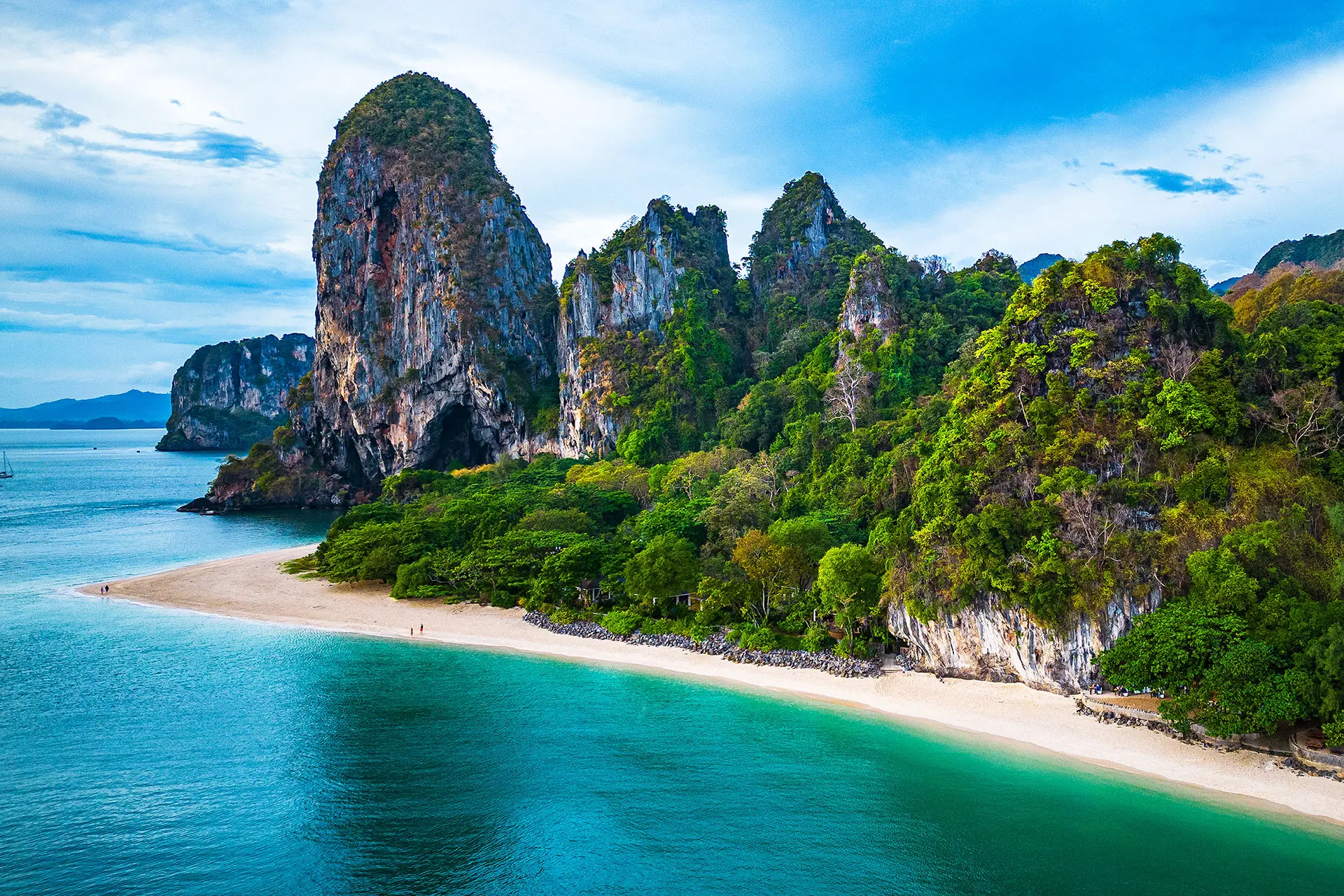
Krabi and Phang Nga supply the limestone karst and marine register, Phuket adds the resort coast and the Sino-Portuguese shophouse streets of the old town, and the islands around Phi Phi supply the beach settings that international audiences already recognise. Marine and island national parks are managed by the Department of National Parks, Wildlife and Plant Conservation, whose permission is coordinated through the Thailand Film Office and carries its own conditions on boat access, crew numbers and seasonal closures. Boat logistics, tide windows and weather buffers are built into the schedule by the fixer team when assessing proposed dates and contingency needs.

North and Heritage
Chiang Mai anchors the northern corridor: highland roads, hill villages, working temples and the mountain landscape north towards Chiang Rai and Mae Hong Son. Forest land is administered by the Royal Forest Department, the national-park authority or the Forest Industry Organization depending on the site, and temples are permitted through their own custodians. Ayutthaya and Sukhothai are the historical parks of the former Thai capitals, both UNESCO-listed, and filming inside them is permitted by the Fine Arts Department with conditions on equipment, crowd size and set dressing around the monuments.

Thailand Film Office, Site Permissions and Restricted Locations
The Thailand Film Office, under the Department of Tourism, runs the national permit for foreign productions. The published process is that the foreign filmmaker hires a local coordinator officially registered with the Thailand Film Office, the coordinator files the application and supporting documents, and the Film, Video and Digital Media Committee decides on approval. The office publishes decision periods of three business days for advertising, public relations, documentary, music video and television programmes, and five to ten business days for feature films, series, drama, short films, reality shows and programmes with sensitive content, counted once the file is complete and correct. The current requirements are on the Thailand Film Office permit process page.
- a letter from the assigned local coordinator to the Director-General of the Department of Tourism;
- an assignment letter from the foreign filmmaker confirming the coordinator has been hired;
- the film-permit application form;
- supporting material by format, such as storyboard, treatment, synopsis or script;
- a filming schedule with exact dates and locations;
- the foreign crew list with names, passport numbers, positions and arrival dates.
The national permit is the entry point, not the whole stack. After approval the Thailand Film Office coordinates with the agencies responsible for specific areas: the Bangkok Metropolitan Administration for the capital, the Department of National Parks, Wildlife and Plant Conservation, the Royal Forest Department, the Forest Industry Organization and the Fine Arts Department for historical parks and museums. Temples, royal-associated properties, military and airport-controlled areas and private sites add their own permissions, and drone filming requires separate checks for aircraft and operator registration, flight permissions and location restrictions, as applicable. Film fixers in Thailand open each of those tracks against the final location list, and the schedule is built around the slowest of them rather than the national decision period.

Foreign Crew and Equipment: Confirm the Current Route
Foreign crew requirements are project-specific and are confirmed for each nationality and role before travel. Thai official material identifies the Non-Immigrant M visa route for media and film crews and requires a supporting letter from the Thailand Film Office issued against the approved permit; the Ministry of Foreign Affairs Non-Immigrant M guidance sets out the document list. The local coordinator sequences the permit approval, visa applications and arrival dates, while the relevant embassy or consulate and employment authority confirm the applicable requirements, so that the crew list on the permit file matches the crew that lands.
Equipment enters on the route confirmed with Thai Customs and the production’s broker for the specific package, whether that is an ATA Carnet or temporary import, and the Thailand Film Office publishes guidance on both. Timing is confirmed with the broker and the port of entry rather than assumed, and specialist items such as drones, wireless systems and vehicles carry their own conditions.
Thailand Film Rebate: Eligibility and Budget Planning
Eligible foreign productions may qualify for Thailand’s cash rebate of up to 30%, subject to spending bands, qualifying criteria and format restrictions. Television commercials are not eligible under the Thailand Incentive Measures Guidelines 2025, which also sets the base rates by spending band and the additional-incentive conditions. The production team checks the applicable scheme against the brief before including an incentive assumption in the budget; the current criteria, process and forms are on the Thailand Film Office incentive criteria page.
Discuss Your Thailand Shoot
A usable first response depends on the brief carrying enough to test the permit, crew and schedule questions in one pass. Send the format and running time, the shoot window, the locations or registers the script needs across Bangkok, the coasts, the north and the heritage parks, the crew size and which heads of department travel, the crew nationalities, the equipment list and whether it ships or rents locally, any permit-sensitive activity such as drones, marine-park work, temples, historical parks or night closures in Bangkok, and an indicative budget range.
We review the brief, identify the initial location and permission questions, and agree the scope and fee for any detailed recce, scheduling and budgeting. Access, supplier availability and approval requirements are confirmed through the relevant parties before commitments are made. For briefs that pair Thailand with Vietnam, Cambodia, Indonesia or Malaysia, the regional comparison and corridor routing are handled by our line producer Southeast Asia team, which covers multi-country Southeast Asian schedules.
