

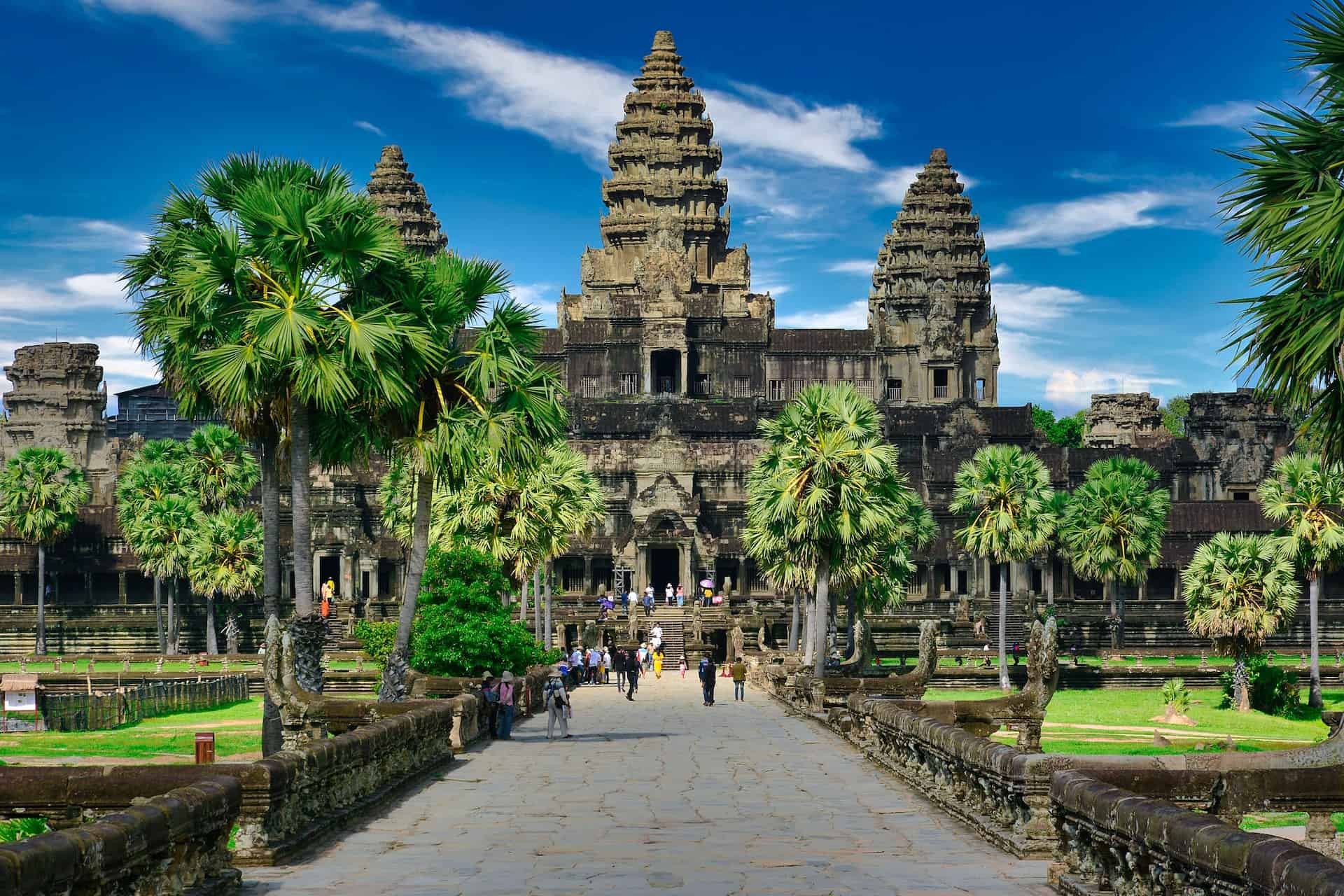
Cambodia carries one of Southeast Asia’s most distinctive location libraries inside a compact production geography. Siem Reap and the Angkor Archaeological Park anchor the international production case — the UNESCO World Heritage Khmer-empire temple complex (Angkor Wat, Bayon, Ta Prohm, Banteay Srei and the broader 9th-15th century corridor) delivers a visual identity that no other Asian territory matches. Beyond Angkor, Phnom Penh adds the colonial-and-historical capital layer through the Royal Palace, the Silver Pagoda, the broader French-colonial central district and the Tuol Sleng historical band. Koh Kong and Sihanoukville extend the Cambodian register into Gulf-of-Thailand coastal work; Battambang carries colonial-heritage Cambodia; Mondulkiri and Ratanakiri provinces add the northeastern indigenous-community and mountain-forest layer.
Our line producer Cambodia desk holds the budget, schedule and national permit plan. Film fixers in Cambodia coordinate locations, daily field execution and the additional APSARA Authority process for Angkor-area filming. Cambodia’s Ministry of Culture and Fine Arts issues the general filming permit; the Cambodian Film Commission assists productions but does not issue the approval (Cambodia Film Commission administrative guidance, production-assistance role).
The Cambodian Film Commission under the Ministry of Culture and Fine Arts handles the national permit framework for international productions, with the APSARA Authority operating in parallel for Angkor Archaeological Park access and the Ministry of Information running script-evaluation review. Cambodia does not currently operate a formal cash rebate scheme — the filming case anchors on the unique location library, the low cost-band positioning and the established Khmer-empire heritage filmography rather than financial-incentive arbitrage. For the deeper Southeast Asia cost benchmark and cross-territory routing comparison, see our Southeast Asia filming overview. For broader cluster context, our Southeast Asia line producer network covers multi-country scheduling cases. Productions running mainland Southeast Asia work frequently anchor Bangkok as the operational base with Siem Reap as the Cambodia-side secondary — the Bangkok-Siem Reap pairing is the strongest real-world production combination in mainland SEA; our Film Fixers In Thailand coverage handles the Bangkok-side framework.
Working crew day-rate benchmarks in Phnom Penh, CFCC and APSARA permit process detail, equipment rental bands and the Cambodia versus Vietnam and Thailand cost comparison sit on our Cambodia film production crew rates and permits page.
| Region | Visual identity | Permit speed | Operational base |
|---|---|---|---|
| Siem Reap / Angkor | Khmer-empire heritage, UNESCO temple, jungle-and-stone | Slower — APSARA Authority + Ministry parallel tracks | Siem Reap |
| Phnom Penh | French-colonial capital, Royal Palace heritage, historical band | Medium — Ministry of Culture + Phnom Penh authorities | Phnom Penh |
| Koh Kong / Cardamom coast | Mangrove coast, Cardamom Mountains, jungle-and-coast | Medium — provincial layers | Phnom Penh (4-5hr) or Koh Kong |
| Sihanoukville / coastal islands | Gulf coastal, beach corridor, Koh Rong island | Medium — provincial + maritime | Sihanoukville |
| Battambang | Colonial heritage, rural Cambodia, Bamboo Train | Medium — provincial | Phnom Penh (5hr drive) |
| Mondulkiri / Ratanakiri | Northeastern wilderness, indigenous communities, forest | Slower — indigenous-community protocols | Phnom Penh (7-8hr drive) |

Siem Reap and Angkor — the UNESCO Khmer-empire monumental core
Siem Reap and the Angkor Archaeological Park carry Cambodia’s strongest international production anchor. The Angkor complex — covering more than 400 km² of 9th-15th century Khmer-empire temple architecture — anchored Tomb Raider (2001 Paramount Pictures, Lara Croft and the Ta Prohm strangler-fig temple), Two Brothers (2004 Jean-Jacques Annaud, the broader Angkor jungle setting), City of Ghosts (2002 Matt Dillon, Phnom Penh and Angkor), and a long pipeline of feature, documentary and high-end commercial work covering Khmer-empire, ancient-Asian or jungle-temple briefs. First They Killed My Father (Angelina Jolie, 2017, Netflix) anchored through Siem Reap and the broader Cambodian archaeological band for the contemporary-historical Cambodian narrative.
Angkor Wat, Bayon, Ta Prohm and the temple corridor
Angkor Wat — the 12th-century state temple of the Khmer Empire — delivers the most-photographed temple facade in Southeast Asia and anchors most productions covering Cambodian or Khmer-empire briefs. Bayon at the centre of the Angkor Thom royal city carries the smiling-stone-face register that distinguishes Cambodian heritage from the broader regional Buddhist temple architecture. Ta Prohm — the strangler-fig temple — became internationally famous through the Tomb Raider sequences and remains the default Cambodian temple location for productions wanting jungle-overgrowth visual identity.
Banteay Srei (the 10th-century “Citadel of Women” with its distinctive pink sandstone) extends the temple corridor with smaller-scale intricate Khmer architecture. The broader Angkor band includes Preah Khan, Pre Rup, East Mebon, Neak Pean and the further Roluos group — together delivering one of the deepest single-location heritage libraries in international production.
APSARA Authority permits and UNESCO heritage-zone protocols
Angkor filming runs through a parallel permit framework. The APSARA Authority (Authority for the Protection and Management of Angkor and the Region of Siem Reap) administers all Angkor Archaeological Park access alongside the Cambodian Film Commission umbrella permit. The framework runs at multiple tiers — standard tourist-zone filming clears within shorter windows, restricted-zone access (close-up temple shoots, after-hours work, scaffolding or crew-density on heritage structures) requires extended lead times and conservation-rotation coordination. UNESCO World Heritage protocols apply across the protected core. Productions covering Angkor as the primary or paired location should sequence the APSARA application at the script-breakdown stage given the multi-layer conservation framework — productions joining at production-prep stage typically discover the APSARA lead time after the schedule is already committed.
Siem Reap as the international production base
Siem Reap operates as both the headline Cambodian filming destination and the operational base for Angkor-anchored productions. The Siem Reap-Angkor International Airport (a recent upgrade with direct international connections) handles equipment-and-crew arrival; the Siem Reap urban centre delivers the production-support infrastructure including hotel-and-accommodation capacity at international standards, equipment-rental coordination through the Phnom Penh-Siem Reap supply chain, and crew-services infrastructure. The Cambodian crew bench has deepened significantly since the early-2000s Tomb Raider generation through to the recent Netflix production work, with experienced bilingual location managers, fixers and crew handling international production work. International shoots typically import the core HoD layer with the wider crew layer sourced from the Phnom Penh-Siem Reap production network.

Phnom Penh — the colonial-historical capital and the wider archaeological band
Phnom Penh anchors Cambodia’s second-major production case. The Royal Palace and the Silver Pagoda complex on Sothearos Boulevard deliver the royal-Khmer architectural register at the contemporary government district. The French-colonial central band — running through the Wat Phnom hill, the Phsar Thmey (Central Market, the iconic 1937 Art Deco yellow dome), the riverside corridor along the Tonle Sap and Mekong confluence, and the surrounding French-colonial residential districts — covers Indochinese-colonial and pre-1975 Cambodian historical work. The Royal Palace specifically requires Royal Household coordination alongside the Cambodian Film Commission framework.
Tuol Sleng, the Killing Fields and historical-sensitivity protocols
Tuol Sleng Genocide Museum (the former S-21 detention centre) and the Choeung Ek Killing Fields memorial carry the recent-historical Cambodian band that productions covering Khmer Rouge-era, Cambodian civil-war or 1970s-1990s contemporary-historical briefs route through. Filming at these sites runs through additional Ministry of Culture coordination with cultural-sensitivity protocols — productions covering this band should engage the line-production layer at script-breakdown to map the sensitivity considerations alongside the practical permit framework. The recent international production case study is First They Killed My Father (2017), which anchored extensively through the historical-sensitivity layer with the line-production team carrying community engagement and survivor-consultation coordination throughout the shoot.
Phnom Penh contemporary urban and the riverside corridor
Beyond the heritage core, Phnom Penh’s contemporary urban band has shifted character significantly over the past decade. The Sisowath Quay riverside running along the Tonle Sap-Mekong confluence covers the contemporary urban and tourist-corridor frame. The Vattanac Capital Tower and the surrounding Norodom Boulevard high-rise district deliver the modern-skyline backdrop for productions covering contemporary Cambodian or pan-Asian commercial work. The Russian Market (Phsar Toul Tom Poung) and the BKK1 district carry the contemporary urban shopping-and-residential layer. Phnom Penh International Airport sits on the city’s western edge, providing the equipment-and-crew gateway alongside the cross-border Bavet land route into Vietnam.

Coastal Cambodia — Koh Kong, Sihanoukville and the Gulf islands
The Cambodian Gulf-of-Thailand coast adds tropical-coastal and jungle-and-coast layers distinct from the Siem Reap temple corridor. Koh Kong on the southwestern coast anchors the Cardamom Mountains-meets-coast register — the Cardamom range delivers one of Southeast Asia’s most intact tropical rainforest corridors, with the Koh Kong coastline providing mangrove, tidal-river and Gulf coastal locations alongside the broader Botum Sakor and Phnom Bokor National Parks. The 4-5 hour drive from Phnom Penh makes Koh Kong a practical option for productions running Cambodia-base with jungle-and-coast secondary days.
Sihanoukville and the Koh Rong island corridor
Sihanoukville carries Cambodia’s main beach-resort production case. The city itself has shifted character significantly since 2017 with rapid contemporary urban development; productions covering pre-development Sihanoukville visual identity now route through the surrounding islands. Koh Rong and Koh Rong Samloem deliver the iconic Cambodian island setting — white-sand beach, palm-fringed bay and tropical-island infrastructure. The smaller islands of Koh Ta Kiev and Koh Tonsay (Rabbit Island) provide remote-island alternatives for productions wanting visual freshness without the developed beach corridor. Shoots covering Cambodian island briefs typically anchor through Sihanoukville with day-trip or extended schedules into the offshore island band.

Battambang, Mondulkiri and the broader Cambodian register
Beyond the headline Siem Reap-Phnom Penh axis, Cambodia’s secondary register adds operational depth that productions running multi-zone schedules route through. Battambang — Cambodia’s second city — carries the strongest French-colonial band outside Phnom Penh, with the colonial-period administrative architecture, the central Psar Nat market and the broader French-period urban layer covering Indochinese-colonial historical work. The Battambang Bamboo Train (norry) delivers the contemporary rural-Cambodia register; the Phnom Sampeau hill caves and the surrounding rice-paddy band cover rural-and-heritage routing.
Battambang work has steadily grown since the early-2000s through documentary and indie feature releases. The Bamboo Train (norry) on the Phnom Penh-Battambang line — improvised flatbed cars running on old French-period railway tracks — has carried multiple international productions covering contemporary rural-Cambodia briefs. The Phnom Sampeau hill complex outside Battambang delivers the cave-and-Buddhist-shrine setting, with the daily evening bat exodus at the Phnom Sampeau bat cave providing a distinctive wildlife-and-heritage location combination. Phnom Banan with its 11th-century Khmer-period temple ruins extends the Battambang archaeological band beyond the colonial layer.
Mondulkiri and Ratanakiri — northeastern wilderness and indigenous-community protocols
Mondulkiri and Ratanakiri provinces in the northeastern highlands deliver the wilderness-and-indigenous-community layer that no other Southeast Asian territory provides at the same density. Mondulkiri’s rolling forested hills, the Bou Sra waterfalls and the broader Bunong indigenous-community districts cover ethnic-minority filming work alongside elephant-and-mahout traditional routing. Ratanakiri’s volcanic crater lakes (Yeak Laom), Virachey National Park and the broader Tampuan, Jarai and Kreung indigenous-community zones extend the northeastern band. Indigenous-community filming requires additional community-liaison protocols alongside the standard provincial permit framework — local engagement at the village-leadership level is essential, and the line-production team carries this layer as standard practice. Productions covering this band should budget 8-10 weeks of pre-production lead time for the multi-layer community and permit coordination.

Permits, the Cambodian Film Commission and cost-band positioning
The Cambodian Film Commission under the Ministry of Culture and Fine Arts administers the national permit framework as the entry point for international productions. The script-evaluation track runs through Ministry of Information review alongside the Cambodian Film Commission permit application — productions covering politically-sensitive content (the Khmer Rouge era, post-1979 contemporary political content, royal-family adjacent material) face longer review with extended consultation. Standard script-evaluation timelines run 4-6 weeks; politically-sensitive content runs 8-12 weeks or longer.
The Bangkok-Siem Reap-Phnom Penh corridor anchors the most-common cross-territory pairing pattern. Productions running Bangkok-base studio work with Cambodia secondary heritage days typically route equipment via the Aranyaprathet-Poipet land border (4-5 hour drive from Bangkok to Siem Reap) under ATA Carnet cross-bond. The HCMC-Phnom Penh corridor via the Bavet land border provides an alternative gateway for productions running Vietnam-base with Cambodia secondary. These cross-corridor pairings extend the production-day economics meaningfully — productions combining the Cambodian monumental register with Thai or Vietnamese production infrastructure can structure the rebate-and-cost math across multiple territories within a single international production.
No formal cash rebate — production case anchors on cost band and location library
Cambodia does not currently operate a formal cash rebate scheme — the production case anchors on the unique Khmer-empire archaeological location library and the low cost-band positioning rather than financial-incentive arbitrage. The cost-band sits at or near the lowest end of Southeast Asia for crew day rates, accommodation and local equipment supply; specialised equipment typically routes from Bangkok or HCMC alongside the production. Cambodia remains one of the lowest-cost production territories in mainland Southeast Asia, although specialist camera, grip and lighting packages are commonly supplemented from Bangkok or Ho Chi Minh City. The combination of unique location identity, competitive cost band and growing international-crew support framework keeps Cambodia in the SE Asia cluster decision even without rebate-arbitrage support.
Visa, ATA Carnet and crew movement framework
Cambodia operates a relatively straightforward visa framework for international productions. Short-engagement crew can typically enter on the e-visa or visa-on-arrival framework available at Phnom Penh International, Siem Reap-Angkor International and Sihanoukville International airports; longer crew engagements run through the Ordinary E-class business visa with parallel work-permit coordination through the Ministry of Labour. ATA Carnet clearance runs through Phnom Penh International alongside the Phnom Penh land-cargo terminal for productions running equipment via Bangkok-Aranyaprathet-Poipet or HCMC-Bavet routes. The Cambodian crew bench benefits from cross-border experience with Thai and Vietnamese specialists routinely supplementing the local production network.

When we recommend each Cambodian region
| Production brief | Recommended Cambodian routing | Reason |
|---|---|---|
| Khmer-empire heritage, ancient-Asian temple | Siem Reap + Angkor Archaeological Park | Unique global register; Tomb Raider and Two Brothers precedent |
| Jungle-overgrowth temple, mystery-archaeological | Ta Prohm + the surrounding temple band | Iconic strangler-fig temple environment |
| Khmer Rouge-era, Cambodian civil war | Tuol Sleng + Choeung Ek with community liaison | Authentic historical sites with sensitivity protocols |
| French-colonial Indochinese capital | Phnom Penh + Battambang | Royal Palace heritage plus colonial corridor |
| Cardamom rainforest, jungle-and-coast | Koh Kong + Cardamom Mountains | Intact tropical rainforest at scale |
| Tropical island, palm-fringed beach | Koh Rong + Sihanoukville-base | Pre-development island identity |
| Indigenous-community, northeastern wilderness | Mondulkiri + Ratanakiri | Bunong/Tampuan/Jarai community access |
| Cross-corridor SEA pairing | Cambodia + Thailand or Vietnam | Bangkok or HCMC base with Cambodia secondary |
Engaging a film fixer and line producer in Cambodia
For a compact brief, one film fixer in Cambodia may coordinate locations and daily execution within the appointed Cambodian production-services company, while the company retains responsibility for permits, contracts and compliance.
Cambodia production runs cleanest when the film fixer and line producer engagement happens at script-breakdown. The reasons: the APSARA Authority parallel-track for Angkor permits (which sets the actual lead-time gate rather than the umbrella Cambodian Film Commission permit), the Ministry of Information script-evaluation review (longer for politically-sensitive content), the indigenous-community engagement layer at Mondulkiri and Ratanakiri (requires extended pre-production lead time), and the cultural-sensitivity layer at the Tuol Sleng and Killing Fields sites (community and survivor-consultation considerations). For productions covering single-zone Siem Reap-anchored work, the engagement timeline is shorter; multi-zone schedules covering Angkor plus Phnom Penh plus coastal or northeastern legs benefit substantially from early line-producer involvement.
For shoots running cross-corridor SEA work — Cambodia paired with Thailand, Vietnam or the wider Mekong corridor — the line-production layer carries the cross-jurisdiction permit coordination, the visa-and-work-permit framework, and the cross-border equipment routing under ATA Carnet through the Aranyaprathet-Poipet, Bavet or aviation gateways. Our filming in Vietnam guide covers the paired Vietnam-side framework; the Southeast Asia filming overview covers the broader multi-territory comparison alongside the Cambodian operational layer here.
