

A Bulgaria shoot runs on a local production team built around two roles. A line producer Bulgaria team holds the budget, schedule and vendor chain and coordinates the supporting rebate documentation with the eligible Bulgarian applicant, while film fixers in Bulgaria coordinate locations, municipal and heritage permit applications, local crew, equipment movement and the daily execution across every zone the schedule touches. Between them they cover a country that packs a feature-grade studio, Roman and Revival-period heritage, an alpine range and a full Black Sea coastline into drive distances a single unit can hold.
Many international briefs anchor on Sofia and the Nu Boyana studio complex, then add the location zones the script needs: Plovdiv for antiquity and Revival-period streets, Bansko, Rila and Pirin for the mountains, and Varna, Burgas and Sozopol for the coast. Bulgaria sits inside our line producer Europe coverage, and its cost economics and studio character differ enough from Western Europe that producers may price it against both Eastern and Western options before choosing a base.
Line Producer Bulgaria and Film Fixers: What the Local Team Manages
Bulgaria has carried large international productions for two decades, most of that work running through Nu Boyana Film Studios on the western edge of Sofia. Verified productions there include The Expendables 2, Rambo: Last Blood, Hellboy, The Hitman’s Bodyguard and London Has Fallen. What keeps the territory in the budget conversation is the combination of an English-capable crew base trained on that work and cost levels that producers benchmark against Western European capitals on equivalent specifications.
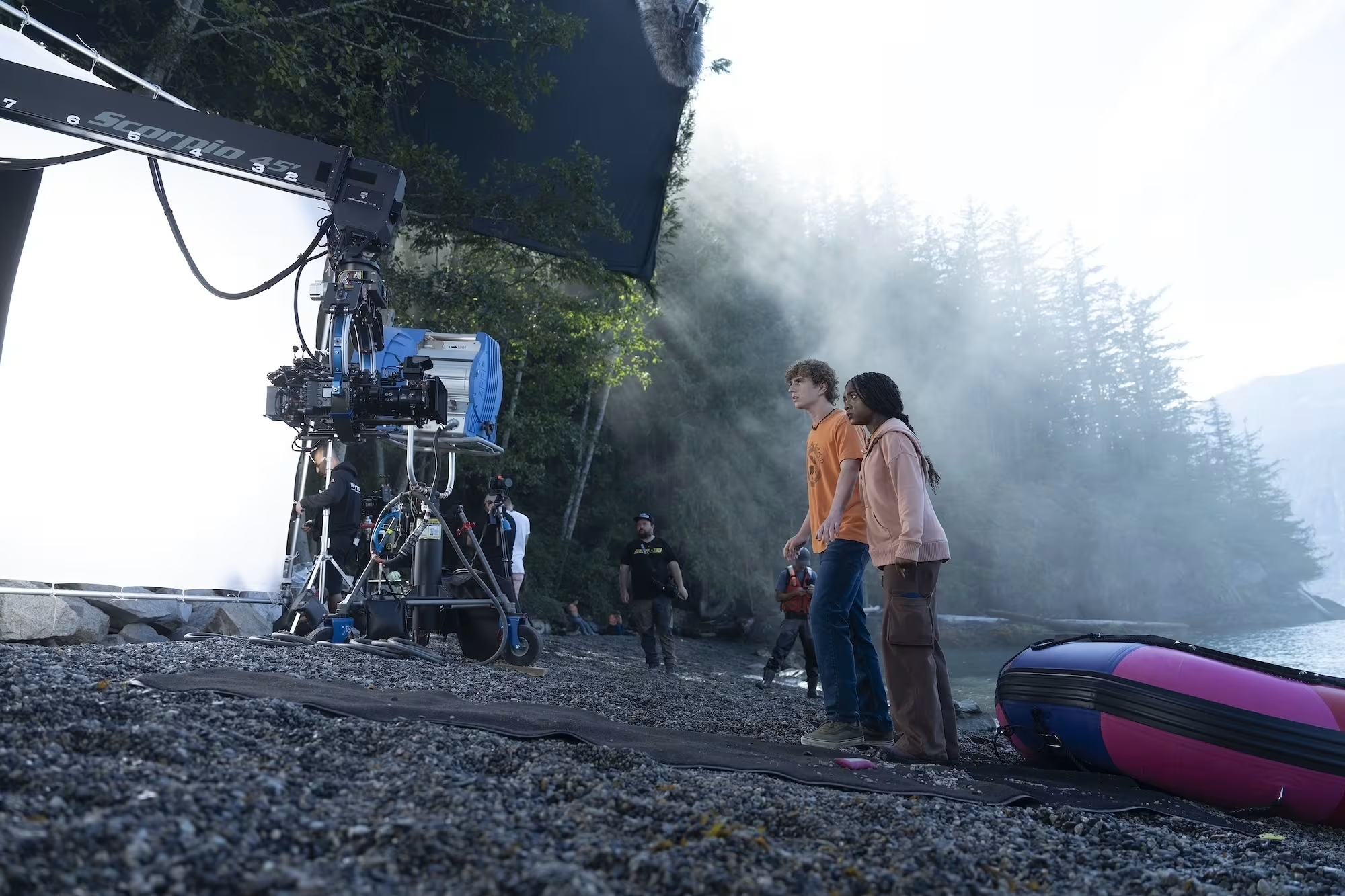
The local team’s job is to turn a script’s location list into a working shoot plan and hold it through delivery. That means sourcing and securing locations, running the permit applications with the right authority for each site, booking local crew from the Nu Boyana pool and the regional layers, moving equipment in and out under the correct customs procedure, and coordinating the rebate documentation for the eligible Bulgarian applicant from prep to wrap. The line producer in Bulgaria holds the money and the schedule; the fixing team coordinates permit applications and site access in each zone, with the approvals themselves issued by the relevant authorities and operators.
Bulgaria offers range within short drives. As office planning estimates subject to route, traffic, weather and seasonal access, Sofia and its studio base sit about two hours from Plovdiv’s heritage core, roughly three from the Bansko ski slopes and the Rila and Pirin high country, and about five from the Black Sea coast. For line production in Bulgaria, a multi-zone brief can therefore run from one production base with overnight crew moves rather than standing up separate units, which suits cost-sensitive features and series.
Sofia and Nu Boyana Studios
Sofia is the principal production base for many international shoots landing in Bulgaria. Nu Boyana Film Studios on the western edge of the city anchors the studio-led work, the central urban core supplies the location work, and the equipment houses, post facilities and crew accommodation all sit within roughly a thirty-minute operational radius as an office planning estimate.

Nu Boyana Studios and Production Infrastructure
Nu Boyana holds multiple feature-grade soundstages, extensive backlot for period and contemporary exteriors, a costume and props inventory built across two decades of productions, and a resident crew pool that supports feature-unit work, with specialist positions confirmed against each production’s requirements. Its water facility is, in the studio’s own description, one of the biggest and most modern water tanks in Europe (Nu Boyana). For studio-anchored work, the line production company in Bulgaria coordinates customs with the appointed broker, while Nu Boyana provides the stages, workshops and unit-base infrastructure on site, so a foreign producer can run a large share of prep through one facility. Outside the studio, Sofia’s rental houses, camera and lighting vendors, and colour and sound post facilities carry the commercial, television and smaller-unit work, which keeps the crew and equipment base busy between features.

Sofia Location Registers
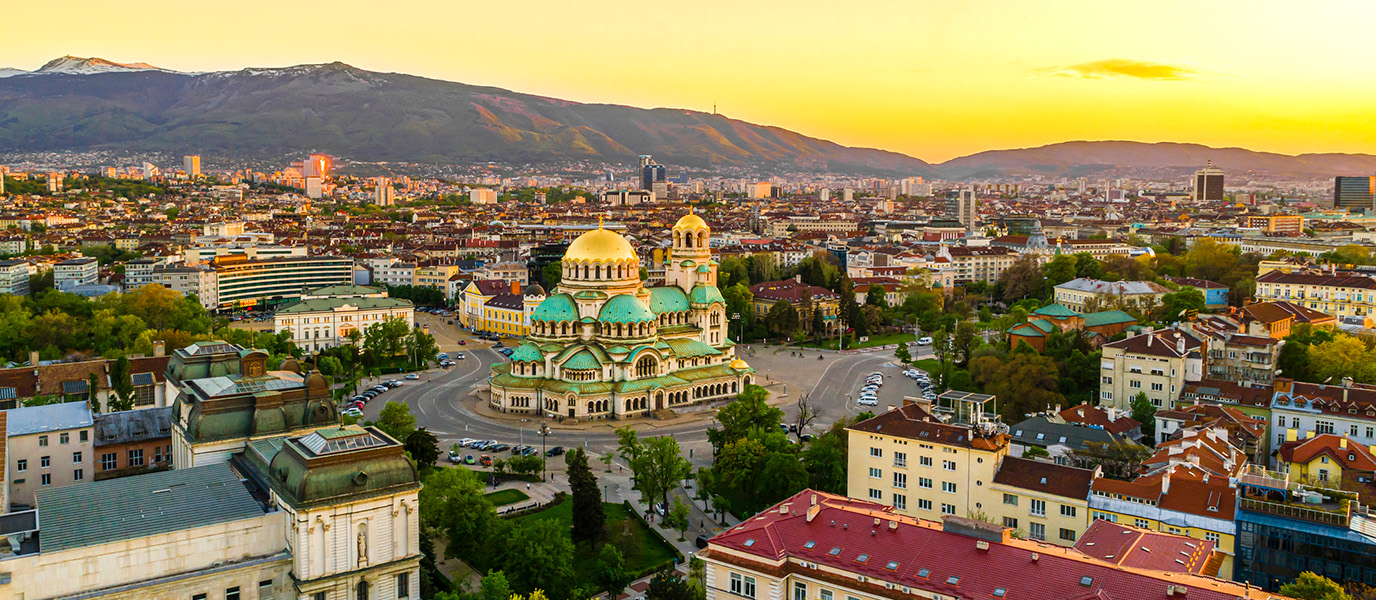
Sofia’s own location register splits across distinct visual bands. Soviet-era architecture, from the Largo to the National Palace of Culture surroundings and the residential Mladost and Lyulin districts, supplies the Eastern-European Cold-War backdrop. Orthodox heritage runs through the Alexander Nevsky Cathedral, the UNESCO-listed Boyana Church and the smaller central churches. Vitosha mountain on the southern flank supplies a natural-environment band without leaving the city, and the Vitosha Boulevard commercial core covers a generic contemporary European look at lower cost than Western capitals.

Plovdiv: Roman Heritage, Historic Old Town and Bulgarian Revival Architecture
Plovdiv is one of Europe’s oldest continuously inhabited cities and Bulgaria’s heritage anchor for international productions. The Ancient Theatre of Philippopolis on the Three Hills, the historic old town with its Bulgarian Revival-period architecture, and the contemporary Kapana creative quarter give the city three distinct visual bands within roughly a ten-minute radius as an office planning estimate. Ancient Plovdiv sits on Bulgaria’s UNESCO Tentative List rather than the World Heritage List, so it is a candidate site, not an inscribed one (UNESCO Tentative List entry).

Ancient Theatre and Heritage Permissions
The Ancient Theatre of Philippopolis, a Roman theatre still in active use as a performance venue, is one of the more accessible Roman-period filming locations in Europe. Permit applications are coordinated with Plovdiv Municipality and the Ministry of Culture cultural-heritage layer, which issue the approvals, with lead times that vary by season and the venue’s own event calendar. Surrounding Roman remains, the stadium under Stamboliyski Square, the eastern gate and the small theatre at the foot of Nebet Tepe, extend the antiquity band, with access and approval requirements confirmed for each site in the final location list.

The old town climbs the western slope of the Three Hills and holds the 19th-century Bulgarian Revival architecture that productions targeting Ottoman-era Balkan or post-Ottoman settings work to. Narrow cobbled streets, painted merchant houses and the Ethnographic Museum surrounds hold a period density few European cities supply in a single walkable district, and its architectural depth lets production design dress it for a range of European heritage settings. Permits route through Plovdiv Municipality with a heritage-zone layer on the most protected streets. Outside the core, the Kapana district and the Maritsa river corridor cover the contemporary-Bulgaria look at typically lower cost than Sofia, making Plovdiv a viable secondary base rather than a day-trip location.
Bansko, Rila and Pirin
South-west Bulgaria carries the alpine and Orthodox-monastery settings. Bansko on the eastern slope of Pirin holds the ski-resort and winter-sports band, the Rila Mountains to the north hold the Rila Monastery and the high-altitude register, and Pirin National Park supplies protected high-mountain terrain for productions needing untouched landscape. Film fixer Bulgaria work in this zone runs through municipal, national-park and monastery permissions rather than a single office.

Bansko sits at 925 metres with a ski area rising to about 2,560 metres and a season running roughly December to April. Its centre carries an authentic Bulgarian Revival core alongside contemporary resort development on the lower slopes, delivering winter-sports and alpine-village looks at typically lower cost than the Alps. Permits route through Bansko Municipality plus the Pirin National Park authority for protected-zone work, while the resort operators handle the ski-area filming chain through their own coordinators.
Rila Monastery, north of Bansko, is the largest Eastern Orthodox monastery in Bulgaria and a UNESCO World Heritage Site. Its church frescoes, fortified walls and forest-and-mountain surrounds supply the Orthodox heritage register at scale, though filming requires agreement with the monastery administration and any applicable cultural-heritage authorities, while the schedule must work around services, pilgrimages and the resident monastic community. Pirin National Park, also UNESCO-inscribed for its natural significance, holds glacial lakes, marble peaks and old-growth forest; filming there needs National Park and environmental permission, and drone work carries separate restrictions.

Varna, Burgas, Sozopol and the Black Sea
Bulgaria’s Black Sea coastline runs roughly 380 kilometres from the Romanian to the Turkish border, with three working production bases. Varna in the north carries a major commercial port and a secondary studio-resource layer; Burgas in the south anchors coastal access; Sozopol and the Nessebar heritage zone deliver the coast’s heritage visual character. Together the coast supplies Soviet-era resort, contemporary beach, fishing-village and maritime bands.
Varna Production Base
Varna, Bulgaria’s third city, supplies the northern production base. The Roman thermae ruins in the old town, the seafront Sea Garden and the resort developments at Golden Sands and Albena cover heritage, urban and resort bands within roughly a thirty-minute radius as an office planning estimate, and Varna airport handles direct flights for crew rotation.
Burgas, Sozopol and Nessebar
To the south, Sozopol’s peninsular old town, Nessebar and the Sunny Beach strip cover the coastal band at depth. Nessebar’s old town is a UNESCO World Heritage Site, its medieval Byzantine church ruins and Revival-period houses forming a distinct heritage zone on the coast; permit applications are coordinated with Nessebar Municipality and the applicable cultural-heritage authorities. Burgas anchors the southern base and carries the equipment, accommodation and crew infrastructure for the lower coast; as office planning estimates subject to route, traffic, weather and seasonal access, it is roughly a four-hour drive from Sofia or a short flight, with Nessebar about 35 minutes away and about 90 from Varna, so a coastal block can run from either end of the shore.

The coast is where a lot of location substitution happens: the resort strips stand in for other Eastern European beach settings, Sozopol’s old town as a stand-in for Mediterranean fishing villages, and the Kaliakra cliffs for Black Sea maritime work. Where a brief is really a stand-in exercise rather than a Bulgaria-specific shoot, our filming in Europe stand-in registers guide covers how these choices compare across the region before a base is fixed.
Permits, crew and temporary equipment import
There is no single national film authority that issues Bulgarian filming permits, and no single EU filming permit either. Responsibility sits with whoever controls the specific requirement: the Bulgarian National Film Center handles incentive administration and project registration; Sofia Municipality and the relevant district authorities handle public-space use; property owners or operators control individual locations; cultural-heritage authorities govern protected monuments; and park administrations and environmental bodies govern protected landscapes. A film fixer in Bulgaria opens the right track with each of these rather than routing everything through one office.
Sofia Filming Permits: Municipal, District and Location Approvals
Permits for Sofia locations run through Sofia Municipality and the relevant district authorities for public space, with property owners or site operators for individual venues and the cultural-heritage authorities for protected monuments such as the Boyana Church. Lead times vary by the type of location and how much public space and traffic a shoot affects, so the practical approach for film fixers in Bulgaria is to open each track early and confirm the current turnaround for the specific location list rather than assume a fixed window.
Crew, EU free movement and Schengen
EU-national crew benefit from EU free-movement rights and from Bulgaria’s full participation in the Schengen Area, which it joined on 1 January 2025 (European Commission). Schengen governs border movement rather than the right to work, so the mobility and employment position for EU nationals comes from EU free-movement rules. Requirements for non-EU personnel must be confirmed by nationality, residence status, role and duration before travel. The working crew base is drawn from the Nu Boyana pool and the regional layers in Plovdiv, Varna and the coast.
Temporary equipment import
Equipment arriving from outside the EU may enter under an ATA Carnet or another applicable temporary-admission procedure. The Bulgarian customs broker should confirm the entry point, security requirements, representation documents and re-export process before dispatch. EU-to-Bulgaria movements generally do not require a Carnet, but customs, ownership and VAT treatment still depend on the equipment’s status. Drone equipment is handled separately: Bulgaria applies the EU open, specific and certified categories, so some open-category operations need no prior authorisation from the Civil Aviation Administration while specific-category operations do, and location or restricted-airspace approvals can sit alongside that (Bulgarian Civil Aviation Administration).
Bulgaria’s EU membership changes the customs and VAT treatment of a multi-country schedule. Equipment moving between EU members is treated as internal-EU movement rather than a Carnet leg, VAT treatment depends on the contracting entity, production structure and qualifying expenditure and should be modelled with the Bulgarian applicant and tax adviser, and a project that qualifies as a co-production under the European Convention on Cinematographic Co-production can open routes beyond a pure service shoot. Each of these depends on how the production is structured and should be confirmed case by case.
Budget planning, the NFC incentive and seasonal scheduling

Bulgaria’s cost position is benchmarked against Western European capitals: crew day rates, equipment rental and unit-base spend are typically lower on equivalent specifications, with the gap narrowing on the most senior international-grade roles that draw from the same global pool. On finishing, Bulgaria carries established colour, sound and post-production capacity, while specialist VFX supervision and final finishing should be quoted against the creative and delivery requirements of the individual project. Producers pricing East against West often set Bulgaria beside our film fixers in Portugal coverage, since the two offer different cost economics and a different register for a European base.
Bulgaria’s 25% NFC Cash Rebate: Eligibility at a Glance
Bulgaria’s national incentive, administered by the Bulgarian National Film Center, reimburses 25% of eligible Bulgarian expenditure, subject to eligibility, project registration and the published procedure (Bulgarian National Film Center scheme). An eligible Bulgarian applicant registers each project and holds and submits the incentive claim, with the line producer Bulgaria team coordinating the supporting documentation, so the rebate is arranged per production rather than through any permanent standing. It is paid after the shoot against audited spend rather than as a front-loaded credit, which matters for the cash-flow plan, and the current thresholds, eligible cost categories and timing should be confirmed against the live NFC procedure at scoping stage.
Seasonal scheduling across the zones
Bulgaria runs a seasonal calendar that shapes access, accommodation and safety planning. Winter, roughly December to March, is when the Bansko and Pirin alpine work is scheduled; snow cover and mountain road access are checked against the shoot dates, with winter-preparedness and snow-day buffers built into the plan. Spring weather is variable, so clear-sky exteriors carry weather buffers or move to late spring or autumn. Summer is the main Black Sea window, when beach and resort permits are in higher demand, accommodation rates rise, crowd density at Sunny Beach and Sozopol affects controlled shoots, and heat planning covers working hours and crew welfare. Autumn, roughly September to October, generally brings lighter tourist load, but weather and municipal and ministry availability are confirmed for the specific dates. The seasonal calendar is built into the shoot plan at scoping stage so each zone is scheduled against its weather, access and permit-availability conditions.
To scope a Bulgaria shoot, the useful starting point is the location list, the shoot dates and the expected crew size, from which the line producer Bulgaria team coordinates the rebate documentation with the eligible Bulgarian applicant, Nu Boyana availability where the work is studio-anchored, the permit timeline across zones, the crew plan, equipment import and a budget range against equivalent European options.
