

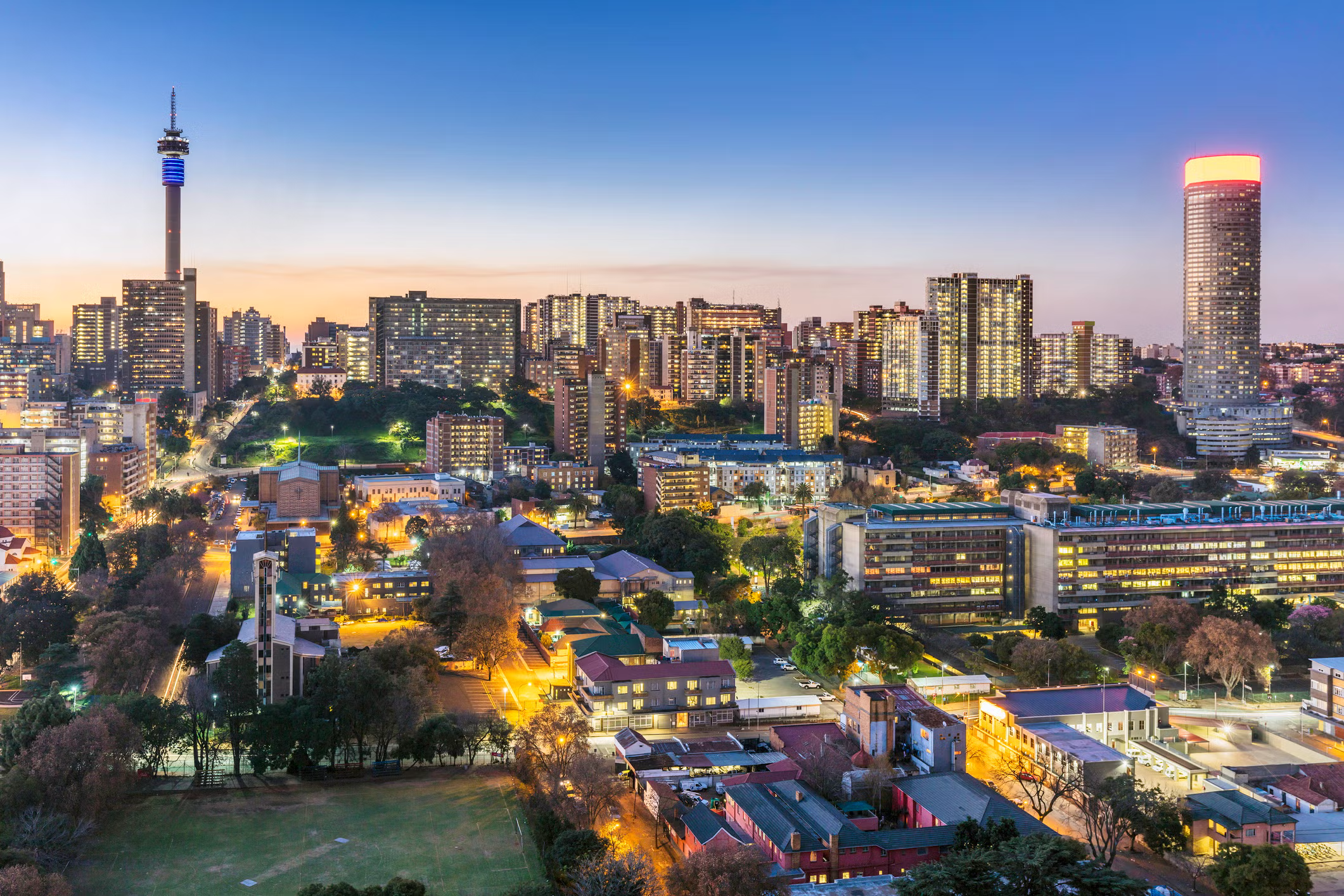
Joburg is the second anchor of the South African production economy and the ad-film capital of Africa. Gauteng province carries the largest contemporary urban location set on the continent, with the Sandton CBD financial-urban register, the Joburg downtown grid stretching from Carlton Centre through Newtown to Maboneng, the regenerated cultural quarters and the Soweto township anchoring the social-realism feature register. Pretoria, 50 kilometres north, adds the Union Buildings administrative-capital architecture and the Voortrekker Monument heritage scale. The Cradle of Humankind, the Magaliesberg range and Hartbeespoort Dam round out the Gauteng day-trip locations within 90 minutes of the OR Tambo gateway.
Film fixers in Joburg and the line producer Joburg network handle Gauteng Film Commission applications, City of Johannesburg film permits, City of Tshwane (Pretoria) film office coordination, SAPS road-closure and crowd-management permits, ATA Carnet at OR Tambo International Airport (JNB), and the multi-zone scheduling that moves a single schedule between Sandton, the CBD, Soweto and Pretoria. The Joburg production layer sits inside our line producer in South Africa network alongside Line Producer Cape Town, Karoo, Cape Winelands and Film Fixers In Durban-KwaZulu-Natal coverage.
Joburg’s role in the international production economy is structural. District 9 (2009), Neill Blomkamp’s BAFTA-winning feature, used Soweto as the alien-quarter location. Tsotsi (2005) won the Academy Award for Best Foreign Language Film with its Sophiatown-set story. Invictus (2009), Clint Eastwood’s Mandela film starring Morgan Freeman and Matt Damon, used Ellis Park rugby stadium, Soweto and the Pretoria Union Buildings. Long Walk to Freedom (2013) starring Idris Elba ran multi-zone Gauteng production. Atlas (2024), Brad Peyton’s Jennifer Lopez Netflix sci-fi feature, shot extensively across Johannesburg using local studio and crew infrastructure. Netflix originals Queen Sono and Shadow continue the contemporary streaming pipeline.
How Joburg’s production layer operates
Joburg’s production economy runs on the largest commercial volume in Africa. The Gauteng Film Commission services the provincial permit framework. The City of Johannesburg film office handles municipal permits across the Joburg metropolitan area. The City of Tshwane film office covers Pretoria. OR Tambo International Airport (JNB) is Africa’s busiest aviation hub, anchoring crew and equipment arrival from London, Frankfurt, Amsterdam, Dubai, Atlanta, Mumbai, Lagos and the regional African network. The Joburg crew bench services ad-film, feature, OTT and commercial work simultaneously, with the largest ad-film volume on the continent.
Joburg fixers, OR Tambo SARS customs film team and Gauteng Film Commission single-window
Joburg fixers carry one operational advantage that no other South African city offers: OR Tambo International Airport hosts the largest SARS customs film team on the African continent, with dedicated film-cargo officers who handle ATA Carnet routing, equipment temporary-import bonds and crew-baggage clearance for productions arriving from anywhere on the global air-freight network. A production routing through OR Tambo with a clean ATA Carnet typically clears customs in a single working day, which is materially faster than the equivalent process at any other Sub-Saharan port. The Joburg fixer’s first call on any inbound production is the SARS film desk, not the location office.
The Joburg authority stack the fixer holds is calibrated to the city’s commercial-production rhythm. Gauteng Film Commission acts as the single-window coordinating layer above the City of Johannesburg, the City of Tshwane (Pretoria) and the Ekurhuleni metro film offices, with the Commission running fast-track coordination for ad-film and series work that needs same-week turnaround. SAPS metro liaison handles street closures, crowd management and the celebrity-security overlays that are routine on Joburg commercial shoots. Cradle of Humankind, Magaliesberg and the Gauteng day-trip locations sit under the Gauteng Provincial Government heritage and environment portfolios, with the fixer carrying the parallel coordination for any one-day breakout from Joburg metro.
The Joburg crew bench is the largest in South Africa by ad-film and short-form commercial volume, with the city carrying credits on productions directed by Neill Blomkamp, Clint Eastwood, Gavin Hood, Justin Chadwick, Brad Peyton, Ralph Ziman and Anthony Fabian. A film fixer in Joburg carrying credits across this volume typically holds standing relationships with the senior crew positions across both the ad-film and the feature side of the city’s working bench. The bench depth lets a Joburg fixer source most crew positions locally, with HOD supplements from Cape Town or international rotation reserved for the senior creative slots on feature work.
Joburg FFTIP-applicant structuring through a Gauteng production service company for ad-film and feature scale
Joburg’s FFTIP economics are shaped by the city’s dominant commercial-production volume rather than feature-led structuring. The Gauteng production service company sits at the centre of a high-throughput pipeline: where Cape Town’s accredited PSCs concentrate on a handful of large foreign features each year, Joburg PSCs process a larger number of FFTIP filings at smaller per-project quantum, driven by the ad-film and short-form commercial production volume that runs continuously through the city. That difference matters for foreign producers weighing where to base their applicant entity, because the audit relationships, dtic interaction cadence and SARS interface on the Joburg side are calibrated for higher filing volume.
For feature work above the R30M local-spend threshold, the Joburg production service company structure separates the line-producer financial-responsibility role from the FFTIP-applicant audit-bearing role, with the PSC carrying the rebate-claim filing and the line producer holding day-to-day vendor contracting. For the ad-film and short-form commercial work that fills most of Joburg’s calendar, a single Gauteng production service company often runs both functions, with the streamlined applicant-and-line-producer model fitting the faster commercial-production turnaround the city is known for. The Joburg-Pretoria axis adds City of Tshwane jurisdiction to the Gauteng FFTIP-applicant operational picture, which is relevant for any production that uses Union Buildings or the wider administrative-capital location set.
OR Tambo International Airport, the African aviation gateway
OR Tambo International Airport (JNB) is the busiest airport in Africa by passenger volume and the primary international gateway into the southern African production economy. SAA, British Airways, Lufthansa, KLM, Emirates, Qatar, Ethiopian, Kenya Airways, Air France, Delta and the major intercontinental carriers serve OR Tambo with daily long-haul connections to Europe, the Middle East, Asia and North America. The two-hour domestic shuttle to Cape Town International Airport (CPT) and the regional African network (Nairobi, Lagos, Accra, Maputo, Windhoek, Gaborone, Lusaka) make Joburg the natural staging base for any multi-country sub-Saharan brief. ATA Carnet processing for incoming production equipment runs through SARS customs at OR Tambo with the largest customs film team in Africa supporting daily-rate carnet clearance.

Joburg’s production zones, Sandton, CBD, Soweto, Pretoria and the day-trip locations
Joburg’s filming geography clusters around four metropolitan zones plus a day-trip-locations envelope. Sandton anchors the contemporary financial-urban register and the modern African metropolitan look. The Joburg CBD carries the regenerated cultural quarters, the heritage architecture and the working downtown grid. Soweto delivers the township and social-realism feature register that defined a generation of South African cinema. Pretoria sits 50 kilometres north and carries the administrative-capital architecture. The Cradle of Humankind, the Magaliesberg range, Hartbeespoort Dam, Walkersons in the Dullstroom highlands and the wider Mpumalanga adjacency form the day-trip envelope within 90 minutes to 3 hours of the OR Tambo gateway.
Sandton CBD and the contemporary financial-urban register
Sandton is the financial centre of Johannesburg and supplies the modern African metropolitan look that international productions reach for when the script wants Africa-without-the-bush. The Sandton CBD glass-and-steel skyline, Nelson Mandela Square, the Michelangelo and Da Vinci towers and the Sandton City retail precinct anchor the contemporary-luxury register. Brand commercial work, automotive launches and high-end corporate production route through Sandton at the highest volume of any African business district. The Sandton precinct sits 25 minutes from OR Tambo on the M1 highway and 35 minutes from Joburg CBD on the Gautrain.

Joburg CBD, Maboneng and Newtown, the regenerated cultural quarters
The Joburg CBD carries the heritage downtown register that anchored the city through the gold-mining boom and the apartheid years. The Carlton Centre, Johannesburg’s tallest building, dominates the southern skyline. The Colosseum Theatre and the Diagonal Street financial district run the heritage-cinema and art-deco architecture register. Maboneng, the regenerated arts-and-loft precinct east of the CBD, supplies the gentrified-creative-quarter look that has anchored Netflix originals, premium commercial work and feature production over the past decade. Newtown carries the cultural-precinct register with the Market Theatre and the Constitution Hill historical site. Braamfontein, immediately north of the CBD, anchors the university-and-young-professional contemporary urban look. The CBD permit framework runs through the City of Johannesburg film office with statutory turnaround 7 to 14 working days for non-restricted locations.

Soweto and the township feature register, District 9, Tsotsi, Invictus
Soweto is the most internationally recognised township in Africa and carries the feature-film register that has defined South African cinema across two decades. Neill Blomkamp’s District 9 (2009) used the township as the alien-quarter location in one of the most internationally seen South African productions of the past 25 years. Tsotsi (2005), directed by Gavin Hood and set in Sophiatown, won the Academy Award for Best Foreign Language Film. Drum (2004) anchored the 1950s Sophiatown jazz-era feature register. Invictus (2009) used the Vilakazi Street precinct, where both Nelson Mandela and Desmond Tutu lived, alongside Ellis Park rugby stadium and the Pretoria Union Buildings. Soweto filming runs through the City of Johannesburg film office with additional community-coordination protocols managed by the relevant ward councillor and the Soweto Tourism Association for any larger shoot inside the residential precincts.

Pretoria, Union Buildings and the administrative-capital register
Pretoria sits 50 kilometres north of Joburg CBD via the N1 highway and 60 kilometres from Sandton via the Ben Schoeman highway. The Union Buildings, designed by Sir Herbert Baker, are the administrative seat of the South African government and the most internationally recognised South African government building. Invictus used the Union Buildings for the Nelson Mandela inauguration sequence. The Voortrekker Monument carries the heritage-scale architecture for period and historical work. Church Square, the Palace of Justice and the Pretoria CBD anchor the colonial-period and contemporary-government register. The City of Tshwane film office handles Pretoria permits with statutory turnaround 7 to 14 working days. Pretoria offers a notably different urban register from Joburg, more colonial-period in architecture and less commercial in operational orientation.

Cradle of Humankind, Magaliesberg and the Gauteng day-trip locations
The Cradle of Humankind sits 50 kilometres north-west of Johannesburg CBD and carries the UNESCO World Heritage paleontological register, with Maropeng visitor centre and the Sterkfontein Caves anchoring the human-origins narrative. Documentary, science-feature and ad-film work tied to evolution and paleontology routes through the Cradle by default. The Magaliesberg range runs north of Joburg and supplies a low-mountain register with traditional Tswana cultural backing. Hartbeespoort Dam, 60 kilometres north-west of Sandton, delivers the contained-water and dam-wall register for productions needing dam or lake coverage near a major metropolitan base. Walkersons in the Dullstroom highlands, 3 hours east of Joburg in Mpumalanga, supplies trout streams, indigenous forest and waterfall registers for productions extending beyond Gauteng proper.

Permits, Gauteng Film Commission and the FFTIP framework
Joburg’s permit framework runs through three coordinating layers. The Gauteng Film Commission anchors the provincial framework. The City of Johannesburg film office handles municipal permits across the Joburg metropolitan area. The City of Tshwane film office covers Pretoria. Restricted-location permits (Union Buildings, Constitution Hill, the Apartheid Museum, the Cradle of Humankind UNESCO zones) stack additional clearance requirements on top.

Gauteng Film Commission and the City film offices
The Gauteng Film Commission anchors the provincial film framework and coordinates with the dtic on FFTIP rebate routing for Gauteng-based productions. The City of Johannesburg film office processes municipal permits across the Joburg metropolitan area including Sandton, the CBD, Soweto, Roodepoort, Randburg and Alexandra. The City of Tshwane film office covers Pretoria and the wider Tshwane metropolitan jurisdiction. Standard permit pipeline runs 7 to 14 working days for non-restricted locations and 14 to 21 working days where SAPS road-closure coordination, restricted-area access or community consultation stack on top. Soweto residential filming requires community consultation that adds 5 to 10 working days to the standard pipeline.
FFTIP rebate filing via a Joburg production service company
FFTIP rebate filing for Joburg-based shoots routes through a South African-registered production service company. The 20% cashback applies on Qualifying South African Production Expenditure (QSAPE), with a 5% BEE uplift taking the headline rate to 25% when the production service company is at least 51% Black-owned per the Broad-Based Black Economic Empowerment codes. Joburg production service companies handle the largest share of FFTIP filings nationally given the city’s commercial and ad-film volume. Disbursement runs staged at 25% first principal photography milestone, 50% mid-production audit, 25% final audit certificate. The line producer in Joburg flags the rebate eligibility check at the briefing stage so the production budget reflects the post-rebate net cost.
ATA Carnet at OR Tambo and the SARS customs film team
ATA Carnet processing for Joburg shoots runs through SARS customs at OR Tambo International Airport, the largest customs film team in Africa. Most international productions originate the carnet through their home-country chamber of commerce and have the carnet stamped on first entry at OR Tambo. The carnet covers cameras, lenses, grip and lighting, audio gear and broadcast packages for up to 12 months. Re-export validation at OR Tambo on exit closes the carnet without bond release. The OR Tambo customs film team’s daily-rate clearance capacity is the operational reason Joburg works as the regional staging base for sub-Saharan multi-country productions, with same-day or next-day carnet clearance the standard.
Joburg as the gateway to Southern Africa
Joburg’s strategic role on the African continent extends well beyond Gauteng’s own production volume. OR Tambo International Airport is the logistical hub for any multi-country Southern African brief, with daily direct flights into the surrounding regional production economies and the largest customs film team on the continent supporting cross-border equipment routing. A production that crosses South Africa with Botswana, Zimbabwe, Mozambique, Zambia or Namibia routinely uses Joburg as the staging base, the crew assembly point, the post-production endpoint and the FFTIP-eligible portion of the larger schedule.
Botswana productions covering the Okavango Delta, the Makgadikgadi Pans or Chobe National Park typically route equipment and HOD bench through Joburg, with the Maun connection via Gaborone running daily and the road crossing at Pioneer or Ramatlabama supporting trucked equipment under ATA Carnet cross-bond. Zimbabwe productions covering Victoria Falls or Mana Pools route via the Beitbridge border crossing or by air through Harare, with Joburg as the southern staging base. A film fixer in Mozambique works in coordination with the Joburg crew bench for any production that touches both territories, with the Komatipoort border crossing running under four to six hours for ATA Carnet cross-bonds and the Maputo flight at 50 minutes from OR Tambo.
Zambia productions covering Victoria Falls’ Zambian side or the Lower Zambezi route via Lusaka with Joburg as the standard staging hub. Namibia, the country whose Skeleton Coast and Sossusvlei dunes anchor a significant share of Southern African desert-feature work, runs equipment routing via Joburg’s road or air corridor at the Trans-Kalahari Highway or the Windhoek connection. The Joburg-anchored Southern African production framework scales beyond these adjacent countries to East Africa (Kenya, Tanzania) and to West Africa (Lagos, Accra) through the OR Tambo air-freight network, with Joburg serving as the originating crew and HOD assembly base even when no equipment crosses South African soil twice.
Engaging a line producer in Joburg
Most Joburg schedules become workable or unworkable at the briefing stage. The variables that matter are which zones the script implies, whether Sandton-Pretoria-Soweto multi-zone scheduling is needed, City of Johannesburg and City of Tshwane permit lead times against the shoot start date, Cradle of Humankind UNESCO access where the Maropeng or Sterkfontein sequences sit, Soweto community-coordination lead times, FFTIP eligibility and rebate filing path, ATA Carnet origin port, Section 11(2) visa stack by nationality, and the Joburg-Cape Town corridor logistics when the schedule extends to Cape Town Film Studios.
Joburg as the ad-film capital of Africa
Joburg carries the largest commercial-production volume on the African continent. The city’s ad-film economy services automotive launches, FMCG campaigns, telco brand work, financial-services commercial volume, fashion, sports and lifestyle production at international standard. Production companies, post houses, equipment rental and the specialist craft crew base service simultaneous commercial production at a scale Cape Town does not match. The Sandton commercial economy, the financial-services HQ concentration and the African continental brand-marketing footprint all anchor the Joburg ad-film volume. Brands choosing between Cape Town and Joburg for commercial production typically pick Joburg when the brief is contemporary-African, financial-services, automotive launch or commercial-volume rather than coastal-aspirational or California-stand-in.
The Joburg-Cape Town corridor and multi-zone scheduling
The pairing model on a Joburg shoot runs as a regional production head holding the contract, the schedule, the budget and the FFTIP rebate filing, with a line producer in Joburg owning day-to-day execution across the Gauteng Film Commission, City of Johannesburg, City of Tshwane, Soweto community coordination and SAPS road-closure layer. The Joburg-Cape Town two-hour shuttle supports multi-anchor productions covering both cities inside a single rebate filing. Equipment routed from OR Tambo to Cape Town runs under domestic carrier or trucked transfer without re-clearing customs, provided ATA Carnet documentation remains valid for the full schedule. Film fixers below the line producer layer handle sub-zone access, including Sandton commercial precinct coordination, Soweto residential community engagement, Pretoria Union Buildings clearance and the Cradle of Humankind UNESCO protocols.
Joburg’s structural advantage on the international production economy is the combination of the largest African aviation hub at OR Tambo, the largest commercial-production volume on the continent, the deepest contemporary-urban location set in Africa, the city’s history-anchored township feature register through Soweto, and the Pretoria administrative-capital architecture, all sitting inside the same FFTIP rebate framework that Cape Town anchors. The Joburg shoot scales from one-camera commercial through to multi-zone international feature production without architectural compromise. For how Johannesburg compares with other African bases on permits, crew and cost, see our filming in Africa guide.
