

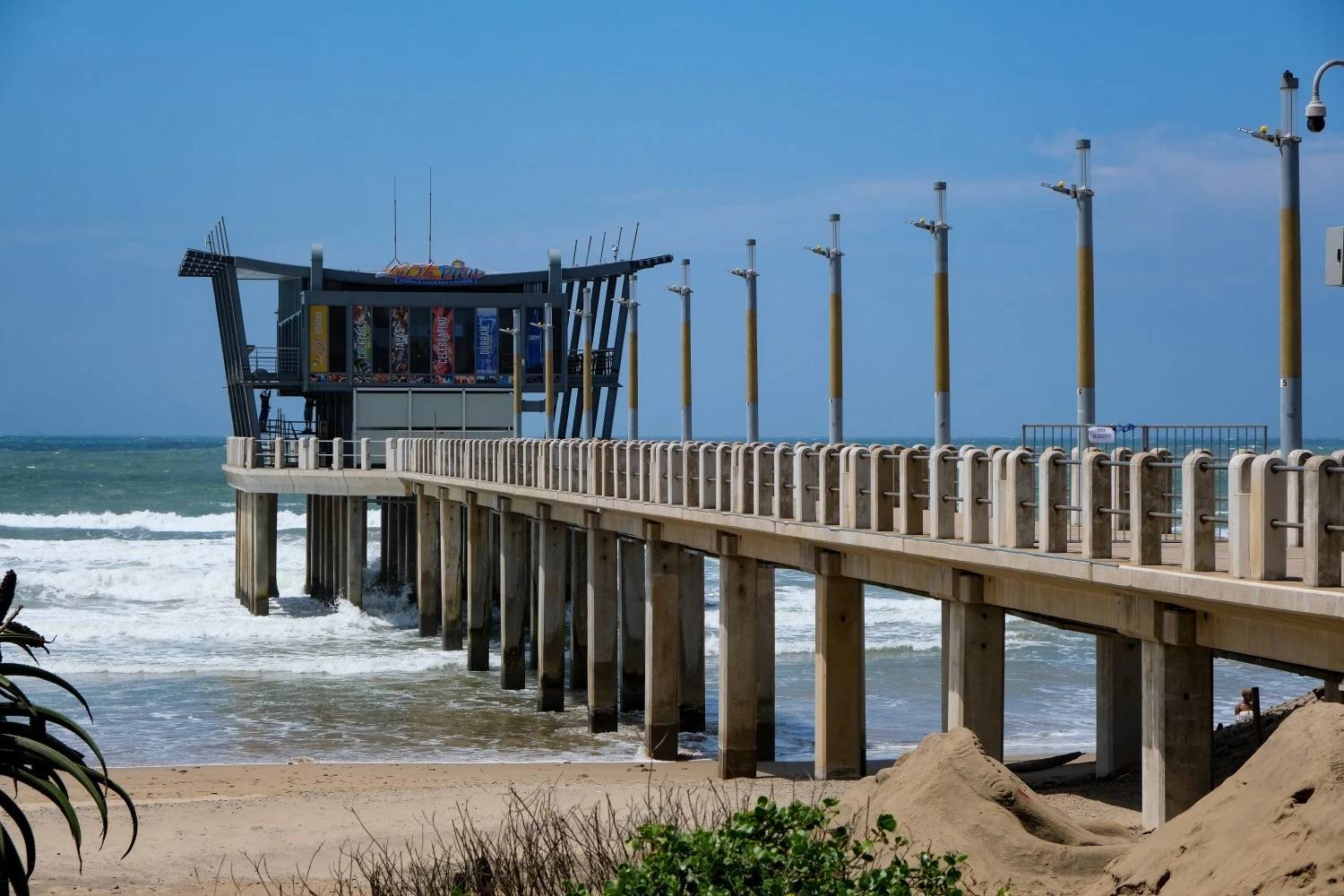
Durban is the third anchor of the South African production economy and the warm-water Indian Ocean counterweight to Cape Town’s Atlantic register. KwaZulu-Natal province carries the southern hemisphere’s most distinctive subtropical-coast and Drakensberg-mountain combination, with the Sugar Coast running north from Umhlanga through Ballito to the Dolphin Coast, the Durban Golden Mile beachfront anchoring the city itself, and the South Coast extending toward Margate and the Wild Coast border. Inland, the uKhahlamba Drakensberg UNESCO World Heritage range delivers the Tolkien-esque high-mountain register. Zululand carries the cultural heritage and Anglo-Zulu Battlefields. iSimangaliso Wetland Park UNESCO at St Lucia anchors the wildlife-and-wetland register.
Film fixers in Durban and the line producer Durban network handle KwaZulu-Natal Film Commission applications, Durban Film Office permits, Ezemvelo KZN Wildlife clearances for game reserve and wetland work, SAPS road-closure coordination, ATA Carnet at Durban port and King Shaka International Airport (DUR), and the multi-zone scheduling that moves a single schedule between the city, the Sugar Coast, the Drakensberg interior and Zululand. The Durban production layer sits inside our South Africa production support network alongside Film Fixers In Cape Town, Film Fixers In Johannesburg, Karoo and Cape Winelands coverage.
Durban’s role in the international production economy is structural. Yesterday (2004), Darrell Roodt’s Zulu-language feature, became the first South African film nominated for the Academy Award for Best Foreign Language Film with its KwaZulu-Natal-set story. The Durban International Film Festival (DIFF), founded in 1979, is Africa’s longest-running film festival and anchors the continental industry calendar. The Durban FilmMart Institute runs alongside DIFF as Africa’s premier co-production market for pitching, financing and distribution deals. Race 3 (2018), the Salman Khan Bollywood feature, shot KZN coastal and inland sequences. Five Fingers for Marseilles (2017) and a steady stream of Netflix originals continue the KZN production pipeline.
How Durban’s production layer operates
Durban’s production economy runs on the third-largest crew bench in South Africa after Cape Town and Joburg. The KwaZulu-Natal Film Commission (KZNFC) anchors the provincial framework. The Durban Film Office handles municipal permits across the eThekwini metropolitan area. King Shaka International Airport (DUR), 35 kilometres north of the city, runs as the regional aviation hub with direct international connections to Dubai, Doha, Istanbul and the regional African network. Durban port, South Africa’s busiest container facility, anchors ATA Carnet equipment routing for productions arriving by sea.
Durban fixers, KZN Film Commission single-window and the Indian Ocean Bollywood corridor
Durban fixers carry one operational advantage no other South African city offers: the Mumbai-Durban Bollywood production corridor has run continuously since the 1990s, with Hindi-language features routinely using Durban as the Indian Ocean coast stand-in. A film fixer in Durban working the Bollywood side carries standing relationships with the Indian production-services layer, customs officers familiar with cargo arriving from Mumbai International Airport, and crew bench depth that includes Hindi-speaking key positions when the brief requires them. That corridor identity is distinct from the European-feature orientation of Cape Town or the ad-film density of Joburg.
The Durban authority stack the fixer holds covers the dual coast-and-interior reality: KZN Film Commission acts as the provincial coordinating single-window with the Durban Film Office as the eThekwini metro layer, Ezemvelo KZN Wildlife governs game reserve and wetland park access including iSimangaliso and Hluhluwe-iMfolozi, Amafa KwaZulu-Natali handles the Battlefields cultural-heritage and Zulu Royal sites, SANParks oversees Drakensberg uKhahlamba UNESCO access, and King Shaka International Airport carries the SARS customs film desk for ATA Carnet cargo. That is five separate authority relationships on a typical KZN shoot, with the warm-water coastline and the high-altitude interior often filmed in the same schedule.
Durban crews have shaped international films across the KwaZulu-Natal feature heritage, with credits on productions directed by Roland Joffé, Justin Chadwick, Michael Apted, Sean Penn and Hany Abu-Assad among others. A film fixer in Durban carrying credits across these productions typically holds bench-depth relationships with both the Durban resident crew and the Mumbai HOD rotation pool. Equipment houses in Durban carry feature-grade packages with overflow from Joburg or Cape Town for larger productions, with the SARS film desk at King Shaka clearing standard ATA Carnet cargo in a single working day.

Durban FFTIP-applicant structuring through a KZN production service company for coast-and-interior work
Durban’s FFTIP-applicant economics are shaped by the city’s dual identity as both the Indian Ocean coast feature base and the staging point for Drakensberg interior work. A KZN production service company holding the FFTIP applicant role typically carries the dual experience set: warm-water coastal scheduling on the Golden Mile, Umhlanga and Sugar Coast, and high-altitude logistics for uKhahlamba-Drakensberg interior shoots. That dual-zone profile matters for foreign producers because Durban PSCs handle the cross-jurisdiction filing complexity that a Cape Town or Joburg-based applicant would have to learn from scratch.
The Durban-specific FFTIP angle is the Mumbai-Durban Bollywood production corridor: Indian-language features routed through Durban for KZN locations have historically used Durban-based production service companies to handle the rebate filing alongside the Indian co-production paperwork, which is operationally distinct from the way European or US producers structure their FFTIP applications. For feature work above the R30M local-spend threshold, the KZN production service company structure separates the line-producer financial-responsibility role from the FFTIP-applicant audit-bearing role; for smaller commercial work a single operator often runs both functions, with the leaner model fitting the Sugar Coast commercial-production rhythm.
King Shaka International Airport and the Indian Ocean gateway
King Shaka International Airport (DUR) is South Africa’s third busiest airport and the primary gateway into the KwaZulu-Natal production economy. Emirates, Qatar, Turkish Airlines, Ethiopian, Kenya Airways and the major intercontinental carriers serve DUR alongside the SAA domestic shuttle to OR Tambo (one hour) and Cape Town (two hours). Durban port, 30 kilometres south of DUR, is South Africa’s busiest container facility and handles maritime ATA Carnet equipment arrival, particularly for productions routing grip and lighting packages by sea from Asia or Europe. The combined airport and port infrastructure makes Durban the natural southern hemisphere staging point for any Indian Ocean coastal brief.
Durban and KwaZulu-Natal’s production zones
Durban’s filming geography clusters around five operational zones spanning the city, the coast and the interior. The Durban City anchors the Golden Mile beachfront, Florida Road heritage and the Moses Mabhida Stadium contemporary register. The Sugar Coast running north from Umhlanga through Ballito to the Dolphin Coast supplies the subtropical-luxury and surf-feature register. The Drakensberg Mountains UNESCO range delivers the high-mountain and Tolkien-esque landscape register. Zululand and the Battlefields carry the Anglo-Zulu heritage and indigenous cultural register. iSimangaliso Wetland Park at St Lucia anchors the UNESCO wetland and wildlife register.

Durban City, the Golden Mile, Florida Road and Moses Mabhida Stadium
The Durban City Golden Mile runs along the Indian Ocean beachfront from uShaka Marine World in the south through North Beach to Suncoast and Blue Lagoon, supplying the year-round warm-water beach register at international-tier production scale. uShaka Marine World, Africa’s largest aquarium, anchors the aquatic and tourism-feature register. Florida Road in Berea carries the heritage-restaurant and contemporary-urban precinct register. Moses Mabhida Stadium, built for the 2010 FIFA World Cup, supplies the contemporary-sport architecture register with the arch crossover providing a distinctive Durban skyline marker. The eThekwini municipality permit pipeline runs 7 to 14 working days for non-restricted locations.
Umhlanga, Ballito and the Sugar Coast subtropical-luxury register
The Sugar Coast runs north from Umhlanga through Ballito to the Dolphin Coast, supplying the subtropical-luxury and surf-feature register that the World Surf League’s Ballito Pro draws on annually. Umhlanga Rocks, 20 minutes north of central Durban, anchors the luxury-coastal-hotel register with the Oyster Box and the Beverly Hills hotels as recognised filming locations. The Ballito sugar-belt coastline supplies the working-cane and tropical-coast register. Salt Rock, Sheffield Beach and Zinkwazi extend the register further north. King Shaka International Airport sits within the Sugar Coast corridor, making this the most accessible coastal production zone in KwaZulu-Natal.
Drakensberg Mountains, UNESCO uKhahlamba and the high-mountain register
The uKhahlamba Drakensberg UNESCO World Heritage site runs along the western border of KwaZulu-Natal with Lesotho and delivers the closest South African landscape to the Tolkien-esque high-mountain aesthetic, with vertical relief over 3,000 metres, dramatic basalt cliffs, San rock-art heritage sites and a wide sky register. The Cathedral Peak, the Amphitheatre at Royal Natal National Park, Champagne Valley and Giant’s Castle anchor the most internationally photographed Drakensberg sequences. The Drakensberg sits 3 to 4 hours west of Durban by road, with Pietermaritzburg, the KZN provincial capital, providing the mid-point staging base. SANParks and Ezemvelo KZN Wildlife coordinate access for any aerial or restricted-zone work.
Zululand, the Battlefields and Hluhluwe-iMfolozi Game Reserve
Zululand stretches north of Durban toward the Mozambique border and anchors the indigenous cultural register and the Anglo-Zulu War heritage that defined Victorian-era military-feature production. Rorke’s Drift, the 1879 Anglo-Zulu battle site immortalised in the 1964 Stanley Baker feature Zulu, and Isandlwana, the larger 1879 battlefield, anchor the Battlefields register that draws period military feature work. The Amafa heritage authority coordinates access. Hluhluwe-iMfolozi Game Reserve, Africa’s oldest proclaimed nature reserve, supplies the Big Five wildlife register with rhino, lion, elephant, buffalo and leopard. Ezemvelo KZN Wildlife handles permit coordination for game reserve sequences.
iSimangaliso Wetland Park UNESCO and the St Lucia coast
iSimangaliso Wetland Park, South Africa’s first UNESCO World Heritage site (declared 1999), stretches 220 kilometres along the KZN north coast from St Lucia to the Mozambique border. The park combines five distinct ecosystems including coastal forest, lake systems, swamps, marine reserve and the Lake St Lucia estuary. Productions seeking wetland, hippo, crocodile, turtle nesting (October to March) or pristine coastal-wilderness registers route here by default. The iSimangaliso Authority coordinates filming permits and ranger access. The drive from Durban to St Lucia runs around 3 hours via the N2 highway. The Mozambique border at Kosi Bay sits within the iSimangaliso footprint and supports cross-border productions routing into Mozambique via Maputo.
Permits, KZN Film Commission and the FFTIP framework
Durban’s permit framework runs through three coordinating layers. The KwaZulu-Natal Film Commission (KZNFC) anchors the provincial framework. The Durban Film Office handles municipal permits across the eThekwini metropolitan area. Restricted-location permits (iSimangaliso Wetland Park, the Drakensberg UNESCO zones, the Battlefields, game reserves under Ezemvelo KZN Wildlife jurisdiction) stack additional clearance requirements on top.

KZN Film Commission and the Durban Film Office
The KwaZulu-Natal Film Commission anchors the provincial film framework, runs the KZN Film Fund for local-content support and coordinates with the dtic on FFTIP rebate routing for KZN-based productions. The Durban Film Office processes municipal permits across the eThekwini metropolitan area including the Golden Mile, Berea, Umhlanga, Ballito and the immediate Durban surrounds. Standard permit pipeline runs 7 to 14 working days for non-restricted locations and 14 to 21 working days where SAPS road-closure coordination, Ezemvelo KZN Wildlife clearances or Amafa Battlefields access stack on top. Durban hosts the annual Durban International Film Festival (DIFF), Africa’s longest-running film festival since 1979, alongside the Durban FilmMart industry co-production market.
FFTIP rebate filing via a Durban production service company
FFTIP rebate filing for Durban-based shoots routes through a South African-registered production service company. The 20% cashback applies on Qualifying South African Production Expenditure (QSAPE), with a 5% BEE uplift taking the headline rate to 25% when the production service company is at least 51% Black-owned per the Broad-Based Black Economic Empowerment codes. KZN production service companies handle FFTIP filings for Durban-anchored shoots, with the KZN Film Commission providing additional supporting documentation for cultural and indigenous-content qualifying expenditure. Disbursement runs staged at 25% first principal photography milestone, 50% mid-production audit, 25% final audit certificate. A line producer in Durban flags the rebate eligibility check at the briefing stage.
ATA Carnet at Durban port and King Shaka International Airport
ATA Carnet processing for Durban shoots runs through SARS customs at King Shaka International Airport for air-freighted equipment and Durban port for container freight. Durban port is South Africa’s busiest container facility, making it the natural maritime entry point for grip and lighting packages routed by sea from Asia, the Middle East or Europe. The customs processing window typically runs 6 to 12 hours at the port and 4 to 8 hours at King Shaka for clean documentation. Re-export validation at the same port closes the carnet without bond release. The Joburg-Durban road corridor at 6 hours via the N3 supports domestic transfer between the two cities under existing ATA Carnet documentation without re-clearing customs.
Durban as the Bollywood and Indian-diaspora production gateway
Durban carries the largest Indian-diaspora population of any city outside India, with approximately 1.3 million people of Indian descent concentrated in the eThekwini metropolitan area, the result of the indentured-labour migration that began in 1860. This single demographic fact has shaped the Durban production economy in a distinctive direction.

The Mumbai-Durban Bollywood production corridor
Bollywood and the wider Indian feature industry route a continuous pipeline of productions through Durban. Race 3 (2018), the Salman Khan-led action feature, shot KZN sequences across the Sugar Coast and the city. Multiple Bollywood, Tamil and Telugu features have used the Durban Indian Ocean coastline as a stand-in for Mauritius, the Maldives, the Seychelles and other Indian Ocean tropical-luxury locations at a fraction of those destinations’ production costs. The Indian-diaspora crew bench in Durban handles Hindi, Tamil, Telugu and English-language operational layers, with bilateral cultural fluency that international productions cannot otherwise access on the African continent. The Mumbai-Durban direct flight via Emirates Dubai connection runs at six to seven hours with a single stop, making the corridor operationally viable for short Bollywood schedule blocks.
Yesterday, Five Fingers for Marseilles and the KZN-language feature register
Yesterday (2004), Darrell Roodt’s Zulu-language feature starring Leleti Khumalo, became the first South African film nominated for the Academy Award for Best Foreign Language Film and remains the canonical KZN-set feature in international art-house cinema. Five Fingers for Marseilles (2017), Michael Matthews’s Sesotho-language Western, used the Drakensberg foothills and rural KZN settings extensively. Drum (2004), set in Joburg but with cross-cultural KZN production routing, joined the wave of post-2000 South African features anchored in indigenous-language storytelling. The KZN crew bench has carried this indigenous-language and cultural-feature tradition continuously through the Netflix era.
Durban as the gateway to Mozambique and the Indian Ocean corridor
Durban’s strategic role on the Indian Ocean coast extends beyond KwaZulu-Natal’s own production economy. The KZN north coast meets the Mozambique border at Kosi Bay inside the iSimangaliso Wetland Park UNESCO footprint, with the Maputo road corridor sitting 600 kilometres north of Durban via the N2 highway through Pongola and the Lebombo border post at Komatipoort or the eastern Kosi Bay route. The flight from King Shaka International Airport to Maputo runs 90 minutes, with LAM Mozambique and South African Airways operating the corridor. Productions covering both KwaZulu-Natal and Mozambique routinely use Durban as the staging base when the brief sits on the warm-water Indian Ocean coast rather than the Joburg-anchored sub-Saharan inland corridor.
Our Mozambique production support works in coordination with the Durban crew bench for any production that touches the southern Mozambique coast at Ponta do Ouro, Inhaca Island or Maputo proper. Equipment under ATA Carnet can cross the Lebombo or Kosi Bay border posts under SARS-administered cross-bond into Mozambican customs, typically within four to six hours for clean documentation. For productions covering the wider Indian Ocean corridor including Madagascar, Mauritius, the Comoros, the Seychelles or coastal Tanzania, Durban port supplies the maritime ATA Carnet entry point and the King Shaka air corridor extends the regional reach.
The strategic logic of staging through Durban rather than Joburg applies when the production has subtropical-coastal locations as the dominant register, when the schedule includes a Mozambique leg with KZN warm-water continuity, when Bollywood or Indian-diaspora production routing is involved, or when the brief sits within iSimangaliso, the Sugar Coast or the Drakensberg interior. Durban’s combined airport-and-port infrastructure, the Indian Ocean shipping-route access and the KZN Film Commission coordination make this the natural southern hemisphere base for any Indian Ocean coastal brief.
Engaging a line producer in Durban
Most Durban schedules become workable or unworkable at the briefing stage. The variables that matter are which zones the script implies, whether the shoot extends to the Drakensberg or iSimangaliso UNESCO zones, KZN Film Commission and Durban Film Office permit lead times, Ezemvelo KZN Wildlife clearances for game reserve or wetland sequences, Amafa heritage authority access for Battlefields, FFTIP eligibility and rebate filing path, ATA Carnet origin port at Durban or King Shaka, Section 11(2) visa stack by nationality, and the Joburg-Durban or Cape Town-Durban corridor logistics when the schedule extends beyond KZN.
The Durban crew bench and the international feature heritage
The Durban crew bench is the third-largest in South Africa after Cape Town and Joburg, with distinctive specialisation in Bollywood and Indian-language production routing alongside conventional feature, OTT, ad-film and documentary work. Local directors, DPs and key craft technicians have worked across the Darrell Roodt, Michael Matthews, Anant Singh (Long Walk to Freedom) and Bollywood-corridor production slates over the past two decades. The Durban International Film Festival and the Durban FilmMart Institute provide a continuous industry-development environment that no other African city outside Joburg matches. The Centre for Creative Arts at the University of KwaZulu-Natal anchors the academic and emerging-talent layer.
The Joburg-Durban corridor and multi-zone scheduling
The pairing model on a Durban shoot runs as a regional production head holding the contract, the schedule, the budget and the FFTIP rebate filing, with a line producer in Durban owning day-to-day execution across the KZN Film Commission, Durban Film Office, Ezemvelo KZN Wildlife and Amafa heritage authority. The Joburg-Durban N3 corridor at 6 hours by road and 1 hour by domestic flight supports multi-anchor productions covering both cities inside a single rebate filing. Equipment routed from OR Tambo to King Shaka runs under domestic carrier without re-clearing customs, provided ATA Carnet documentation remains valid for the full schedule. Film fixers below the line producer layer handle sub-zone access including Sugar Coast beach permits, Drakensberg restricted-zone clearance, Zululand cultural protocols and Battlefields heritage coordination. For how Durban compares with other African bases on permits, crew and cost, see our filming in Africa guide.
