

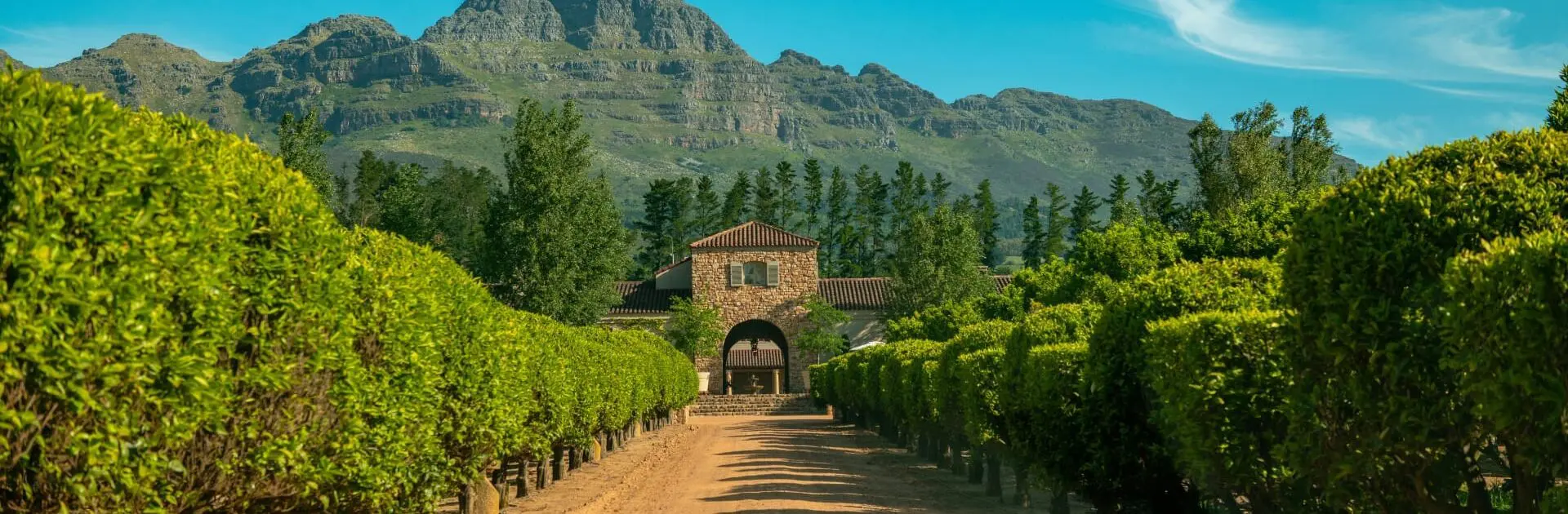
The Cape Winelands are the European-period stand-in heart of the South African production economy and the Western Cape sub-region that doubles convincingly for Provence, Tuscany, the Loire Valley and Mediterranean Europe at 40 to 60 percent of European production costs. Stellenbosch, Franschhoek and Paarl anchor the three primary wine-corridor zones, each carrying a distinct register. Stellenbosch is the academic and Cape Dutch heritage centre, founded in 1679 as South Africa’s second-oldest European settlement. Franschhoek carries the French Huguenot heritage from the 1688 settlement at La Cotte. Paarl, named for the Paarl Rock granite peak, anchors the oldest South African wine corridor. Constantia, within Cape Town’s southern suburbs, holds Groot Constantia as a Cape Town wine-estate extension rather than a Winelands corridor zone. Productions with stand-in briefs outside the European register route through siblings in the SA cluster: arid open-land and Outback frames through our line producer Karoo team, and Lusophone island-volcanic frames through our São Tomé line producer coverage.
Film fixers in Cape Winelands and the line producer Cape Winelands network handle Stellenbosch Municipality and Drakenstein Local Municipality film office permits, Cape Winelands District Municipality coordination, estate-level access negotiation with the filming-friendly estates (Babylonstoren, Boschendal, Spier, Vergelegen), ATA Carnet via Cape Town International Airport (CPT) and Cape Town port, and the multi-zone scheduling that moves a single schedule across the Stellenbosch-Franschhoek-Paarl wine corridor. The Cape Winelands production layer sits inside our South African production team and operates in tight coordination with our Line Producer Cape Town team given the 45-minute drive between Cape Town CBD and Stellenbosch.
The Cape Winelands’ role in the international production economy is structural. Premium fashion houses (Chanel, Louis Vuitton, Burberry) have routinely used the Winelands as Mediterranean stand-in for editorial and commercial work. Automotive launches (Range Rover, Audi, BMW, Mercedes-Benz, Volkswagen) draw on the Helshoogte and Franschhoek Pass scenic-drive register for global brand work. Period feature productions seeking Provence, Tuscany, the Loire Valley or generic European-wine-country settings route through Stellenbosch and Franschhoek by default.
How the Cape Winelands production layer operates
The Cape Winelands production economy runs as an extension of the Cape Town crew bench. Most international shoots in the Winelands use Cape Town-rotated HODs (DP, gaffer, key grip, production designer) with Winelands-local crew filling location-coordination, transport, art department and catering roles. The Stellenbosch Municipality and Drakenstein Local Municipality (covering Paarl and Franschhoek) handle permits at the local level. The Cape Winelands District Municipality coordinates cross-jurisdictional shoots. Estate-level access is negotiated directly with the relevant wine farm or heritage estate, with the filming-friendly properties operating their own internal film coordination.
Cape Winelands fixers, estate-level access and the Stellenbosch/Drakenstein municipal interface
Cape Winelands fixers carry one operational advantage no other South African sub-region offers: estate-level access at the Cape Dutch heritage scale. The senior filming-friendly estates, Babylonstoren, Boschendal, Spier, Vergelegen and the cluster of farms across Stellenbosch and Franschhoek, are private estate environments with their own access protocols, location-management teams and crew-staging facilities. A Cape Winelands fixer carrying standing relationships across these estates compresses the access-negotiation timeline from weeks to days, which is materially faster than approaching the estates cold from a Cape Town base.
The Cape Winelands authority stack the fixer holds reflects the cross-jurisdictional reality of the wine region: Stellenbosch Local Municipality film office for Stellenbosch town and university properties, Drakenstein Municipality film office for Paarl and the granite-peak environments, Cape Winelands District Municipality for cross-jurisdictional shoots spanning multiple municipal boundaries, the individual estate film offices for private access, and the City of Cape Town Film Permit Office for any Constantia or Cape Town wine-estate work that crosses metro boundaries. That five-layer authority stack is unique to the Winelands and explains why a fixer-and-line-producer pairing matters here.
The Cape Winelands crew bench depends on Cape Town as the equipment and HOD staging base, with Winelands-local crew supplements drawn from the Stellenbosch and Paarl resident community for estate-knowledge and Cape Dutch-period dressing expertise. A film fixer in Cape Winelands working a European-stand-in feature typically coordinates with the Cape Town accredited production service company on the FFTIP filing while running the Winelands estate-access and municipal-permit coordination directly. Equipment routing follows the Cape Town corridor, with ATA Carnet cargo arriving at Cape Town International Airport and trucked to the Winelands estate locations.
Cape Winelands FFTIP-applicant structuring through a Cape Town or Cape Winelands production service company
Cape Winelands FFTIP-applicant economics typically route through a Cape Town production service company rather than a Winelands-resident PSC, with the staging dependency on Cape Town’s equipment, crew and accredited applicant infrastructure shaping the structuring. The Cape Town-based applicant entity files the rebate with the dtic, with the Winelands portion of the qualifying spend covering estate access fees, location-day rates at Stellenbosch, Franschhoek and Paarl, and the period-specific dressing budgets that European-stand-in features absorb. For larger features with extended Winelands schedules, a dedicated Cape Winelands production service company structure can absorb the Stellenbosch and Drakenstein municipal liaison alongside the rebate filing.
The Winelands-specific FFTIP angle is the European period stand-in economics: features routing to Cape Winelands for Tuscany, Provence or Loire Valley stand-in work typically front-load the qualifying spend on estate access, period-dressing and Cape Dutch architectural integration. The estate access fees and the multi-week filming windows for vineyard period work are FFTIP-eligible, with the Cape Town accredited applicant managing the rebate documentation alongside the line-producer financial-responsibility role.
Cape Town as the equipment and crew staging base
The Cape Winelands sit 45 minutes east of Cape Town CBD via the N1 highway, with Stellenbosch closest, Franschhoek another 30 minutes further via Helshoogte Pass and Paarl 50 minutes via the R45. Cape Town International Airport (CPT) and Cape Town port supply the ATA Carnet entry points, with equipment trucked to the Winelands the same day. The Cape Town crew bench supplies HODs and specialist crew rotated in for the Winelands schedule. Cape Town Film Studios at Faure sits within a 60-minute drive of the Winelands, allowing single-schedule routing between studio days at Cape Town Film Studios and exterior days across the vineyard valley.
Cape Winelands’ production zones, Stellenbosch, Franschhoek and Paarl
The Cape Winelands’ filming geography clusters around three wine-corridor zones. Stellenbosch anchors the Cape Dutch heritage and academic town register. Franschhoek carries the French Huguenot heritage and Champagne Valley sub-register. Paarl runs the granite peak and oldest-wine-corridor register. Constantia, within Cape Town’s southern suburbs, reads as a Cape Town wine-estate extension and is covered separately below.

Stellenbosch, the Cape Dutch heritage and university town register
Stellenbosch is South Africa’s second-oldest European settlement, founded in 1679 by Simon van der Stel. The town centre carries the densest concentration of Cape Dutch heritage architecture in South Africa, with the Dorp Street and Andringa Street precincts preserving white-washed gabled houses, oak-lined avenues and original 18th-century homesteads. Stellenbosch University, founded in 1918 and the country’s oldest Afrikaans-medium university, supplies the academic-town register. The Stellenbosch wine estates including Spier (1692), Vergelegen (1700) and Lanzerac anchor the working-vineyard filming register. The Stellenbosch Municipality film office processes permits with statutory turnaround 7 to 14 working days.

Franschhoek, the French Huguenot village and Champagne Valley register
Franschhoek, French for “French Corner”, was settled in 1688 by French Huguenot refugees fleeing religious persecution after the revocation of the Edict of Nantes. The village carries the French heritage register in street names, architecture, restaurant culture and the Huguenot Memorial Monument at the head of the valley. Franschhoek sits at the eastern end of the Cape Winelands valley, accessible from Stellenbosch via the scenic Helshoogte Pass (30 minutes) or from Paarl via the Franschhoek Pass. The valley delivers the Champagne-region stand-in register, with estates including Boschendal, La Motte, Babylonstoren (just outside Franschhoek toward Simondium) and the Mont Rochelle hotel running an active filming pipeline. The Drakenstein Local Municipality handles Franschhoek permits.

Paarl, the granite peak and the oldest wine corridor
Paarl, the third-largest town in the Western Cape, takes its name from the Paarl Rock (Afrikaans for “pearl”), the three-domed granite peak that dominates the local skyline and runs second only to Australia’s Uluru as the world’s largest exposed granite monolith. The Paarl Mountain Nature Reserve supplies the rock-and-fynbos hilltop register. Paarl Main Road carries the Cape Dutch heritage architecture from the 1720s settlement, with the Drostdy, the Strooidakkerk (1805) and the Paarl Museum anchoring the historical layer. The Paarl wine corridor extends north toward Wellington, supplying the oldest South African wine-region register. The Drakenstein Local Municipality processes Paarl filming permits alongside Franschhoek under the same jurisdictional umbrella.

Constantia and the Cape Town wine estates
Constantia, the southern Cape Town suburb tucked under the eastern slopes of Table Mountain, holds Groot Constantia, the oldest wine estate in South Africa, founded in 1685 by Simon van der Stel as his personal farm. The estate’s preserved Cape Dutch manor house, working cellars and historical vineyards anchor a distinct register that sits within Cape Town’s metropolitan envelope (20 minutes from the CBD) rather than the Stellenbosch-Franschhoek-Paarl corridor 45 minutes east. Klein Constantia, Buitenverwachting and Constantia Glen extend the constellation. The City of Cape Town Film Permit Office processes Constantia permits under the same municipal framework as the rest of Cape Town.

The filming-friendly estates, Babylonstoren, Boschendal, Spier and Vergelegen
A defined set of Cape Winelands estates run active filming coordination as part of their operations. Babylonstoren near Simondium, the 300-year-old farm estate, operates an onsite hotel, working garden complex, Cape Dutch heritage buildings and a vinotheque, with internal film coordination handling lifestyle, hospitality and commercial production. Boschendal between Stellenbosch and Franschhoek runs 2,500 hectares of historical estate with the original 1685 Cape Dutch homestead complex available for filming. Spier between Stellenbosch and Faure operates an Africa-focused filming-friendly campus with onsite production support and a working amphitheatre. Vergelegen near Somerset West, founded 1700 by Willem Adriaan van der Stel, anchors the heritage-luxury Cape Dutch register at the southern Winelands corner. Each estate has its own access protocols and lead times, with the line producer in Cape Winelands coordinating across estate management teams in parallel.
Permits, FFTIP and the operational framework
The Cape Winelands permit framework runs through three municipal layers plus the Cape Winelands District Municipality for cross-jurisdictional coordination. The FFTIP rebate framework administered by the dtic applies on Qualifying South African Production Expenditure across the Winelands in the same way it applies to Cape Town itself.

Stellenbosch, Drakenstein and Cape Winelands District municipal film offices
The Stellenbosch Municipality handles film permits for the Stellenbosch town and the surrounding wine estate corridor. The Drakenstein Local Municipality handles Paarl and Franschhoek. The Cape Winelands District Municipality coordinates cross-jurisdictional shoots that span multiple local municipalities or that touch the wider district administrative envelope. Standard permit pipeline runs 7 to 14 working days for non-restricted locations and 14 to 21 working days where SAPS road-closure coordination, heritage-property access (Cape Dutch homesteads under provincial heritage protection) or estate-management consultation stack on top. Aerial filming over the vineyard valley requires South African civil aviation clearance coordinated through the relevant municipal authorities.
FFTIP rebate via a Cape Winelands or Cape Town production service company
FFTIP rebate filing for Cape Winelands shoots routes through a South African-registered production service company, typically the same Cape Town entity that anchors a multi-zone Western Cape schedule. The 20% cashback applies on Qualifying South African Production Expenditure (QSAPE), with a 5% BEE uplift taking the headline rate to 25% when the production service company is at least 51% Black-owned per the Broad-Based Black Economic Empowerment codes. Cape Winelands-specific expenditure (estate location fees, Winelands-local crew salaries, Stellenbosch and Franschhoek transport and accommodation) qualifies as QSAPE alongside the Cape Town-anchored production base costs. Disbursement runs staged at 25% first principal photography milestone, 50% mid-production audit, 25% final audit certificate.
Cape Winelands as the European-period stand-in
The Cape Winelands’ commercial value to international productions sits in the European-period stand-in role. The combination of vineyard valley, Cape Dutch heritage architecture, oak-lined avenues, mountain backdrop and the 1685-onwards working wine industry delivers the Provence-Tuscany-Loire register at 40 to 60 percent of the cost of filming in the actual European locations. The Winelands’ role in the international production calendar reflects this cost arbitrage directly.
Provence, Tuscany and Loire Valley stand-in economics
Premium fashion houses (Chanel, Louis Vuitton, Burberry, Hermes), luxury automotive brands (Range Rover, Audi, BMW, Mercedes-Benz, Volkswagen) and the wider European luxury commercial economy route a significant share of their southern hemisphere autumn production through the Cape Winelands. The autumn vineyard turn (March to May) supplies the European-autumn light without the European winter weather risk. The Helshoogte Pass and Franschhoek Pass scenic drives have anchored automotive launch and brand commercial work for decades. The estates run their own filming protocols with predictable lead times that the established commercial production economy relies on.
Wine industry commercial production economy
South African wine industry commercial production anchors a continuous local commercial pipeline that the Winelands fixer layer services year-round. The South African wine industry’s export market (UK, Netherlands, Germany, China, Canada, US) drives brand and commercial production volume that fills the Winelands calendar between international shoot windows. Wine industry brand work also serves as the training and continuity layer for the Winelands-local crew bench, supporting the same operational infrastructure that the international productions draw on when they land.
Engaging a line producer in the Cape Winelands
Most Cape Winelands schedules become workable or unworkable at the briefing stage. The variables that matter are which zones the script implies, whether estate-level access is needed and which estates (Babylonstoren, Boschendal, Spier, Vergelegen, or others), Stellenbosch and Drakenstein Municipality permit lead times, heritage-property access requirements where Cape Dutch homesteads sit under provincial heritage protection, FFTIP eligibility and rebate filing path, ATA Carnet origin port at Cape Town International Airport or Cape Town port, Section 11(2) visa stack by nationality, and the Cape Town corridor logistics for HOD rotation and equipment transport.
The Cape Town to Winelands corridor and multi-zone scheduling
The pairing model on a Cape Winelands shoot typically runs as a regional production head holding the contract, the schedule, the budget and the FFTIP rebate filing from a Cape Town base, with a line producer in the Winelands owning day-to-day execution across Stellenbosch Municipality, Drakenstein Municipality, the estate management teams and the SAPS road-closure layer. The 45-minute Cape Town to Stellenbosch drive supports same-day routing between Cape Town Film Studios, Cape Peninsula exteriors and Winelands days inside a single rebate filing. Equipment routed from Cape Town port or Cape Town International Airport reaches the Winelands the same day under valid ATA Carnet documentation. Film fixers below the line producer layer handle sub-zone access, including individual estate coordination, heritage-property protocols and the Helshoogte and Franschhoek Pass scenic-drive logistics that anchor most automotive and luxury commercial work.
The Cape Winelands’ structural advantage on the international production economy is the combination of authentic Cape Dutch heritage architecture sitting under working wine estates that have operated continuously since the 1685-onwards original Cape colony settlement, the Mediterranean and Provence climate parallel that delivers the southern hemisphere equivalent autumn light, the 45-minute proximity to Cape Town’s deep crew bench and international airport infrastructure, and the FFTIP rebate framework that brings the post-rebate net cost into commercial competitive parity with the lowest-cost European alternatives. The Cape Winelands shoot scales from one-camera commercial through to multi-day feature production without architectural compromise. For how the Cape Winelands compares with other African bases on permits, crew and cost, see our filming in Africa guide.
