


Saudi Arabia film incentives and rebates now headline the Gulf. The Saudi Film Commission has raised the national cash rebate to a top rate of up to 60 percent, the highest advertised production incentive in the region, and paired it with a faster audit and disbursement process. Underneath that headline sit two location engines most producers are still catching up on: NEOM, with its own 40 percent regional rebate and newly opened soundstages, and AlUla, with tailored location incentives across Hegra and the wider oasis. This page sets out how the money actually works, what qualifies, and where the numbers stop being a press release and start being a cash-flow line.
Saudi is a young production market moving fast, so the gap between the announced rate and the banked rebate is where schedules are won or lost. Getting the applicant of record, the qualifying-spend definition and the disbursement timeline right from prep is the job of a line producer Saudi Arabia desk, coordinated through our Line Producer Middle East team. Because the banked figure turns on how the base rebate stacks with the NEOM or AlUla uplifts, producers work that modelling through our film incentive and rebate consulting before spend is committed.

The Saudi 60% cash rebate: how it works
The national scheme is a cash rebate on qualifying Saudi spend, administered by the Saudi Film Commission under the Ministry of Culture. It reimburses a percentage of what a production actually spends inside the Kingdom, paid after the shoot on an audited claim rather than taken as an upfront discount. That structure matters for financing: the rebate is a receivable, not a rate card, so it has to be modelled against a real cash-flow gap during production, and it is one strand of the Vision 2030 push to build a resident screen industry rather than a one-off subsidy.
From 40% to 60%: the step change
The national rebate launched at 40 percent and has since been lifted to a headline of up to 60 percent, with the operational layer rebuilt around it: clearer eligibility pathways, a published financial-audit-and-disbursement guide, and accelerated reimbursement. The rate grabs attention, but the more consequential change for a production accountant is the audit guide, because a rebate you cannot forecast the payout date on is a rebate you cannot fully finance against. Saudi moved from being a headline to being bankable in the same step.
The base rate and the uplifts that reach 60%
The 60 percent figure is a ceiling reached by stacking, not a flat rate every production receives. A base cash rebate applies to qualifying spend, and uplifts layer on for the elements Saudi wants to grow: local Saudi content and story elements, spend routed through Saudi companies and crew, and use of Saudi talent and locations. The Commission has not published a line-by-line breakdown of each uplift band.
So the honest planning number is a range. Budget the base case conservatively, treat the path to 60 percent as an optimisation to be confirmed against the current qualifying-criteria guide at the point of application, and design the production so the uplift-earning elements are baked into the plan rather than retrofitted. A brief that shoots Saudi stories with Saudi crew in Saudi locations sits near the top of the band by construction; a brief that merely visits does not.

Qualifying spend, eligibility and the applicant of record
Rebates reimburse qualifying Saudi expenditure, meaning spend that lands with Saudi vendors, crew and facilities rather than money that merely passes through the territory. Local crew day rates, equipment hire from Saudi houses, studio and location fees, accommodation, ground transport and Saudi post all typically qualify; fees contracted to offshore entities usually do not, even when the work happens on Saudi soil.
As across the Gulf, the claim is filed by a locally registered applicant of record, so a foreign production needs a Saudi corporate vehicle or a local production-services partner to hold it. The practical failure point is rarely the rate, it is spend that turns out non-qualifying because it was contracted the wrong way, and that gets designed out in prep, not argued after wrap. This is the single most expensive detail to get wrong on a first Saudi shoot.
Disbursement and the audit guide
The scheme now includes a financial-audit-and-disbursement procedures guide aimed squarely at implementation speed, the area early productions found slowest. In practice the claim is audited against qualifying-spend evidence after delivery, then disbursed, so the documentation standard, not the shoot itself, decides how much of the headline rate actually converts to cash. Keep contracts, invoices and proof of Saudi payment clean and claim-ready from day one, confirm the current audit checklist before the shoot, and build the reimbursement lag into the finance plan rather than assuming day-one recovery.
NEOM: the 40% regional rebate and the new studios
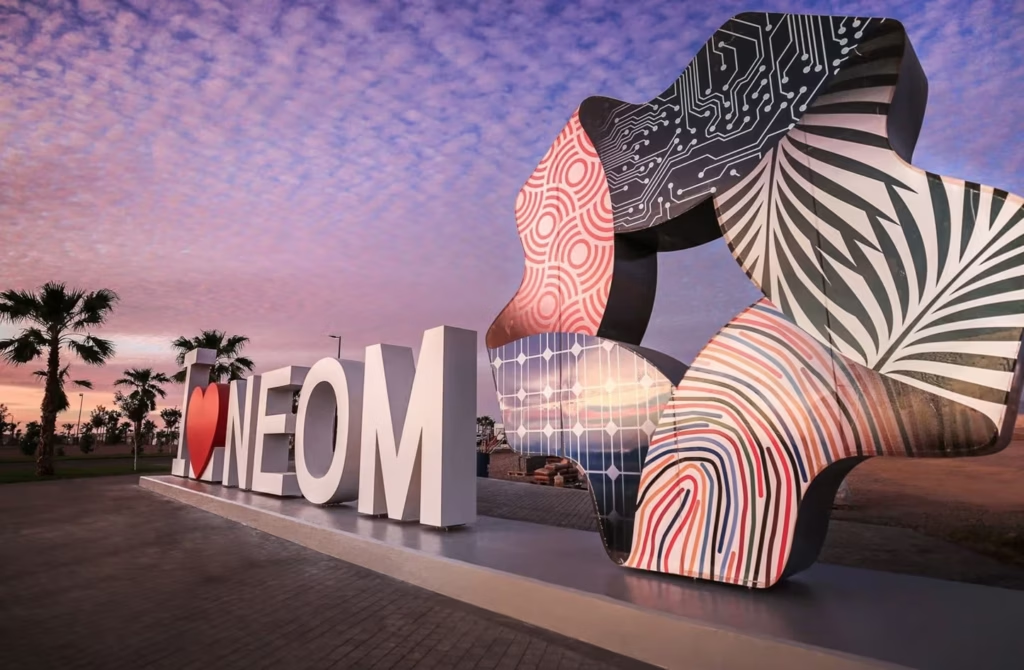
NEOM runs its own production incentive on top of the national picture, and it is now backed by physical infrastructure rather than a masterplan. For productions that can base in the north-west, the NEOM stack changes the build-versus-travel maths, because the soundstages, backlot, desert exteriors and crew housing all sit inside one controlled zone with a single point of coordination.
The 40% rebate and the up-to-10% NEOM uplift
NEOM offers a minimum 40 percent cash rebate across features, TV drama, reality, documentary and commercials, with higher percentages available for productions that contribute to local industry development through crew hiring and set-build investment. The minimum qualifying NEOM spend is 500,000 US dollars.
NEOM’s own 40 percent does not simply double up with the national 40 percent, but a production running on the national incentive can claim an additional NEOM uplift of up to 10 percent on NEOM-based facilities, post-production and resident talent. Read NEOM as a stacking uplift, not a competing scheme: the decision is not which rebate to take, it is how much of your qualifying footprint you place inside the NEOM zone to unlock that extra layer on top of the national claim.
NEOM Media Village and Bajdah Desert Studios
The stages are open, not coming soon. NEOM Media Village runs a 2,400 square-metre sound stage with further stages in build, including a volumetric capture stage, alongside make-up rooms, green rooms and production offices. Bajdah Desert Studios adds two 3,000 square-metre stages already operational, with more scheduled.
For a production weighing a controlled desert build, that is stage capacity plus practical desert, mountain and canyon exteriors in the same footprint, which is the combination Wadi Rum and Ouarzazate have historically split between them. The volumetric and virtual-production capability also matters for briefs that want in-camera VFX close to the location, rather than shooting plates in one country and finishing on a stage in another.
Crew depth, accommodation and concurrent capacity
NEOM lists 350 accommodation units for cast and crew alongside construction warehouses, prop shops, wardrobe, SFX facilities and a grip, lighting, camera and access-equipment pool. The zone states crew depth to support three to four concurrent productions and has a build-out toward roughly 37 stages and studios planned.
Concurrent capacity is the number that matters for series and back-to-back features: it decides whether a slate can be housed in one base or has to fragment across territories. The realistic caveat is crew maturity, the market is young, so a first-unit brief still travels key heads of department and sources mid-tier and daily crew locally, which is exactly the balance a Saudi desk scopes against the schedule before committing to an all-local build.
AlUla and the wider location stack
If NEOM is the built-infrastructure play, AlUla is the location and heritage play, and together they give Saudi two very different production registers under one national rebate. Film AlUla has been the on-the-ground driver of the sector’s recent momentum, and it pairs locations with its own support layer.
Film AlUla incentives and the Hegra locations
Film AlUla offers tailored incentives designed to reduce production cost, layered on top of the national rebate, plus a full location-support service: dedicated scouting across Hegra’s UNESCO-listed Nabataean tombs and the AlUla sandstone canyons, permit liaison, equipped backlots and crew and accommodation access. The exact AlUla incentive percentage is set through its eligibility criteria rather than published as a flat headline, so it is confirmed case by case against the production’s qualifying AlUla spend.
The draw is the register: rock-cut monuments and desert that read as ancient-world or off-planet without a build, served by a dedicated AlUla airport and a growing local base. For an international brief, AlUla removes the two things that usually kill heritage-desert shoots elsewhere, access logistics and permit uncertainty, and folds them into one commission’s remit.

How the regional uplifts stack on the national 60%
The structure to hold in your head is national plus regional. The Saudi Film Commission rebate is the base national layer, up to 60 percent on qualifying Kingdom-wide spend, and the regional programmes at NEOM and AlUla add location-specific uplifts on spend that lands in their zones.
A production is not choosing between them: it is deciding where its qualifying spend physically sits, because that placement is what unlocks the regional uplift on top of the national claim. Split a schedule between a NEOM stage build and an AlUla location block and both zones’ uplifts can apply to their respective spend, all sitting on the national base. This stacking structure is what makes Saudi Arabia film incentives and rebates a modelling exercise rather than a single rate: getting the split right in prep is the difference between the advertised ceiling and the banked figure.
| Layer | Rate | Applies to |
|---|---|---|
| National (Saudi Film Commission) | Up to 60% | Qualifying Kingdom-wide spend; base rate plus uplifts for Saudi content, spend and talent |
| NEOM | 40%, plus up to 10% uplift | NEOM facilities, post and resident talent; 500,000 dollar minimum NEOM spend |
| Film AlUla | Case by case | Tailored location incentive on qualifying AlUla spend, on top of the national rebate |
Red Sea, Riyadh and the studio map
Beyond NEOM and AlUla, the Kingdom’s production map now runs from the JAX district and studios around Riyadh to the Red Sea coast and Jeddah’s historic Al-Balad, backed by the Red Sea International Film Festival and its fund as a soft-power and financing layer. For an international brief that means a genuine choice of registers within one rebate: built stages, heritage desert, modern-city and coastal, without leaving the incentive envelope.
It is the same MENA corridor logic that connects Saudi to the UAE film incentives and rebates and the Egypt film incentives and rebates for productions routing a multi-country shoot: Saudi for scale, rate and heritage-desert, its neighbours for the infrastructure, coastline or urban registers a single territory cannot cover alone.

What the incentive means for your production budget
Saudi Arabia film incentives and rebates only earn their keep when modelled as cash, not as a headline. Three things decide the real number: how much of your spend qualifies, which regional uplifts your footprint unlocks, and how long the money takes to come back.
A worked cash-flow example
Take a production placing 10 million US dollars of qualifying spend inside Saudi Arabia. At the headline 60 percent rate the rebate is up to 6 million dollars; modelled conservatively on the base band nearer 40 percent it is closer to 4 million. Route a share of that spend through NEOM facilities and resident talent and the up-to-10 percent NEOM uplift applies to that slice on top.
The number every financier asks next is timing. Because the rebate is reimbursed after an audited claim, the production carries the full spend during the shoot and recovers the rebate months later, so the finance plan has to bridge that gap. In practice that is done by discounting the expected rebate through a gap facility or an equity bridge, which is only bankable if the qualifying-spend paperwork is watertight, another reason the claim is engineered in prep rather than assembled at the end.
Permits and the Film Commission workflow
Permitting runs through the Saudi Film Commission and the audiovisual regulator, with location and zone-specific clearances at NEOM and AlUla handled by their own teams. Equipment moves on an ATA carnet, and customs, content review, drone clearance and location approvals carry real lead times that have to be booked against the shoot dates, not assumed.
None of it is exotic, but it is sequential, and content review in particular rewards early, accurate submission over a last-minute scramble. A schedule that treats permits as a formality is the one that slips; a schedule that front-loads the paperwork protects both the shoot dates and, because clean documentation feeds the rebate claim, the incentive itself.
Where a line producer Saudi Arabia closes the gap
Every figure on this page is achievable and every one of them can leak. The applicant of record, the qualifying-spend design, the NEOM and AlUla footprint decision, the carnet and permit sequence and the reimbursement bridge are all set in prep, and locking them down before the first invoice is raised is what our film fixers in Saudi Arabia and line-production desk is engaged to do. That is the difference between a 60 percent press release and a 60 percent that banks. Our Saudi desk runs inside the wider Gulf corridor and can scope the incentive against a specific brief, budget and schedule.

Saudi Arabia film incentives and rebates: questions producers ask
Is the 60% rebate guaranteed?
No. Sixty percent is the top of a stacked band, not a flat rate. A base cash rebate applies to qualifying spend and uplifts are added for Saudi content, Saudi-routed spend and Saudi talent and locations. Budget the base case conservatively and treat the climb to 60 percent as an optimisation confirmed against the current qualifying-criteria guide when you apply.
Can a foreign producer claim the rebate directly?
Not directly. The claim is filed by a locally registered applicant of record, so a foreign production works through a Saudi corporate vehicle or a local production-services partner that holds the claim and the qualifying-spend paperwork. Setting that structure up correctly in prep is what protects the rebate.
How long until the rebate is paid?
It is reimbursed after an audited claim once the production has delivered, not during the shoot, so the production carries the spend and recovers the rebate months later. A financial-audit-and-disbursement guide was introduced to speed that up, but the finance plan should still bridge the gap rather than book the rebate as day-one cash.
Can NEOM and AlUla incentives be combined with the national rebate?
Yes, as stacking uplifts. The national Saudi Film Commission rebate is the base, and spend that physically lands in NEOM or AlUla can earn those zones’ location uplifts on top, with NEOM adding up to 10 percent on a 500,000 dollar minimum NEOM spend. You are not picking one incentive, you are placing your qualifying footprint to unlock the layers.
