

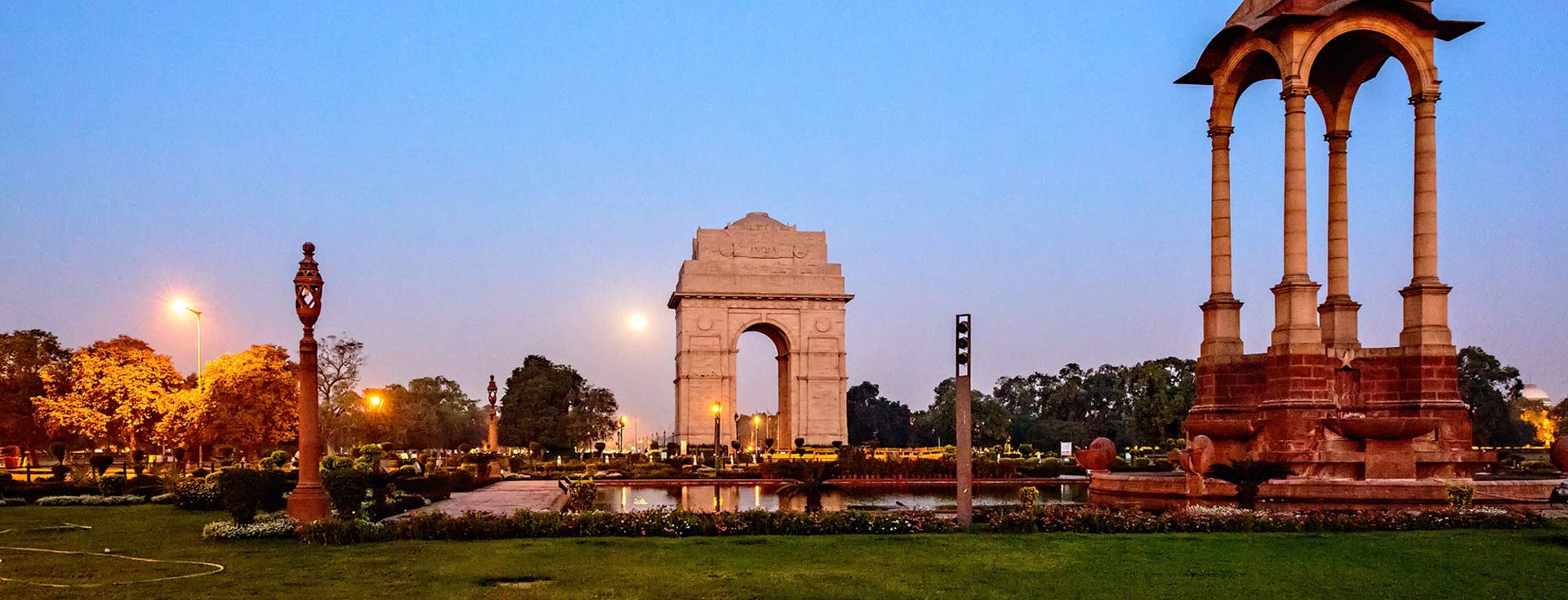
A line producer Delhi NCR team holds one accountable production structure across Delhi, Noida and Gurugram, so that a shoot moving between the three is run on one budget, one schedule and one reporting line while each jurisdiction’s permissions are filed separately. Film fixers in Delhi carry the ground layer under that structure: location access, the municipal, police and site permissions, local crew, equipment movement and the daily liaison with the authorities on set.
Delhi, Noida and Gurugram can operate as one production corridor while still requiring separate location, police and site permissions. That is the whole premise of this page. It covers what the line producer and fixer roles handle in the National Capital Region, how the three jurisdictions differ, the permit layers a foreign or Indian production has to sequence, the production bases and location registers across the corridor, crew and equipment movement, and what a brief needs to contain. Rates, incentives, Rajasthan routing and railway permissions sit on their own pages and are linked once where they belong.

What a Line Producer and Film Fixer in Delhi NCR Handles
The line producer in Delhi holds the commercial and scheduling layer: the budget and cash flow, the master schedule across the three jurisdictions, vendor contracts, crew deals, equipment and customs sequencing for imported packages, the national and state permission applications through the registered Indian entity, and the reporting line to the foreign or out-of-state producer. On a feature, a series or a multi-week commercial campaign this role is separate from day-to-day fixing.
A film fixer Delhi engagement holds the ground: scouting and locking locations, opening the municipal, police, site-owner and heritage tracks against the final location list, sourcing local crew and vendors, transport and accommodation, crowd and traffic management on the day, and the on-set relationship with the officer or custodian whose signature the shoot depends on. Film fixers in Delhi are the reason a permit that exists on paper turns into a unit that rolls at the agreed call time. On smaller shoots one company supplies both roles; on larger ones the split keeps the person answering to the budget separate from the person negotiating a lane closure at dawn.
Delhi, Noida and Gurugram: One Shoot, Separate Authorities
The corridor is one economy for crew, equipment and accommodation and three legal territories for permissions. Delhi is the National Capital Territory with its own film single window, municipal bodies and police. Noida is in Uttar Pradesh, administered by the New Okhla Industrial Development Authority with Uttar Pradesh Police and the state’s own film-facilitation framework. Gurugram is in Haryana, with Gurugram district administration, Haryana Police and the Haryana state film framework. A schedule that shoots a Lutyens exterior in the morning, a Cyber City office interior in the afternoon and a Noida studio stage the next day is one production and three permission files.
| Jurisdiction | State or territory | Location and public-space permissions | Police layer | Typical use in a schedule |
|---|---|---|---|---|
| Delhi | National Capital Territory | Delhi single-window film-shooting procedure; NDMC for the New Delhi municipal area; MCD for the rest of the city; DDA, PWD and other land-owning agencies for their properties | Delhi Police, through the station with jurisdiction over the location | Heritage exteriors, Old Delhi streets, central-district architecture, government-adjacent settings where permitted |
| Noida | Uttar Pradesh | Noida Authority for sector roads and public spaces; site owners; Uttar Pradesh film-facilitation framework for state-level matters | Uttar Pradesh Police (Gautam Buddh Nagar) | Studio stages and equipment houses at Film City, new-build residential and commercial exteriors |
| Gurugram | Haryana | Gurugram district administration; individual property owners and developers for corporate campuses; Haryana forest department for the Aravalli belt; Haryana film framework for state-level matters | Haryana Police (Gurugram) | Contemporary corporate-glass and business-district settings, highway and expressway exteriors |
The practical consequence is sequencing. Each jurisdiction is filed on its own timetable, so the line producer Delhi NCR team builds the schedule around whichever permission is slowest for the specific locations, not around a corridor average, and keeps a contingency location inside each jurisdiction so a late approval moves a day rather than the shoot.
Permits: National, Delhi, Site and Police Layers
For a foreign production the national layer comes first. Permission to film in India is applied for through India Cine Hub, the Ministry of Information and Broadcasting’s single window, by the Indian line producer or production-services company acting for the foreign producer; the state and local layers below are opened against that approval. Indian productions start at the state and local layers directly.
The Delhi Layer
Delhi runs a single-window procedure for film shooting on government and public locations, with the land-owning or administering agency confirming its own conditions inside that process. The New Delhi Municipal Council administers the central New Delhi area, including Connaught Place and the Lutyens grid, and the Municipal Corporation of Delhi administers the rest of the city, including Old Delhi. The published procedure, forms and agency list are set out in the Delhi single-window film-shooting procedure. Sensitive central-government, defence and diplomatic zones sit outside the ordinary single-window route and are confirmed for the specific brief before scheduling rather than assumed to be available.

Site and Heritage Layers
Protected monuments in Delhi, including the Red Fort, Qutub Minar, Humayun’s Tomb, Purana Qila and Jantar Mantar, are Archaeological Survey of India properties and are permitted by the ASI on its own track, with its own conditions on equipment, lighting, generators, crew numbers and sound. Private properties, institutions, hotels, markets and corporate campuses are permitted through their owners or operators, and in Gurugram the developer of a campus is often the effective permit authority for its buildings and plazas. Film fixers in Delhi open these tracks against the location list rather than after the municipal permit lands.

Police and Airspace
Any street-level or public-space shoot needs police clearance from the station with jurisdiction over the location, in addition to the municipal or site permission, and that clearance is what governs generator placement, road use, crowd handling, action sequences and night work. Drone and aerial filming across the corridor runs on the DGCA Digital Sky framework and the airspace category of the specific location; large parts of Delhi sit in restricted or controlled airspace around Indira Gandhi International Airport, Palam and central-government installations, and Gurugram and Noida carry their own restrictions. The India Cine Hub aerial-filming guidance sets out the national route; feasibility is confirmed per location before an aerial shot is written into the schedule.
Locations and Production Bases: Delhi, Noida and Gurugram
Delhi supplies the heritage and civic registers: Mughal and Sultanate-era monuments, the Old Delhi lanes and bazaars around Chandni Chowk and Jama Masjid, the Lutyens-era avenues and Connaught Place, the colonial-period institutional architecture, and the residential colonies and markets that carry contemporary Indian urban stories. Noida supplies the studio and equipment base at Film City in Sector 16A together with new-build residential and commercial exteriors. Gurugram supplies the contemporary corporate register of glass towers, business parks and expressway frontage that productions use for modern-office and business-district settings, with the Aravalli belt at its edge.

Bases follow the schedule rather than the other way round. A Delhi-heavy heritage or street schedule is run from central or south Delhi, a stage-heavy schedule from Noida, and a corporate campaign from Gurugram, with the crew and equipment pool shared across all three. Briefs that pair the corridor with Rajasthan are planned with the line producer Rajasthan team, since Delhi is the usual arrival and staging point for Jaipur, Jodhpur and the desert.

Crew, Equipment and Cross-NCR Movement
The corridor shares one crew and equipment market. Heads of department, camera, lighting, grip and sound crew are booked from the Delhi and Noida pool and work across all three jurisdictions on the same deal; equipment hire is concentrated at Noida Film City and in the Delhi rental houses; and studio stages are booked at Film City for interior work. Imported packages enter through Indira Gandhi International Airport on the route confirmed with customs and the production’s broker, whether an ATA Carnet or temporary import, with timing confirmed for the specific shipment rather than assumed.
Movement between the three is the daily planning problem. Distances are short and drive times are not: a line producer Delhi engagement schedules cross-border moves outside the peak windows, keeps units inside one jurisdiction per day where the location list allows, and stages equipment and crew overnight near the next morning’s set rather than convoying at dawn. Working day rates, equipment bands and per diem ranges for the corridor are maintained as dated planning estimates on the India production rates page.
Planning a Brief: Schedule, Sensitive Locations and Contingencies
A usable first response depends on the brief carrying enough to test the permit and schedule questions in one pass: the format and running time, the shoot window, the locations or registers the script needs across Delhi, Noida and Gurugram, the crew size and which heads of department travel, crew nationalities, the equipment list and whether it ships or rents locally, any permit-sensitive activity such as heritage interiors, government-adjacent settings, drones, night closures, action or crowd scenes, and an indicative budget range.
- Sensitive locations: a film fixer Delhi team confirms heritage monuments, government and diplomatic zones, defence areas, airports, metro and rail infrastructure and religious sites for the specific brief before they enter the schedule.
- Season: the corridor is scheduled around the winter months where exteriors allow, with heat, monsoon and air-quality conditions treated as scheduling and welfare inputs rather than fixed dates.
- Contingencies: each jurisdiction carries a fallback location and a weather or approval buffer, so one late permission moves a day rather than the production.
- Incentives: where the production is eligible for the central or a state scheme, the qualifying-spend records are set up from the first Indian invoice; the rules and claim sequence are on the India film incentives page.
Proven NCR Execution
Celluloid Pact has run units across all three jurisdictions on the same production: handheld work in the Chandni Chowk lanes under municipal and police permissions, rail-infrastructure interiors under the separate Indian Railways clearance track, corporate-campus days in Gurugram and stage days in Noida, with a single line producer Delhi NCR structure holding the schedule and budget across them. The photographs on this page are from those shoots.

To scope a Delhi, Noida or Gurugram shoot, send the brief outlined above and the line producer Delhi team will return a schedule, a budget outline, the permission tracks the location list triggers and the sequencing across the three jurisdictions. For productions spanning the country beyond the corridor, the line producer India page holds the national structure.

