

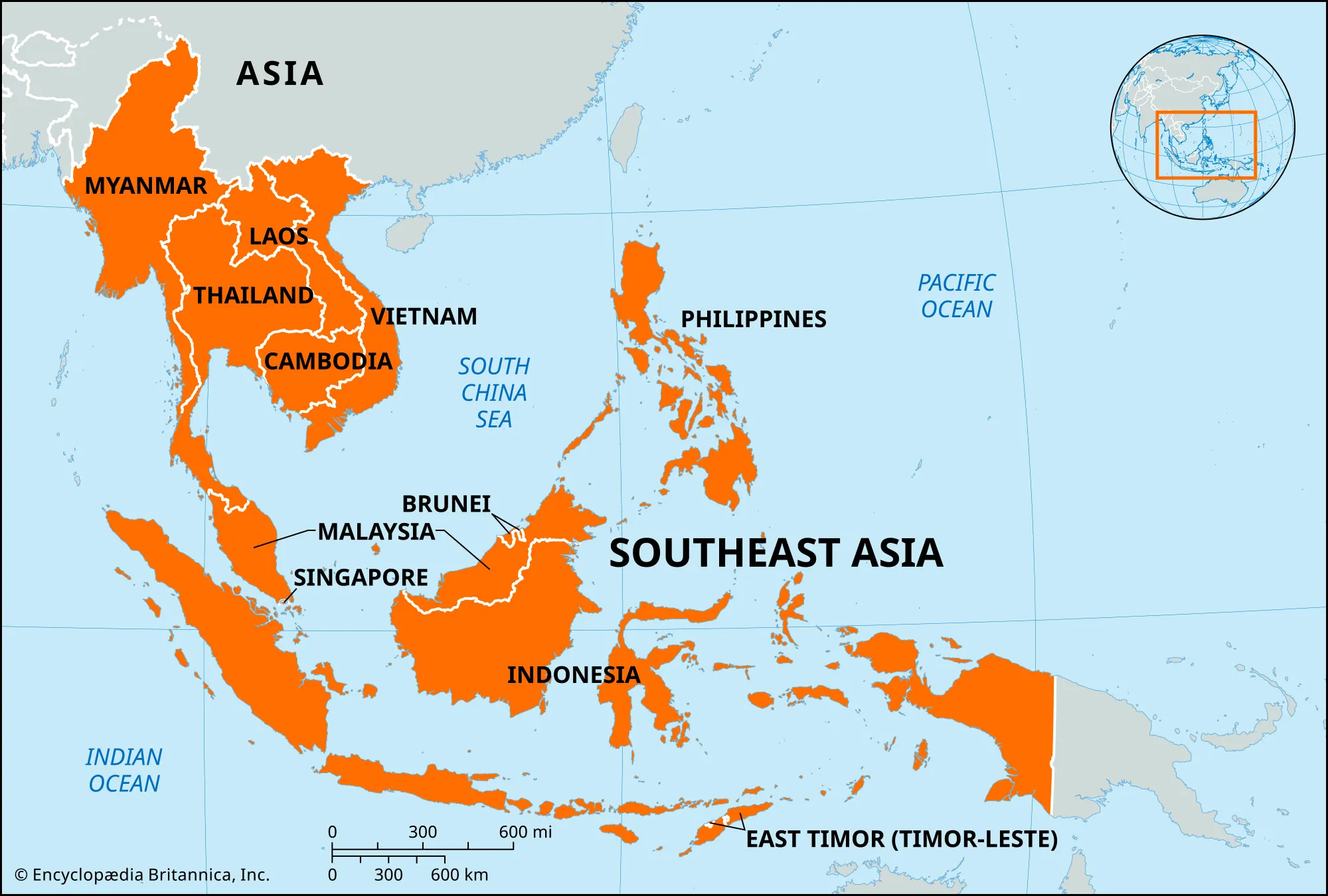
Southeast Asia (and via our East Asia line producer network for Korea, Japan and the Himalayan corridor) has become one of the world’s most consistent service-shoot regions for international film, streamer and brand productions. The combination of competitive day rates, English-capable production layers, distinct location registers across four core territories, and operational ease in routing multi-country schedules has made the region a default option for foreign producers planning Asia briefs. When multi-country routing makes sense, the line-producer interface that holds the cross-territory layer end-to-end is what makes the routing operationally viable.
Celluloid Pact runs Southeast Asia across Vietnam, Thailand, Cambodia and Indonesia, with the line producer Southeast Asia coverage holding the cross-territory production-services interface. This article covers cost benchmarks, permit frameworks per country, when multi-country routing makes sense, and the territory-selection logic that determines which Southeast Asian country fits a specific brief.
The projects we take up across the SEA cluster sit in three categories — streamer service shoots for Netflix / Apple TV+ / Disney+ / Amazon and HBO; international feature work routed through Bangkok studio infrastructure or location-led briefs across the Mekong corridor and the wider region; and brand campaigns, TVCs and commercials anchored on the SEA visual range. The core skills CP brings are line production execution, permit handling per territory, ATA Carnet customs at each gateway airport, crew sourcing across city bases, and crew rotation across territories on multi-country briefs.
Why Southeast Asia for international filming
Three structural realities anchor Southeast Asia in the international production-routing decision. Cost arbitrage versus Tokyo, Seoul, London and Sydney holds at meaningful differentials on day-rate-driven line items. Permit frameworks per territory are documented, English-accessible and clear in known windows — Vietnam’s Department of Cinema, Thailand’s Film Office, Cambodia’s APSARA Authority and Indonesia’s Ministry of Tourism and Creative Economy each operate predictable application chains. And the crew depth across the four territories has expanded materially through the streamer-era surge of 2018-2024, with international productions now routinely cycling the same DPs, gaffers and key positions across multiple SEA shoot blocks.
The region’s core production territories are geographically close enough that multi-country schedules can often be executed without the logistics burden associated with longer-haul regional productions. Ho Chi Minh City to Bangkok is a one-hour-twenty-five flight; Bangkok to Phnom Penh is fifty minutes; Phnom Penh to HCMC is fifty minutes; Jakarta connects to all three through Singapore-or-direct rotation. For foreign producers running multi-country briefs, this means crew, equipment and units can move across territories under one schedule without absorbing the long-haul overhead a comparable European or Latin American multi-country brief carries.
The streamer-era surge of recent years materially expanded SEA production capacity. Bangkok added studio and post-production capacity; Bali’s international production-services ecosystem matured around hospitality, lifestyle and brand work; and crews across Vietnam, Thailand, Cambodia and Indonesia accumulated experience on international episodic and feature work. The customs-and-permit broker relationships at each major gateway airport tightened around higher-frequency international filing patterns.

Cost benchmarks across the Southeast Asia cluster
Indicative cost positions vary materially by territory and by qualifying-spend category, with day rates running at meaningful discounts versus Western European and North Asian production capitals. The strategic decision at scoping stage is which territory or combination of territories captures the best position against the brief’s location list, crew specifications and rebate eligibility.
Day-rate and crew-cost differentials
Vietnam runs the cost-advantage end of the cluster for principal-photography line items — day rates on DPs, gaffers, key grip, sound and art-department leads typically sit 20-30% below Bangkok equivalents on equivalent specifications, with the gap narrowing on the most senior international-grade roles. Cambodia runs at similar or slightly tighter cost positions to Vietnam on standard crew categories, though heritage-permit lead times add operational complexity that affects the schedule cost. Thailand sits at the premium end of the SEA cluster — Bangkok day rates are the highest in the region but the post-production tier, equipment vendor depth and English-language working level are the strongest. Indonesia (Jakarta, Yogyakarta, Bali) runs intermediate positions, with Bali specifically operating at a hospitality-premium cost tier for the international production-services market.

Tax rebates and incentive frameworks per territory
Thailand offers a cash rebate scheme administered through the Thailand Film Office on qualifying production spend. Specific percentages, caps and qualifying-cost definitions are modelled per brief at scoping stage rather than assumed as static rates. Indonesia operates a service-production incentive scheme through the Ministry of Tourism and Creative Economy, applicable to qualifying foreign productions partnered with a registered Indonesian production-services company. Vietnam’s national support remains more location- and province-driven than rebate-driven, with incentives and facilitation varying by local authority. The Department of Cinema runs the permit framework; specific provincial People’s Committees coordinate location access and any region-specific support. Cambodia does not yet operate a national rebate but APSARA Authority permits and Ministry of Culture clearances are predictable and well-documented. The line producer interface models the current rebate position against the brief at scoping stage rather than at locked-budget stage — the routing decision is often determined by which rebate position the brief qualifies for, not by which territory has the highest headline rate.
Loaded production cost — beyond day rates
The day-rate comparison only tells part of the cost story. Loaded production cost includes the social-charge and tax-withholding layer per territory, equipment rental at Thai or Vietnamese vendors, ATA Carnet customs handling per gateway, accommodation at city or provincial bases, transport between shoot blocks, and the rebate-recovery cash flow timing. We model the full loaded cost per territory at scoping rather than at budget-lock, so the brief’s true cross-territory cost stack is known before script-lock decisions are made.
As a working example, a six-week mid-budget feature shoot anchored in Bangkok with location blocks in Phuket and Krabi typically runs at a meaningfully lower loaded-cost basis than the equivalent shoot anchored in Auckland or Sydney on equivalent crew specifications. A streamer episodic block routed across HCMC and Phnom Penh typically delivers further cost arbitrage versus Bangkok at the trade-off of permit complexity and crew specialism on specific technical positions. The optimal routing per brief depends on the crew specification, the location list, and the rebate-position calculation per territory — and the line-producer interface models the loaded cost across all four territories rather than assuming the single-country shoot.
Permits per country across the Southeast Asia cluster
Each SEA territory operates its own permit framework administered through national, regional and city authorities. The application chains are predictable when filed through registered production-services entities; lead times vary by location category (urban, heritage, UNESCO-zone) and by territory.
Vietnam — Department of Cinema and provincial People’s Committees
Vietnam’s Department of Cinema administers the national permit framework. Standard urban briefs across Ho Chi Minh City, Hanoi and Da Nang typically clear within three to four weeks; UNESCO-listed locations including Halong Bay, Hoi An and Phong Nha-Ke Bang National Park require six to eight weeks and additional ministry coordination. ATA Carnet equipment lodgements run through Noi Bai (Hanoi) and Tan Son Nhat (HCMC) with broker partners pre-cleared for known-filer status. Drone work requires Civil Aviation Authority of Vietnam clearance plus People’s Committee permission per location.
Thailand — Thailand Film Office and Bangkok Film Office
Thailand’s Film Office runs the national-level permit and rebate-registration interface. Bangkok city permits route through the Bangkok Film Office. Permits for Bangkok studio work, Phuket and Krabi coastal locations, Chiang Mai north and Ayutthaya heritage typically clear cleanly inside two to four weeks for standard briefs. Marine Department permits run in parallel for Phang Nga Bay, Maya Bay and other coastal locations. The Bangkok Film Office one-window clearance is one of the fastest urban-permit processes in the region.

Cambodia — APSARA Authority and Ministry of Culture
Cambodia’s Angkor permit chain runs through the APSARA Authority — the most regulated filming framework in the SEA cluster. Permits for Angkor Wat, Bayon, Ta Prohm, Banteay Srei and the satellite temple sites clear through APSARA with fees scaled by production type and shoot day count; standard lead time is six to eight weeks. Phnom Penh city permits route through the Ministry of Culture and Fine Arts plus the municipality. Drone work in the Angkor Archaeological Park requires separate Civil Aviation and APSARA clearances. Outside Angkor, Koh Kong, Bokor and the Cardamom Mountains operate through their own local-permit layers.
Indonesia — Ministry of Tourism and Creative Economy
Indonesia’s Ministry of Tourism and Creative Economy administers the national permit framework with provincial authorities adding local clearance layers in Jakarta, Yogyakarta, Bali and the outer islands. Borobudur and Prambanan archaeological zones require Cultural Heritage Conservation Centre coordination. Bali permits typically clear faster than Jakarta city-zone work on standard briefs given Bali’s mature international-production-services market. ATA Carnet customs runs through Soekarno-Hatta (Jakarta) and Ngurah Rai (Bali) international gateways.
Permit timeline planning across multi-country briefs requires parallel rather than sequential filing. A brief touching Vietnam, Thailand and Cambodia can compress cumulative permit lead time from twelve to sixteen weeks of sequential applications down to six to eight weeks of parallel filing — provided the registered production-services entities are accredited in each territory and the application materials are submitted simultaneously rather than in sequence. The strategic question at scoping stage is whether the production engagement timeline allows for parallel registration across territories — productions that brief at script-lock stage typically capture meaningfully better permit positions than productions that brief at locked-budget stage.
Multi-country routing and the Mekong corridor strategy
International productions running Southeast Asia briefs now routinely route through two or more territories on a single production schedule. The strategic logic comes from cost-arbitrage across territories, location-band coverage that no single country can supply, and the rebate-position calculus when two or more territory frameworks apply to qualifying-spend categories.

The Mekong corridor — Vietnam, Cambodia, Thailand as one operational geography
The Mekong corridor operates as a connected production network on foreign-producer briefs. A unit basing in Ho Chi Minh City can have a Phnom Penh-side crew on standby within twenty-four hours, with equipment moving by truck where customs and temporary-import arrangements have been pre-cleared through local broker partners. Border-crossing logistics vary by shipment and shoot timing — pre-clearance and broker coordination at scoping stage are what make the operational pattern work. The same brief can then push west into Bangkok for studio-tier work. Crew rotation across the three territories runs on the short flight network — HCMC ↔ Bangkok ↔ Phnom Penh — and the historical track record of crews working across borders. Our dedicated Film Fixers In Vietnam, line producer Thailand and Film Fixers In Cambodia pages cover the three Mekong-corridor territories at country-level detail.
Maritime SEA — Indonesia and Bali as the southern peer
Indonesia anchors the maritime southern segment of the SEA region. Jakarta supplies urban and corporate visual range; Yogyakarta and central Java hold the Borobudur-tier heritage; Bali sits as a category of its own — coastal, temple-circuit, Ubud cultural and the established international film-and-creative production base. The dedicated line producer Indonesia and film fixer Bali pages cover the maritime SEA segment at territory-level detail. For the Indonesia rate-side detail — trimmed working-budget model, per-line USD amounts, and reproducible sub-total build — the Indonesia film production rates satellite carries the line-by-line worked example.
When the cluster routing makes more sense than a single-country shoot
The multi-country route earns its complexity when at least one of the following holds — the brief needs visual register variety the single country cannot supply, cost arbitrage across territories materially reduces the budget, specific iconic locations drive script-level requirements (Angkor, Halong, Maya Bay, Borobudur), or the rebate position across two or more territories beats the single-country incentive. For productions requiring multiple visual registers across the region, a cluster strategy is increasingly common — though many international productions still run single-territory schedules through Thailand, Indonesia, Vietnam or Cambodia alone.
Choosing the right Southeast Asia territory for your brief
The four working territories deliver different strengths. Most single-country briefs land in the territory where the location requirement, crew specialism and cost position align — the choice is rarely about which country has the highest headline rebate.
Thailand — infrastructure, studio depth, crew specialism
Choose Thailand when the brief needs studio-anchored work, deep English-fluent crew, and international-grade post-production. Bangkok holds the strongest production infrastructure in the region; Phuket and Krabi cover the coastal feature work; Chiang Mai north supplies the mountain and Buddhist-heritage register. Thai crew specialism on principal photography (DPs, gaffers and key positions) is among the strongest in Southeast Asia; the Thailand Film Office cash rebate adds material cost reduction for productions that qualify at scoping.
Vietnam — cost advantage, urban Southeast Asia, coastal range
Choose Vietnam when cost position is the decisive factor and the brief works with the urban Southeast Asian register or the central-coast and Halong Bay visual range. Day rates run at meaningful discount to Thailand on equivalent specifications; HCMC and Hanoi supply French-colonial architecture and contemporary Asian urban; Da Nang and Hoi An cover central-coast heritage; Halong Bay anchors the marine visual band. Vietnam is the right routing for documentary, mid-budget feature, and brand-campaign briefs where the loaded cost stack matters more than studio-tier infrastructure. For country-deep detail on cost benchmarks, Department of Cinema permits and the four-zone production model, see our Vietnam cost and permits guide.
Cambodia — Angkor heritage and specialist period work
Choose Cambodia when the brief anchors at Angkor or the broader heritage-temple register. The APSARA Authority permit chain is the most regulated in the SEA cluster but predictable when filed through registered production-services entities. Phnom Penh covers urban and French-colonial; Siem Reap and the temple circuit cover Angkor-tier heritage; Koh Kong, Bokor and the Cardamom Mountains extend the remote-environment range. Cambodia is the routing decision for productions where the script anchors at a Cambodian-specific location reference. It is a specialist territory rather than a broad-spectrum service-shoot destination.
Indonesia — tropical, islands, hospitality and the Bali ecosystem
Choose Indonesia when the brief needs tropical-coastal, island, hospitality or Borobudur-tier heritage. Bali specifically is its own routing decision — the international production-services market is mature, the location range covers coastal, temple-circuit and Ubud cultural at depth, and the brief categories that route here typically include luxury, hospitality, lifestyle and fashion alongside feature and documentary work. Jakarta supplies the corporate-urban register; Yogyakarta holds Borobudur and Prambanan heritage; the outer islands extend the maritime visual range.
Engaging Celluloid Pact for Southeast Asia productions
Single point of contact across the four working zones — Vietnam, Thailand, Cambodia and Indonesia — for the foreign or Indian producer running a Southeast Asia brief. The line producer Southeast Asia interface holds the multi-country permit stack, ATA Carnet customs lodgements at each gateway airport, crew sourcing across city bases, crew rotation across territories on multi-country schedules, and the foreign-producer-facing contract layer end-to-end.
The projects we take up across the SEA cluster
The cluster work we deliver sits in three brief categories. Streamer service shoots for Netflix, Apple TV+, Disney+, Amazon and HBO — episodic series and feature work routed across one or more SEA territories. International feature work — mid-budget and high-budget features routed through Bangkok studio facilities or location-led production across Bali, the Mekong corridor and maritime SEA. Brand campaigns, TVCs and commercials — luxury, automotive, fashion and consumer-brand work that uses the SEA visual range. Each brief category has its own optimal routing pattern, crew specification and permit timeline.

Our core skills and operational layers
The core skills CP brings to SEA briefs are line production execution under one contract, permit handling per territory (Department of Cinema, Thailand Film Office, APSARA Authority, Indonesian Ministry of Tourism), ATA Carnet customs at each gateway (HCMC, Bangkok, Phnom Penh, Jakarta, Bali), crew sourcing across city production bases and crew rotation across territories on multi-country schedules. The line-producer interface holds the cross-territory layers under one contract so the foreign producer signs one entity rather than negotiating four country-level vendors.
- Multi-country permit stack coordination across the four SEA territories
- Thailand Film Office cash rebate registration and disbursement tracking
- Indonesia Ministry of Tourism service-production incentive application
- Angkor APSARA Authority permits and heritage-zone clearances
- Halong Bay UNESCO marine permits via Vietnam Department of Cinema
- ATA Carnet customs coordination via HCMC, Bangkok, Phnom Penh, Jakarta and Bali gateways
- Drone clearance via Civil Aviation authorities and territory-specific layers
- Crew work permits via embassy-of-origin routes per territory
- Local crew sourcing across HCMC, Bangkok, Phnom Penh, Jakarta and Bali production circuits
- Cross-border Mekong-corridor crew rotation and equipment movement logistics
- Streamer service-shoot, feature and brand-campaign brief delivery under one contract
Request a Southeast Asia production feasibility assessment
To engage our Southeast Asia production-services team for a specific shoot brief — single-territory or cross-border across the Mekong corridor and maritime SEA — reach out via the contact form with shoot dates, location bands, expected crew size and the brief register. We respond within twenty-four working hours with a feasibility assessment covering location routing across the four territories, permit strategy per country authority, incentive and rebate eligibility, crew plan, customs and ATA Carnet requirements, and the estimated budget range against the cross-territory cost stack.
