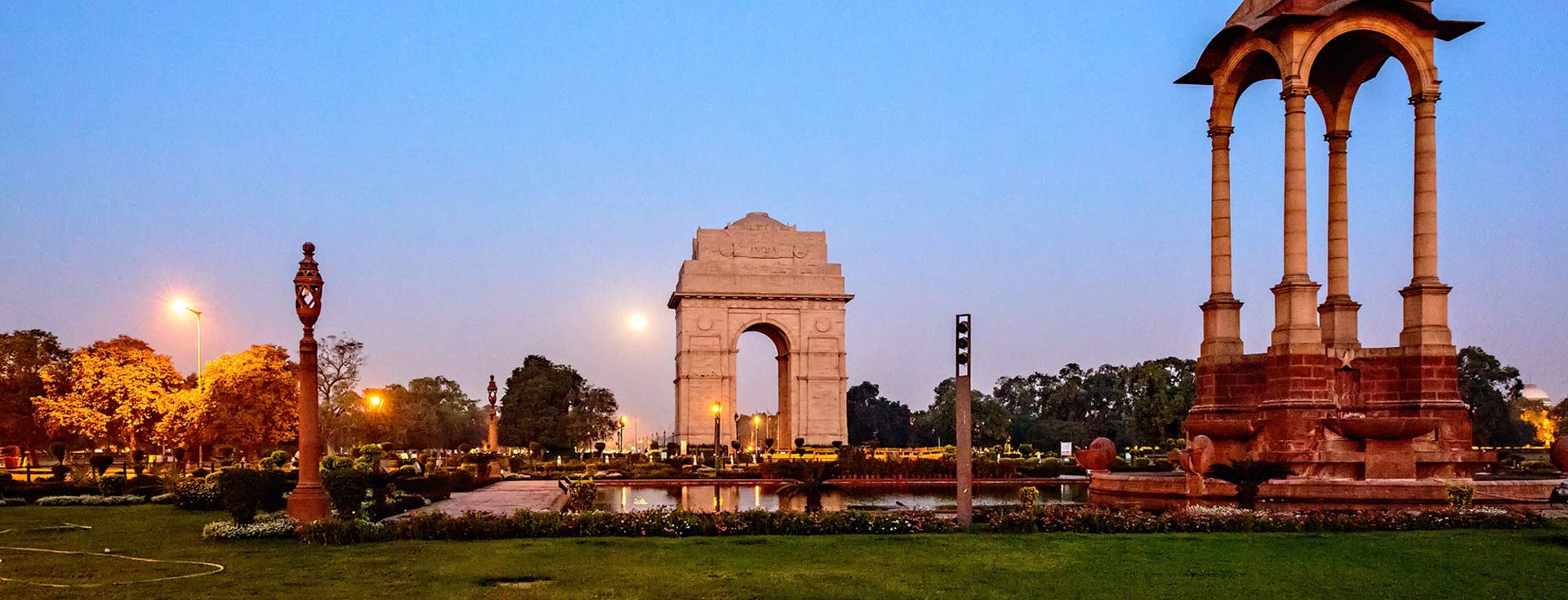
Delhi is India’s federal production gateway and the operational centre of the National Capital Region (NCR), where Delhi, Gurugram and Noida function as a single production ecosystem despite spanning multiple jurisdictions. Within that triangle a single working day can move a crew through three police jurisdictions, two state governments and one Union Territory, and most production teams operating here treat it as one location rather than three. Our Indian operations sit under line producers in India, with Delhi running as the standalone production hub for North India, federal-permit gateway, NCR labour and equipment pool, and the operational base for any production needing the federal permitting ecosystem or the Mughal-heritage location range. Extensions into Rajasthan, Uttarakhand and the Himalayan belt route through Delhi but are secondary to the city’s own production geography.
Celluloid Pact has coordinated productions across Delhi, Noida and Gurugram spanning feature films, commercials, documentaries and international productions requiring federal clearances, heritage permits and multi-jurisdiction coordination. Our Delhi desk works alongside the wider India network to deliver permitting, crew, equipment, studio access and cross-state production management through a single accountable line producer. The line producer Delhi desk holds the budget, schedule, crew and cross-jurisdiction permit plan, while the location fixers manage daily execution across Delhi, Noida and Gurugram.
This page explains how film fixers in Delhi and the line producer team coordinate shoots across Delhi, Gurugram and Noida as one NCR production corridor. Permits, route logistics, weather windows, the Gurugram corporate stand-in market that quietly powers a lot of international FDI and brand work, and what it takes to engage a single line producer or film fixer in Delhi for the whole geography. Heritage city deep-dives for the Rajasthan corridor live on a separate page; this one focuses on Delhi and the surrounding NCR footprint.
How Delhi’s production corridor operates
Two things shape every shoot here: Delhi’s role as the federal capital, and the way the surrounding sub-regions function as one labour and equipment market. A line producer operating across Delhi, Gurugram and Noida is really managing both, the permit ceiling that comes with federal locations, and the floating crew and equipment pool that moves between Gurugram, Noida and Delhi each day. That day-to-day floor is where a film fixer in Delhi plays a critical operational role, coordinating an MCD application on Monday, a Gurugram property call Tuesday, a Noida police intimation Wednesday, without the sequence ever leaving the line producer’s schedule.

Delhi as the northern hub for Rajasthan productions
For most international and high-end Indian productions shooting Rajasthan, Delhi is not a destination but a staging post. Crews fly into Indira Gandhi International, clear customs on equipment carnets at the IGI cargo terminal, and road down to Jaipur via the Delhi–Jaipur expressway. The expressway runs Delhi to Jaipur in roughly four and a half hours off-peak, which makes Delhi the practical equipment base for the entire Rajasthan circuit. Film fixers in Delhi handle the corridor north into film fixers in Rajasthan work, permit transfer between Delhi-side film cells and Rajasthan-side palace authorities is a regular Delhi-hub job.
Generator trucks, lighting packages, vintage vehicles, picture cars and bulk grip move overnight Delhi to Jaipur and onward to Jodhpur, Udaipur or Jaisalmer. Base camps for the line producer team often sit Delhi-side, production offices, accounts, customs coordination and equipment staging, while the shoot floor lives in Rajasthan. If your project is Rajasthan-led, the film fixers in Rajasthan page covers the city-by-city operations from Jaipur through Jaisalmer; this page covers the Delhi end of that pipeline.

Delhi as a single working production geography
Inside the triangle, four jurisdictions overlap on a single shoot day. NDMC governs the Lutyens and central diplomatic zone, Kartavya Path, India Gate, Connaught Place, Khan Market. MCD covers the rest of Delhi proper, including Old Delhi, Saket, Vasant Kunj and the outer ring. HSVP together with Gurugram police governs the Haryana side, Cyber City, the Aravalli forest belt, DLF’s golf-and-tower clusters. Noida Authority and UP Police govern the eastern side, Noida sectors, Film City, the expressway to Greater Noida. A film fixer in Delhi team operates the four sub-regions (Delhi, NCR, Noida, Gurugram, also written as Gurgaon) as one working footprint, crew, equipment houses, and post facilities all sit inside the same corridor.
A crew can shoot Noida Film City in the morning, move to Cyber City Gurugram for an afternoon commercial setup, and wrap with a Lutyens Delhi exterior the same evening. Equipment hire usually comes out of Noida Film City, the largest concentration of cameras, lights, generators and studio space in the north. Crew, costume and art-department vendors are spread across Delhi and Gurugram. Production base camps default Delhi-side because federal permits, embassy coordination and customs all sit there. The line producer in Delhi role is essentially holding this four-way jurisdiction together for the duration of the shoot.
Sub-location coverage, Lutyens zone, Old Delhi, Connaught Place, Gurgaon-Noida tech corridor
Delhi covers a wide range of looks within one production geography. Mughal heritage shoots anchor at the Red Fort, Humayun’s Tomb and Old Delhi’s lanes. Colonial Lutyens’ Delhi around Connaught Place and the government quarter handles the central-government and political-drama register. The modernist Gurgaon-Noida tech corridor doubles as a stand-in for global corporate and East Asian commercial settings. A line producer in Delhi works all four sub-regions as one labour and equipment market: vendors, lights, and crew move daily between Lutyens, Old Delhi, Gurgaon and Noida.
Gurugram as a corporate stand-in for China and East Asia

A quieter but commercially significant value of the Delhi production corridor: Cyber City Gurugram is the most used stand-in location in India for China, Hong Kong, Singapore and the broader East Asian corporate glass aesthetic. The DLF Cyber City and Cyber Hub clusters, the towers along Golf Course Road, and the newer M3M and Two Horizon zones together carry the closest visual match in the country to a Shanghai Pudong, Hong Kong Central or Singapore CBD plate. Productions assembling China and East Asia frames in Gurugram pull film fixers in Delhi for the corporate-permit interface, building lobbies, atrium access, and security cooperation work through the same Delhi-side film fixer relationships.
Advertisers routing through Gurugram
International advertisers and feature productions that need an Asian financial-district plate that can be easily dressed to resemble Shanghai, Hong Kong or Singapore route the shoot through Gurugram instead of paying full Hong Kong or Singapore rates. Film fixers in Gurugram coordinate access to the corporate-glass office towers that make up most of this stand-in inventory, subject to each property’s own filming approvals and availability. Brand films for global banks, consulting firms, telcos and tech companies route through this market routinely.
Delhi production routes
Almost every Delhi-region shoot involves cross-region movement. The numbers below are the working distances and times we plan against, useful for scheduling call sheets, locking transport quotes and deciding which side of the triangle the unit bases out of. A line producer in Delhi brief planning the regional production routes balances NH-8 to Gurugram, the Yamuna Expressway to Noida, and the NH-48 corridor onward to Jaipur, each route has its own daily-time window.
Distance, drive time and weather windows
| Route | Distance | Off-peak | Peak hour | Best shoot window |
|---|---|---|---|---|
| Lutyens Delhi ↔ Cyber City Gurugram | ~30 km | 45 min | 90 min | Oct–Mar AM |
| Lutyens Delhi ↔ Noida Film City | ~22 km | 40 min | 75 min | Oct–Mar AM |
| Cyber City Gurugram ↔ Noida Film City | ~45 km | 70 min | 2 hrs | Oct–Mar |
| IGI Airport ↔ Lutyens Delhi | ~18 km | 30 min | 60 min | year-round |
| IGI Airport ↔ Old Delhi (Red Fort) | ~22 km | 45 min | 90 min | Oct–Mar AM |
| IGI Airport ↔ Jaipur (Rajasthan corridor) | ~270 km | 4.5 hrs | 5.5 hrs | Oct–Mar |
Peak hour across the Delhi corridor is wider than most cities, roughly 8.30 to 11.00 in the morning and 5.00 to 8.30 in the evening, with Gurugram–Delhi traffic at Mahipalpur and the DND flyway into Noida being the two reliable choke points. Schedules that ignore these windows lose a unit hour every shoot day.

Weather and air-quality calendar
Delhi has a sharp seasonal calendar that productions plan against, not around. October through March generally offers the most favourable shooting conditions, cold mornings, clear afternoons, comfortable crew conditions and the cleanest light Delhi gets, despite occasional winter fog and seasonal air-quality fluctuations that shift call sheets. International features and most premium ad films lock dates inside this band.
Two complications inside the prime band. December and January carry early-morning fog from roughly six to ten, visibility can drop under 100 metres, which kills exterior wides but creates the soft diffuse light some productions chase. November carries the stubble-burning AQI spike from neighbouring Punjab and Haryana fields; productions with talent sensitive to air quality push schedules into late December or February.
Operational costs: dust, AQI, fog and heat
Delhi weather imposes operational costs beyond the calendar itself. Summer months push generator cooling schedules to the limit and heat-haze affects long-lens sharpness on outdoor shoots. Winter fog compresses working daylight and forces call-sheet adjustments; foggy Delhi mornings routinely delay outdoor units until 09:30 or 10:00 through late December and January. AQI monitoring becomes a daily production-management task from October through February. When AQI reaches severe levels, productions commonly issue respirator masks to crew, increase indoor holding time and adjust outdoor schedules to protect talent and unit health. Dust contamination on lenses and glass matte-boxes is a year-round concern in the outer NCR belt around Gurugram and Noida, and cleaner-and-cover kits sit inside every camera department’s daily standard.
April through June brings dust haze, 40+ degree heat and harsh midday light, film fixers in Gurugram and Noida typically restrict exterior windows to before nine and after five through these months. Monsoon from July to September is the lightest production season; humidity damages camera packages and unpaved Aravalli or Yamuna-bank locations turn unusable. A Delhi line-production team planning a year-round commercial calendar generally treats April–September as studio-and-interiors months.
Permits, jurisdictions and clearances across Delhi and the corridor
Permits across Delhi and the surrounding production corridor are layered. A single location can sit under three authorities at once: the city municipality for the street and crowd, the federal agency for the building, and the police for everything in between. Lead times scale with how many of those layers you trigger.

Delhi-side film permissions
NDMC handles the central diplomatic and ceremonial zone, Kartavya Path, India Gate, Connaught Place, Khan Market, Lodhi Garden, the entire Lutyens grid. NDMC film-shoot applications are processed inside two weeks for standard requests; sensitive areas around the Rashtrapati Bhavan vista require central clearance instead. MCD handles the rest of Delhi, Old Delhi, Saket, Vasant Kunj, Dwarka, the outer ring. MCD lead time is similar but the office split makes coordination slower. Film fixers in Delhi coordinate with the Delhi Police Film Cell, the NDMC permission desk and the DTTDC e-Film Clearance system, the three-window stack that every Delhi production day-1 application clears.
Delhi Police clearance is a separate track for any street-level or public-space shoot, the application goes through the local police station with jurisdiction over the location. Generator trucks, road blocks, action sequences, drone operation and crowd handling all require police sign-off in addition to the municipal permit. National film permission runs through the India Cine Hub / MIB single-window, while Delhi location permissions run through DTTDC’s e-Film Clearance system. Federal locations and any shoot that touches the Defence belt, the embassy belt in Chanakyapuri or the Parliament radius need central clearance and a written brief approved by the relevant ministry, filed well ahead of the shoot.
Cross-border production layers, Haryana and Uttar Pradesh
Gurugram is the second-largest production zone in the Delhi corridor after central Delhi itself. Permits run through Gurugram police plus individual property NOCs, DLF for the Cyber City glass towers, individual corporates for the FDI office stand-ins, and the Haryana forest department for any shoot in the Aravalli green belt. The China and East Asia stand-in market noted earlier runs on these same property NOCs, which is why a Gurugram-experienced line producer compresses the permit timeline materially below what a Delhi-only fixer can offer for the same corporate-glass shoot. A film fixer in Delhi unit operating across the Haryana (Gurugram) and Uttar Pradesh (Noida) jurisdictional lines runs three parallel film-cell applications in tandem, Delhi, Gurugram, and Noida each have their own format and lead time.
The Noida jurisdiction: sector permits and equipment corridor
Noida runs on a different model. The Noida Authority handles sector-level permissions, UP Police handles street and public-space clearance, and Film City inside Sector 16A operates as a studio campus with its own internal booking system. Most equipment hire for the Delhi corridor comes out of Noida Film City, cameras, lights, gennies, grip, and studio floor space. A line producer Noida role is typically a hybrid: shoot coordination plus equipment-hire coordination from the same corridor.

Sensitive zones and ASI properties
The Archaeological Survey of India runs a completely separate clearance track for heritage monuments. Red Fort, Qutub Minar, Humayun’s Tomb, Old Fort, Safdarjung’s Tomb, Jantar Mantar and roughly thirty other ASI-protected sites across Delhi and the surrounding corridor are not bookable through NDMC or MCD, the ASI head office in Janpath handles every application directly. Lead time runs four to six weeks; sound recording inside ASI properties is rarely cleared, visual capture is cleared with restrictions on lighting rigs, generator placement and crew count.
The Defence belt from Dhaula Kuan to Cantonment, and the embassy belt in Chanakyapuri, are restricted zones in practice. Visual capture of embassy facades is technically permissible from public roads but operationally discouraged; the line producer team usually negotiates a workable angle that keeps the unit clear of the embassy perimeter. Parliament complex, North Block, South Block and Lok Kalyan Marg are sensitive central-government zones. Filming feasibility and the required permissions must be confirmed for the specific brief before scheduling.
Drone permissions and Delhi airspace
Drone filming across Delhi and the NCR requires compliance with India’s DGCA Digital Sky system and applicable airspace restrictions. Large parts of Delhi fall within controlled or restricted airspace because of the proximity to Indira Gandhi International Airport (IGI), Palam Air Force base, and multiple defence and government installations. Central Delhi contains red and restricted airspace. Any proposed flight must follow the permissions applicable to that zone through Digital Sky and the relevant central authorities. Gurugram and Noida carry their own restrictions around defence contractor properties and government sector boundaries. Drone and aerial work depends on the specific location and airspace classification; India Cine Hub aerial-filming guidance advises applying at least two months ahead for airport or aerial filming, and a line producer in Delhi holds a backup ground-based coverage plan for zones where clearance timelines slip.

Rate ranges for Delhi productions
The numbers below are Celluloid Pact planning estimates and working bands, not vendor quotes or published rate cards. Actual rate depends on the project tier, the season, the crew’s credits, and the equipment package spec. Delhi is meaningfully below Mumbai for crew and equipment on the mid-tier band, comparable to Hyderabad and Bengaluru, and above Jaipur or the Rajasthan corridor. For international productions weighing multi-jurisdiction rebate stacking against straight cost comparisons, our tax incentive and rebate consulting coverage walks through the state and central subsidy layers Delhi productions typically stack.
Typical professional day rates commonly fall within the ranges below depending on project scale, credits, equipment package and seasonal demand. Rates fluctuate with peak-season demand, senior-tier availability and the specific vendor relationships a production carries. Treat the bands as a working baseline for budgeting rather than fixed prices.
Crew day rates by role
Indicative Delhi day rates for a mid-tier feature or OTT shoot: a working line producer runs roughly ₹20,000–60,000 per day depending on tier and credits; a DOP ₹25,000–1,20,000; a gaffer ₹3,500–7,000; a focus puller ₹4,000–9,000; an art director ₹12,000–40,000. Production designer rates typically lock as project fees rather than day rates. Costume, hair-makeup, sound and set-dec department day rates sit in similar bands with department-head premiums above. International-tier crew rates run two to four times these numbers with corresponding rider provisions.
Equipment hire and studio rentals
Camera package day rates in Delhi: ARRI Alexa Mini LF body around ₹35,000–55,000 plus lens and support; Red Komodo around ₹22,000–32,000; Sony Venice in the ARRI band. Most Delhi productions source lighting and grip out of Noida Film City vendors, package rates run ₹40,000–1,20,000 per shoot day for lighting depending on fixture count. Grip trucks, hi-hats and condors carry separate hire lines. Sound stage hire at Noida Film City runs from ₹40,000 per day for a small stage to ₹2,50,000-plus for a premium stage with full power, ventilation and grid access.
Production office, per diem and accommodation
Production offices in central Delhi run ₹80,000–3,00,000 per month depending on location tier, Connaught Place and Nehru Place premium bands, Saket and Gurugram Cyber City mid-band, Noida Sector 18 workable-band. Crew accommodation splits by tier: budget hotels around Karol Bagh and Paharganj ₹3,000–7,000 per room-night, mid-tier chains in South Delhi and Gurugram ₹7,000–15,000, premium and international-brand hotels in Chanakyapuri, Aerocity and Cyber City ₹15,000–40,000. Per diem allowances for domestic crew run ₹1,500–3,500 per shoot day depending on tier; international crew per diems run to international standards with local top-ups.

Why international studios choose Delhi
International studios routing productions through Delhi and the NCR draw on a specific commercial infrastructure that Indian cluster peers cannot replicate at the same scale. The federal-permit gateway is the most tangible piece: Delhi is where the federal permitting ecosystem is centred, embassy coordination happens, and any shoot needing federal-tier clearance, defence property access, or diplomatic-quarter permits routes through the Delhi line producer network by default. Foreign productions needing central MIB or India Cine Hub approval and MEA introductions run those tracks out of the Delhi office rather than the shoot city.
Multilingual crews and embassy access
The Delhi crew bench carries the deepest multilingual coverage in the Indian cluster: Hindi, English, Punjabi and Urdu across all senior heads, with fluency in French, German, Spanish and Arabic available through the diplomatic-quarter interpreter network at day-rate. Embassy liaisons for filming permissions on diplomatic property, foreign-cultural-institute grounds and international-school locations run through the same relationship layer. International brand films for global banks, consulting firms and telcos that need embassy-quarter or Chanakyapuri backdrops route through Delhi for exactly this access.
IGI customs and Rajasthan gateway logistics
Indira Gandhi International Airport (IGI) is one of India’s busiest international air-cargo gateways for film equipment entering North India. Customs clearance at the IGI cargo terminal runs on established freight-forwarder relationships that the Delhi line producer network maintains as standing infrastructure, not per-shipment negotiation. Equipment arriving at IGI for a Rajasthan heritage shoot typically clears customs, transits through the Delhi equipment corridor, and reaches Jaipur on the same working day via the Delhi-Jaipur expressway. Our film fixers in Rajasthan network takes the equipment onward through Jaipur, Jodhpur, Udaipur and Jaisalmer, Delhi as the corridor entry, Rajasthan as the shoot floor.
Corporate stand-ins, railway infrastructure and heritage inventory
Beyond federal access, Delhi carries three distinct visual inventories international productions rely on. Cyber City Gurugram’s corporate-glass towers stand in for Shanghai, Hong Kong and Singapore financial districts, the closest Asian financial-district visual match available in the Indian cluster. The Northern Railway network out of Old Delhi, New Delhi and Nizamuddin stations opens rail-set access (motor rooms, freight yards, station platforms) that few production markets globally can offer at the same permit depth. Mughal-era heritage properties across Old Delhi, Red Fort, Humayun’s Tomb, Purana Qila and the Lodi Gardens complex sit on the ASI Janpath office’s permit register, with lead times of 4–6 weeks for standard clearances and expedited tracks available for pre-approved productions. Sibling access into the Mumbai crew and equipment market runs through our Line Producer Mumbai desk when a project needs both federal-permit gateway and Bollywood-scale studio infrastructure.
Engaging a line producer in Delhi
Engaging a line producer in Delhi means working a single operator across India Cine Hub / MIB national permissions and DTTDC e-Film Clearance location permits, ASI clearances for Red Fort and Humayun’s Tomb, and the daily Lutyens / Gurugram / Noida crew rotation. A film fixer in Delhi typically handles the city’s permit interface and on-ground coordination; the line producer in Delhi holds the schedule, budget, vendor chain and customs interface end-to-end, so the foreign or out-of-state producer signs one contract rather than negotiating each NCR vendor independently.
The line producer and film fixer split
Beneath the line producer sits our film fixer in Delhi desk, the operational execution layer handling day-to-day permit coordination with MCD, NDMC and the DTTDC e-Film Clearance system, vendor onboarding across Gurugram-Noida-Delhi crew houses, ATA Carnet routing through IGI cargo, and the daily paperwork that keeps the shoot legal on set. The line producer holds the schedule, budget and cross-jurisdiction contracting; a film fixer in Delhi runs the ground reality that keeps those layers moving in parallel.
Delhi-region shoots are almost never single-jurisdiction. A typical week pulls a unit across MCD, NDMC, Gurugram and Noida, sometimes all four in a single day. That cross-region reality is what makes a single line producer the right structural choice over a Delhi fixer plus separate Noida and Gurugram fixers.

Why a single line producer covers all four sub-regions
The shot above is from a Celluloid Pact shoot inside a Delhi railway motor room, the kind of unusual-access setup that needs the Railways NOC, station-master coordination, MCD for the platform side, Delhi Police for the public area outside, and a base camp arrangement that works around suburban train timings. That is one shoot day with five clearance streams in the background.
A line producer holding the Delhi corridor coordinates with NDMC, MCD, Gurugram police, Haryana forest department, Noida Authority, UP Police, the ASI Janpath office and the central film-permission desks. Filing applications in parallel rather than sequentially, and mapping the multi-authority sequence at the budgeting stage, is what keeps the permit calendar realistic, without changing the formal approval requirements or their statutory timelines. A line producer in Delhi pairs with film fixers in Delhi as one combined desk so the brief covers the metropolitan administrative complexity from a single accountable position rather than juggling four sub-region contacts.
Why the split-fixer model breaks down
Splitting the role into a Delhi fixer, a Noida fixer and a Gurugram fixer creates handoff gaps on cross-border shoot days, and roughly doubles the coordination overhead, three separate briefings, three quote streams, three approval chains. International productions that try the split model usually consolidate to one line producer in Delhi after the first scout, because the corridor is functionally one production market.

Working examples from our Delhi production slate
The Chandni Chowk frame above is from a Celluloid Pact handheld unit working the Old Delhi lanes, permit-wise this is the MCD-and-Delhi-Police-together pattern, with controlled crowd flow handled by the location team on the day rather than through a hard street closure. Old Delhi shoots compress fastest when the line producer team understands which lanes accept small-footprint setups versus which need an early-morning clear window.
Rail interior shoots like the one above are a separate clearance track again, Indian Railways NOC out of Rail Bhavan, station-master sign-off for the platform, and a tight blocking window between scheduled trains. The Delhi railway hub has more bookable interior options than any other city in the country, which is why Delhi keeps showing up as the chosen location for rail-set scenes even in scripts that have no other Delhi connection.
Lead times and budgeting by sub-region
The lead times below are Celluloid Pact planning estimates, not published authority service standards. Planning lead times: three to four weeks for a Delhi-only shoot with municipal permits; two to three weeks for a Gurugram-only commercial setup; two weeks for a Noida Film City studio booking. Federal locations or ASI monuments push the timeline to six or eight weeks; embassy belt or Defence zone shoots need eight to ten and a clear narrative justification. Engaging film fixers in Delhi early in the budgeting stage helps sequence the multi-jurisdiction filing across NDMC, MCD, ASI, Railways and the Police layers so the calendar stays realistic. The wider line producer India infrastructure covers cast booking, DOP attachment, and the financial structuring that Delhi-hub productions need.
Delhi-region shoot day rates sit mid-tier in the Indian production market, meaningfully below Mumbai for crew and equipment, comparable to Hyderabad and Bengaluru, above Jaipur and the Rajasthan corridor. The arithmetic that matters for international productions is the corridor advantage: Delhi as a permit base and corporate stand-in market, Rajasthan as the heritage shoot floor, and a single line producer in Rajasthan holding both ends. That is the operational shape most of our Delhi-region briefs end up taking.

Frequently asked questions
How much does a line producer cost in Delhi?
Line producer day rates in Delhi typically run between INR 20,000 and INR 60,000 per shooting day depending on credits, project scale and shoot complexity. For feature and prestige TV work, senior line producers usually engage on a project-fee basis covering prep, shoot and wrap phases; commercial and OTT-episodic work typically runs on day-rate contracts. International productions bringing federal-tier permit requirements typically engage at the senior tier for the compliance layer alone.
How long do Delhi filming permits take?
NDMC and MCD location permits typically clear in 7 to 14 working days for standard public-location shoots. ASI clearances for heritage properties (Red Fort, Humayun’s Tomb, Purana Qila) run 4 to 6 weeks. Sensitive-zone approvals (federal properties, defence-adjacent areas, Parliament Street and North Block) can extend to 6 to 8 weeks. Noida Film City studio bookings run on separate lead times managed directly with the studio floor. Multi-jurisdiction shoots benefit from parallel application filing which a Delhi line producer handles routinely.
Can foreign crews film in Delhi?
Yes, but the national approval and visa route depends on the production format. Features and eligible television or web productions generally require MIB project approval before the appropriate film visa, while documentaries, AV commercials and music videos follow the applicable MEA approval route. Delhi location permissions remain separate, and current crew, visa and union requirements should be confirmed before travel. See the India Cine Hub FAQ.
Can you shoot at India Gate?
India Gate is a federal-tier public monument on Kartavya Path. Filming permissions require NDMC coordination, Delhi Police clearance for crowd control on the surrounding lawns, and CPWD sign-off for the monument-side plot. Commercial shoots require additional MIB approval. Standard lead time is 3 to 4 weeks for straightforward requests; complex setups involving vehicle bans, night shoots or aerial coverage run longer.
Does ASI require separate approval for heritage properties?
Yes. All ASI-protected properties in Delhi (Red Fort, Humayun’s Tomb, Purana Qila, Qutub Minar, Safdarjung’s Tomb, the Lodi Gardens tombs) require separate ASI clearance from the Janpath office in addition to MCD or NDMC location permits. ASI applications typically run 4 to 6 weeks and require detailed submissions covering shoot activities, equipment lists, crew size and impact-mitigation plans.
Is Noida Film City available for international productions?
Yes. Noida Film City in Sector 16A operates as a studio campus with multiple sound stages, back-lot sets, in-house equipment rentals and production office space. Bookings run through the studio’s internal system with standard rates and terms. International productions can hire studio floors directly, and most Delhi-corridor productions source lighting and grip packages from Noida Film City vendors even when shooting outside the studio.
Can Delhi double for other cities?
Yes, extensively. Cyber City Gurugram doubles for Shanghai, Hong Kong, Singapore and other Asian financial districts. Central Delhi’s Lutyens zone stands in for British colonial administrative capitals, Islamabad, Colombo or generic South Asian government-district plates. Old Delhi’s narrow lanes read as generic developing-world urban texture for documentary and drama. The diplomatic quarter around Chanakyapuri stands in for European embassy zones or generic international-organization campuses.
When is the best season to film in Delhi?
October through March is the prime window: cool mornings, clear afternoons, comfortable crew conditions, cleanest light. Winter fog through late December and January delays outdoor starts and AQI spikes in November require air-quality mitigation. April to June is peak summer with heat-haze issues and dust contamination on outdoor shoots. July to September is monsoon with rain-day risk and humidity that pushes most productions to studio interiors. International productions targeting the prime window should book crew and equipment 3 to 4 months in advance.
