

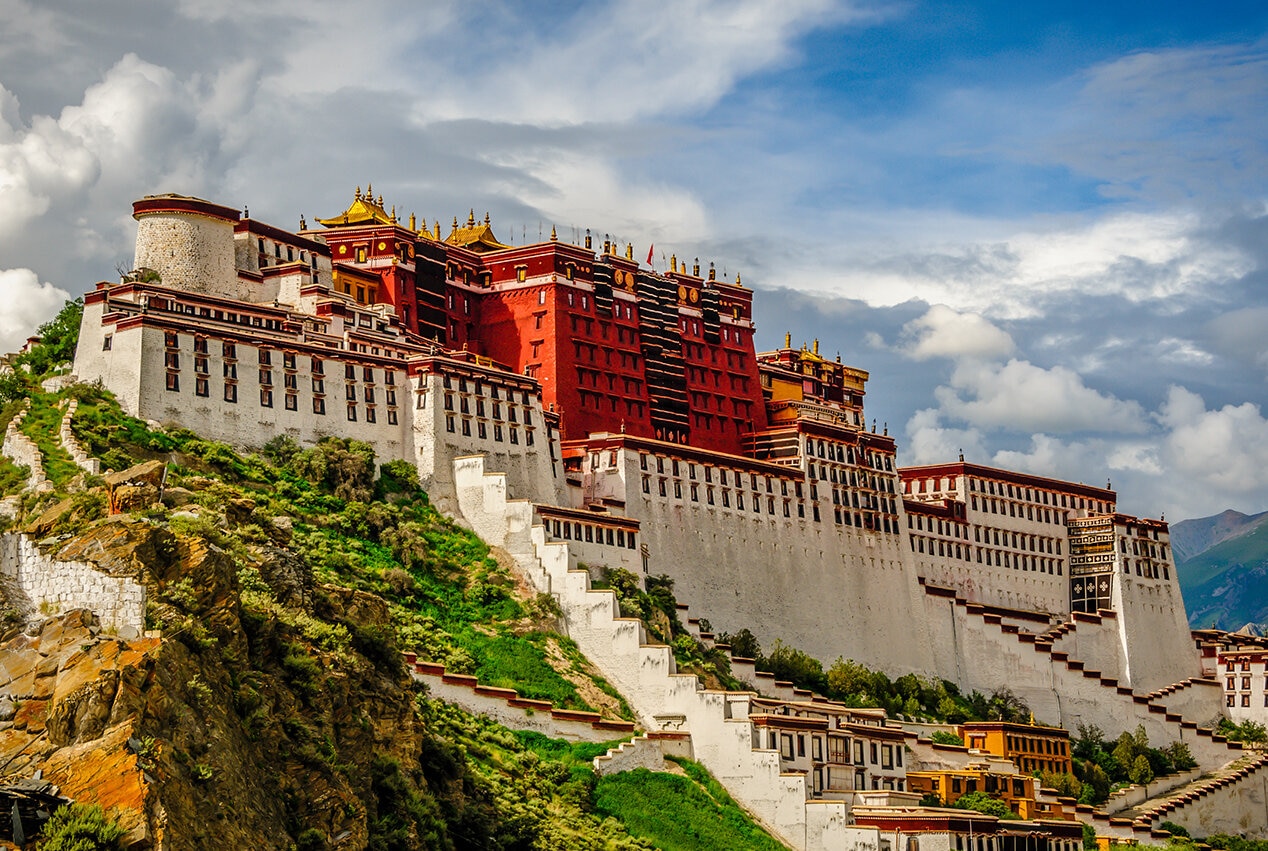
Tibet film permits are among the most heavily governed clearances in the world. Tibet Autonomous Region is not a permit territory a foreign production can approach directly. Foreign productions cannot approach TAR the way they approach Morocco, Portugal or Thailand. There is no dedicated Tibet film office issuing permits directly to foreign crews, no cash rebate scheme, and no independent journalist accreditation route into the region. Every foreign production wanting to shoot inside TAR must enter through the mainland Chinese framework, and that framework has one mandatory entry point: the China Film Co-Production Corporation.
This documents the actual China-side permit chain, the March 2023 amended Sino-Foreign co-production regulations, the Chengdu logistics base most productions use, and the realistic access track record. It sits alongside our Tibet and Myanmar stand-in filming routes page, which covers the stand-in alternative most producers end up choosing when the co-production route proves too slow or the script does not clear review.
The structure below moves from the permit chain, through the co-production categories, into Chengdu crew and equipment logistics, then the physical and access constraints inside TAR itself, and closes with the stand-in path for productions that decide the real-Tibet route is not viable.

The Chinese Film Administration permit chain for TAR-shot productions
Any foreign production wanting to shoot on mainland Chinese territory, including TAR, moves through three separate authorities before a single frame is captured. The chain is sequential, not parallel, and each stage has its own review clock. Producers new to the process consistently underestimate the total lead time, and Tibet film permits routinely take longer than any other China-side clearance.
China Film Co-Production Corporation as the mandatory applicant
CFCC is the state-owned corporation designated as the sole official applicant for foreign filming projects intending to shoot on Chinese territory. A foreign producer cannot apply directly. The producer must first partner with a licensed Chinese production entity, which then routes the application through CFCC. CFCC negotiates the shape of the arrangement, files the paperwork with the Chinese film authorities for project approval, and holds the Permit for Chinese-Foreign Film Co-production once granted. This is the choke point. Without CFCC engagement there is no legal on-ground filming in China.
CFCC is headquartered in Beijing and operates as a division of the China Film Group Corporation. In practice, the CFCC intake team assesses whether the proposed project has the shape and thematic content likely to clear the wider approval chain before it accepts the file. Projects flagged as sensitive can be quietly discouraged at the intake stage without formal rejection, which producers should read as a signal to restructure or withdraw. CFCC also charges a coordination fee, structured as a percentage of the Chinese-side budget line, that must be built into the co-production financial model from the start.

NRTA script review and the Standard Chinese requirement
The film script must be submitted in Standard Chinese characters, not a translation the Chinese partner assembles later. Provincial radio and television departments conduct first review, then escalate to the National Radio and Television Administration for formal examination. The review is substantive: NRTA assesses ideological alignment, political sensitivity, and thematic content. Anything relating to Tibet, Xinjiang, or border regions receives heightened scrutiny. Scripts with Tibetan religious content, Dalai Lama references, or independence themes will not clear. Productions that revise scripts to remove flagged content restart the review clock.
NRTA review runs on two parallel tracks, thematic review and technical review. Thematic review is the substantive one. Reviewers assess script content against a working list of sensitive categories that includes religious content, ethnic minority framing, historical revisionism, and geopolitical alignment. Technical review checks production feasibility, budget realism and the Chinese partner’s capacity to deliver. Feedback typically arrives as a written notice specifying which script elements require revision, with a timeline for resubmission. Producers who fight the feedback rather than revise routinely see their applications drift into administrative limbo.
TAR extra layer, the Foreign Affairs Office pre-approval
TAR is the only Chinese region that requires an additional Foreign Affairs Office approval on top of the CFCC and NRTA workflow. This is a China Foreign Affairs Office authorisation covering foreign nationals entering the region, and it applies to filming crews the same way it applies to independent journalists. The application must specify precise dates, locations, personnel and equipment. Government-supervised group visits organised through the State Council or Ministry of Foreign Affairs are the standard entry format. Independent, self-directed access is not part of the workflow.
Sino-Foreign co-production categories and the workable path into TAR
The Administrative Regulations on Sino-Foreign Television Drama Co-Productions were first promulgated in 2004 and amended in March 2023. The framework recognises three formal categories of foreign involvement, and only one of them opens meaningful TAR access.
Joint, assisted and entrusted arrangements
A joint production means the Chinese and foreign parties share investment, creative control and distribution rights. An assisted production means the foreign party provides funding and creative direction while the Chinese partner handles on-ground execution. An entrusted production means the foreign party fully commissions the Chinese partner to produce on their behalf, with limited foreign creative involvement. Joint productions receive the most favourable treatment for TAR access because Chinese authorities view the shared-control structure as reducing political and editorial risk. Assisted and entrusted formats face harder scrutiny for sensitive regions.

The licensed Chinese partner requirement
The Chinese entity acting as your partner must hold a valid film production permit issued by the relevant provincial radio and television bureau. Not every Chinese production house holds this permit. Partner selection is one of the most consequential early decisions because the partner controls script filing, permit routing and, if it comes to it, script revision negotiations with NRTA. Partners with prior CFCC filing experience and existing NRTA relationships materially shorten the timeline. Producers who choose a partner on cost alone frequently spend the difference in delayed approvals.
Realistic approval timeline and script revision cycles
A joint co-production application with a compliant script and experienced Chinese partner typically clears in 6 to 9 months from first CFCC filing to Permit for Chinese-Foreign Film Co-production. Applications requiring script revision extend to 12 to 18 months. TAR-shot projects add 2 to 4 months for the Foreign Affairs Office layer. Producers pitching TAR content to distributors should model 18-month lead times as the working assumption, not 6 months. Attempting to compress this by scheduling ambitious travel dates before the co-production permit is granted routinely fails, both the crew and equipment cannot legally enter.
Full multi-jurisdiction structuring across incentive and permit frameworks is documented in our tax incentive and rebate consulting, which covers how co-production budgets stack against direct-permit territory options in the same region.
Chengdu as production base and Chinese crew rate benchmarks
Almost every foreign production filming in TAR uses Chengdu, capital of Sichuan Province, as the operational base rather than Lhasa itself. Chengdu holds the equipment rental depth, the crew market, and the flight-plus-rail connections into TAR that Lhasa cannot match on its own. The pattern is consistent enough that Chengdu functions effectively as the Tibet gateway, similar to how Kathmandu serves Nepal Himalayan productions.

Chengdu equipment rental and crew depth
Chengdu holds one of the top three film equipment rental markets in western China, alongside Chongqing and Xian. Camera packages, grip and lighting, sound and playback equipment can all be sourced locally. Beijing remains the deepest market for high-end packages, and larger productions ship gear from Beijing to Chengdu by rail before the Tibet transfer. Chengdu crew bench includes bilingual DPs, gaffers, key grips, sound recordists and production coordinators with prior TAR shoot experience. Chengdu crews understand altitude protocols, cold-weather rigging and the specific documentation TAR entry requires.
Rental depth in Chengdu covers Arri Alexa Mini and 35, Sony Venice, and Red Komodo camera packages, plus standard cine lens sets from Zeiss and Cooke. Specialist equipment (technocranes, remote heads, Motion Control rigs) typically ships from Beijing or Shanghai. Post infrastructure inside Chengdu handles dailies review and rough-cut work, but final grade and VFX pipelines route to Beijing or Shanghai facilities. Productions running tight schedules should factor the equipment logistics from Beijing into Chengdu into the pre-production timeline, adding 5 to 7 days for rail transfer and pre-check before TAR entry.

Crew day-rate benchmarks in Chengdu
Working benchmark ranges published by production coordination firms operating in Chengdu place a full crew package with camera operator, sound and basic lighting at US$1,500 to US$5,000 per day depending on shape and equipment class. Individual camera operators run US$200 to US$400 per hour for spot work, sound technicians and assistants sit lower. These rates are Chinese-national rates, not the premium foreign-crew-in-China rates. Bringing foreign HODs from Beijing or Shanghai adds domestic travel and per-diem, but the base crew day-rate is generally competitive with Southeast Asia benchmarks for equivalent skill levels.
Kathmandu as the secondary logistical gateway
Chengdu is the standard base, but Kathmandu functions as the second working gateway to TAR for productions where the Nepal-side geography is already part of the shoot. The Kathmandu-Lhasa air corridor is one of only two international flight routes into TAR, and the overland Kerung border crossing remains active when CFCC has pre-cleared the entry point. Productions combining northern-Nepal filming (Mustang, Everest South Base Camp, Annapurna) with a TAR-side sequence typically stage the Nepal legs first, then transit through Kathmandu. The Line Producer Nepal covers the Kathmandu-side crew market and permit workflow.
Transport into TAR, permits, cargo and customs
Equipment moves from Chengdu into TAR by either the Chengdu-Lhasa flight route or the Qinghai-Tibet railway. Both require pre-cleared cargo manifests filed against the co-production permit. Camera gear, lighting rigs, drones and specialist equipment must be listed by serial number on the manifest. Anything undeclared risks confiscation at the TAR entry checkpoint. ATA Carnet is not the standard route for China, most productions use CFCC-coordinated temporary import filings instead. Drones face additional Civil Aviation Administration of China clearance on top of the film permit, and drone use in TAR is subject to case-by-case Foreign Affairs Office approval.
The wider East Asia regional context, including how China co-production timelines compare against Korea and Japan production routes, is covered in the Line Producer East Asia regional network.
TAR physical constraints and the foreign-production access track record
Even with all permits granted, TAR presents physical filming challenges that shape shot design, day count and crew composition. Producers who plan TAR shoots as if they were any other high-altitude location routinely underestimate the pace-of-work reduction and the medical support overhead. Tibet film permits granted on paper do not automatically translate to unrestricted physical filming.
Altitude, weather and medical infrastructure at Lhasa
Lhasa sits at 3,656 metres (11,995 feet), with much of TAR filming country running 4,000 to 5,000 metres. Altitude acclimatisation adds 3 to 5 days before productive shooting begins. Crew members not previously altitude-tested should undergo medical assessment before travel. Oxygen supplementation on set is standard rather than optional. Emergency medical infrastructure inside TAR is thin outside Lhasa itself, and evacuation is complex. Winter temperatures at Lhasa drop below minus 10 Celsius overnight, and battery and lubricant performance on camera and lighting rigs degrades accordingly. Cold-weather rigging protocols are a specialist skill Chengdu crews carry.
Practical impact on shot design is significant. Productions typically drop from a 12-hour crew day to a 9 or 10-hour effective day, plan for reduced physical activity in-shot for actors not altitude-conditioned, and schedule higher-altitude sequences later in the shoot after crew acclimatisation. Camera batteries lose 15 to 20 percent of rated capacity at altitude, so battery inventory doubles compared with sea-level shoots. Two experienced altitude medics per crew is the working benchmark for TAR shoots above 4,500 metres, with portable hyperbaric bags as standard field equipment.

Restricted border zones with India, Nepal and Bhutan
TAR shares borders with India (Ladakh, Arunachal Pradesh), Nepal and Bhutan. The border zones extending 30 to 100 kilometres inland from each frontier are classified as sensitive military areas and are effectively closed to foreign film crews under any permit configuration. This rules out Everest north face access below the base camp perimeter, the Nyalam corridor into Nepal, and any Arunachal-adjacent zones. Iconic locations in Rongbuk Valley have received exceptional case-by-case access for high-profile productions, but the default assumption should be no access rather than permit-restricted access.

The foreign-journalist denial track record and what it signals
The Foreign Correspondents Club of China survey data documents the access reality clearly. Between 2015 and 2018, formal applications from foreign correspondents to visit TAR dropped from 45 to 5 per year, with zero approvals for independent reporting from 2018 onwards. Similar patterns hold through 2022, according to survey data collected by the International Campaign for Tibet. This is not a filming-specific policy, it is the general foreign-access framework, and film crews sit inside the same envelope. Producers should read this as the base rate for permit outcomes on TAR applications, not as a temporary tightening.
When the co-production route is not viable, the stand-in path
A meaningful share of foreign productions that begin the CFCC route ultimately switch to a stand-in filming approach rather than push through the 12 to 18 month co-production timeline. The stand-in path uses Ladakh and Arunachal Pradesh in India, or Bhutan and northern Nepal, as visual doubles for TAR interior and landscape work.
Ladakh, Tawang and Bhutan as visual doubles
Ladakh (India) delivers the high-altitude, Buddhist-monastery, treeless-plateau visual grammar most audiences associate with Tibet. Tawang in Arunachal Pradesh offers Tibetan-Buddhist monastery interiors and exteriors that stylistically read as TAR. Bhutan delivers Buddhist-culture continuity with a more forested register. Northern Nepal (Mustang, Dolpo) offers dry-plateau geography closer to TAR than most substitute options. None of these require Chinese authority clearance. All operate under normal Indian, Bhutanese or Nepalese permit frameworks with vastly shorter lead times.

When to switch and when to hold on the co-production route
The financial case for the stand-in route also matters. A 6-week TAR co-production carries the CFCC coordination fee, the Chinese partner overhead, the Foreign Affairs Office documentation cost and the altitude medical infrastructure premium. A 6-week Ladakh or Bhutan shoot carries none of the China-side overheads and clears permits in 4 to 8 weeks under standard Indian or Bhutanese frameworks. For productions where visual doubling is defensible, the stand-in path can compress schedule by 12 to 18 months and cut the permit-and-coordination budget line by half or more.
The switching decision usually turns on script content and shot list. Productions with substantial Tibetan-language dialogue, interior monastery scenes and generic plateau exteriors can shift wholesale to Ladakh or Bhutan with no visible loss. Productions with specific Lhasa architecture requirements (Potala Palace, Jokhang Temple), or specific Everest north-face angles, cannot substitute and must either hold on the co-production route or restructure the script to remove those anchors.
