

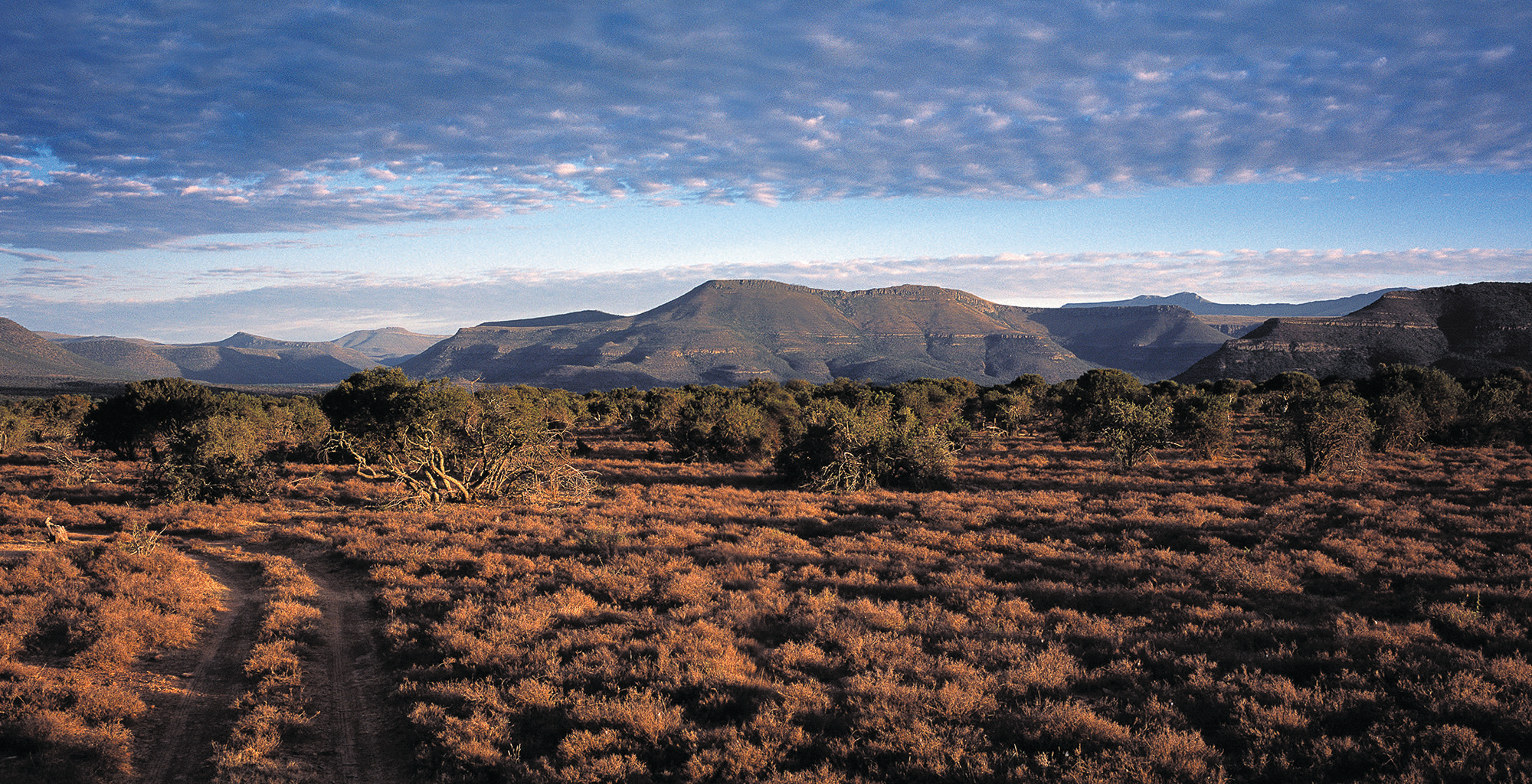
The Karoo is the semi-arid plateau heart of the South African production economy and the country’s principal stand-in territory for Australian Outback, American Southwest and post-apocalyptic open-land registers. Beaufort West, Oudtshoorn, Cradock and Graaff-Reinet anchor the four primary production sub-zones across Western, Northern and Eastern Cape provincial overlap. Beaufort West sits on the N1 as the principal Great Karoo waypoint. Oudtshoorn anchors the Little Karoo between Swartberg Pass and the Outeniqua Mountains. Cradock holds the 1812 British colonial town register with Mountain Zebra National Park access. Graaff-Reinet, the “Gem of the Karoo”, carries Cape Dutch heritage architecture adjacent to Camdeboo National Park.
Film fixers in Karoo and the line producer Karoo network handle Western Cape, Northern Cape and Eastern Cape provincial film commission permits, SANParks access for Karoo National Park (Beaufort West), Camdeboo National Park (Graaff-Reinet) and Mountain Zebra National Park (Cradock), ATA Carnet routing through Cape Town International Airport or OR Tambo (Joburg) with road transport to the Karoo, and the multi-zone scheduling that crosses the four sub-locations on a single production calendar. The Karoo production layer sits inside our film fixer South Africa network and routes most international shoots through our Film Fixers In Cape Town team given that Beaufort West sits four-and-a-half hours from Cape Town CBD along the N1.
The Karoo’s role in the international production economy is structural. Mad Max: Fury Road location scouting routed through the Karoo before committing to the Namib Desert. Lost in the Karoo (2018) anchored a South African feature production entirely within the central Karoo. Period feature work seeking American Southwest, Outback or post-apocalyptic registers routes through Beaufort West and Cradock by default, and premium automotive launches (Land Rover, Toyota, Ford) draw on the Karoo open-horizon and unpaved-road register.

How the Karoo production layer operates
The Karoo production economy runs as an extension of the Cape Town and Joburg crew benches. Most international shoots in the Karoo use Cape Town-rotated HODs (DP, gaffer, key grip, production designer) with Karoo-local crew filling location-coordination, transport, art department and catering roles. The Western Cape (Beaufort West, Oudtshoorn), Northern Cape (Sutherland, Carnarvon) and Eastern Cape (Cradock, Graaff-Reinet) provincial film commissions handle permits at the provincial level. SANParks coordinates access to the three Karoo national parks. Private game reserves and working farms negotiate access directly with production.
Karoo fixers, SANParks cross-provincial coordination and remote-location logistics
Karoo fixers carry one operational advantage no other South African region offers: cross-provincial routing across Western Cape, Eastern Cape and Northern Cape boundaries inside a single shoot. The Karoo is the only South African region where a film fixer routinely holds film-office relationships across three provincial film commissions simultaneously, with the cross-jurisdictional permit calendar running as the binding lead time on most multi-location Karoo schedules. That cross-provincial coordination capacity is what distinguishes a Karoo fixer from a Cape Town or Joburg-based operator extending into the region for a single shoot.
The Karoo authority stack the fixer holds is shaped by the remote-location reality of the region: SANParks for Camdeboo National Park around Graaff-Reinet, Mountain Zebra National Park near Cradock, and the smaller protected areas across the Karoo plateau, the three provincial film commissions (Western Cape, Eastern Cape, Northern Cape) for any cross-provincial schedule, the relevant local municipality for Beaufort West, Oudtshoorn, Cradock and Graaff-Reinet town shoots, SAPS for road closures on the N1 and the secondary regional routes, and the private estate and farm owners for any non-park rural shoot. That is five separate authority categories on a typical Karoo schedule, with fuel and water planning sitting alongside the permit calendar as binding logistical constraints.
The Karoo crew bench depends on Cape Town and Joburg as the staging bases, with Karoo-local crew supplements drawn from the resident production community across Beaufort West and the small-town Karoo network. A film fixer in Karoo working an open-land feature typically coordinates with the Cape Town or Joburg accredited production service company on the FFTIP filing while running the cross-provincial logistics directly on the ground. Equipment routing follows the N1 from Cape Town for southern Karoo work or via OR Tambo and the N1 from Joburg for shoots routed from the north, with ATA Carnet cargo trucked under cross-bond to the remote shoot locations.
Karoo FFTIP-applicant structuring through a Cape Town or Joburg production service company for cross-provincial shoots
Karoo FFTIP-applicant structuring follows the cross-provincial reality of the region: the Karoo spans the Western Cape, Eastern Cape and Northern Cape, and the FFTIP applicant entity typically sits in Cape Town for shoots routed via Beaufort West and Oudtshoorn, or in Joburg for shoots routed via the N1 from the north. The production service company carries the qualifying-spend register that covers fuel and water planning for remote-location days, SANParks access fees for Camdeboo, Mountain Zebra and adjacent national parks, and the multi-provincial municipal liaison that crossing the Karoo demands.
The Karoo-specific FFTIP angle is the open-land economics: Mad Max and Australian Outback stand-in features front-load qualifying spend on equipment routing, remote-location accommodation and the longer principal-photography windows that desert and semi-arid shoots demand. American Southwest and Texas-Arizona-New Mexico register work follows a similar economic profile. The Cape Town or Joburg accredited applicant manages the rebate documentation while the Karoo film fixer coordinates the day-to-day cross-provincial logistics.
Cape Town and Joburg as equipment and crew staging bases
The Karoo’s two principal staging bases are Cape Town and Joburg, with most international shoots anchoring out of Cape Town. Beaufort West sits 460 km north-east of Cape Town along the N1 (4.5 hours by road) or 1,000 km south-west of Joburg (9 hours by road or one-hour charter flight). Cape Town International Airport (CPT) and OR Tambo (JNB) supply the ATA Carnet entry points, with equipment trucked to the Karoo over one or two travel days. Cape Town Film Studios at Faure handles any studio days that book-end the Karoo schedule. Equipment storage and crew rotation through Beaufort West, Oudtshoorn or Graaff-Reinet runs out of local guest farms and small-town hotels. Sutherland in the Northern Cape Karoo also supports astronomy-led productions through the SALT observatory access, though this is a niche register beyond the four primary sub-locations.

Karoo’s production zones, Beaufort West, Oudtshoorn, Cradock and Graaff-Reinet
The Karoo’s filming geography clusters around four sub-zones that span the Great Karoo (Western and Northern Cape) and the Eastern Cape Karoo. Beaufort West anchors the Great Karoo N1 corridor. Oudtshoorn runs the Little Karoo and Cape Floristic Region register between the Swartberg and Outeniqua mountain ranges. Cradock holds the 1812 British colonial heritage town and Mountain Zebra National Park access. Graaff-Reinet, the fourth-oldest town in South Africa, anchors the Cape Dutch heritage and Camdeboo National Park register.
Beaufort West, the Great Karoo N1 anchor
Beaufort West is the principal Great Karoo town and the operational base for Karoo National Park access. The town sits on the N1, the principal road artery between Cape Town and Joburg, and serves as the equipment staging point for any production shooting on the surrounding Great Karoo plateau. Karoo National Park, 750 square kilometres of typical Great Karoo terrain, sits immediately south-west of the town with SANParks-managed access for filming under permit. The Great Karoo plateau around Beaufort West runs as the most photographed Karoo open-land register, including the long-horizon dirt roads, dry riverbeds and Karoo koppie outcrops that anchor the Australian Outback and American Southwest stand-in work. The Beaufort West Local Municipality and the Western Cape Provincial Film Commission share permit jurisdiction.
Oudtshoorn, ostrich industry and Little Karoo register
Oudtshoorn anchors the Little Karoo, the narrow corridor between the Swartberg and Outeniqua mountain ranges that sits between the Great Karoo and the Western Cape coastal belt. The town is the ostrich-farming capital of South Africa and has carried that agricultural register through international productions since the 1990s. The Cango Caves north of the town are the largest cave system in South Africa with permitted filming access. Swartberg Pass, an unpaved mountain crossing into the Great Karoo, holds UNESCO Cape Floristic Region heritage status and serves as the most photographed mountain-pass register in the country. Ladismith, 100 km west of Oudtshoorn in the Little Karoo, anchors the Klein Karoo wine-and-agriculture register including period drama feature work. The Western Cape Provincial Film Commission handles Little Karoo permits.

Cradock, 1812 colonial heritage and Mountain Zebra National Park
Cradock is the principal Eastern Cape Karoo town and carries the 1812-onwards British colonial heritage town register. The town centre, the Tuishuise heritage cottages on Market Street and the 1825 Dutch Reformed Church anchor the period feature drama register. Mountain Zebra National Park sits 12 km west of Cradock under SANParks management, with 28,000 hectares of plateau, kloof and grassland habitat. The park holds Cape mountain zebra, cheetah and lion populations and supplies the wildlife-and-landscape register for production work that requires national park access without the deep-Kruger logistics. The Eastern Cape Provincial Film Commission handles Cradock permits with SANParks coordination on park access.
Graaff-Reinet, Cape Dutch heritage and Camdeboo National Park
Graaff-Reinet, founded 1786, is the fourth-oldest town in South Africa and carries the densest Cape Dutch heritage architecture outside Stellenbosch. The town sits inside the Camdeboo National Park horseshoe, surrounded by the park on three sides, with the Valley of Desolation rock formation as the most photographed geological feature. The Reinet House Museum, the Drostdy Hotel and Church Street’s preserved 18th-century facades supply the Cape Dutch heritage register at feature production scale. Camdeboo National Park (19,500 hectares) runs under SANParks with permitted filming access. The Eastern Cape Provincial Film Commission handles Graaff-Reinet permits.

Permits, FFTIP rebate and SANParks access
The Karoo runs across three provincial film commissions and three SANParks units. The Western Cape Provincial Film Commission handles Beaufort West, Oudtshoorn and the Little Karoo. The Eastern Cape Provincial Film Commission handles Cradock and Graaff-Reinet. The Northern Cape Provincial Film Commission handles Sutherland and Carnarvon for any astronomy-or-deep-Karoo work. Permits run 7 to 14 working days for non-restricted locations and 14 to 28 working days where SAPS road-closure coordination, SANParks national-park access or private-estate negotiation stacks on top. The Foreign Film and TV Production Incentive (FFTIP) administered by the dtic delivers 20% cashback on Qualifying South African Production Expenditure with a 5% BEE uplift to 25%, the same incentive layer that applies across the rest of the South African production economy.
Provincial film commissions and the cross-provincial Karoo shoot
The four-sub-location Karoo shoot routinely crosses provincial film commission jurisdiction. A schedule that opens in Beaufort West (Western Cape), moves to Oudtshoorn (Western Cape Little Karoo), then to Cradock and Graaff-Reinet (Eastern Cape) crosses one provincial border. The provincial commissions share permit data with each other and with the dtic for FFTIP audit purposes, but each issues permits independently. The Karoo line producer handles the cross-provincial paperwork upstream of the actual shoot dates. Production service companies based in Cape Town carry stronger Western Cape commission relationships, while Joburg-based operators tend to carry deeper Northern Cape and Eastern Cape relationships through the Bloemfontein-via-Joburg routing. Choose the production service company aligned with the schedule’s centre of gravity.
SANParks access for Karoo, Camdeboo and Mountain Zebra National Parks
SANParks (South African National Parks) administers Karoo National Park (Beaufort West), Camdeboo National Park (Graaff-Reinet) and Mountain Zebra National Park (Cradock). Filming inside national parks requires a SANParks filming permit, processed through the SANParks Head Office in Pretoria with on-the-ground coordination by the park manager. Standard turnaround for SANParks permits is 21 to 30 working days. Permit fees are tiered by production category (commercial, feature, documentary, series) and on-the-ground footprint (crew size, vehicle count, drone deployment). Drone work over the parks requires South African civil aviation clearance coordinated through SANParks operations. Ranger escort is mandatory for any off-road or off-trail location access.

Stand-in register, Outback, American West and post-apocalyptic open-land. Productions whose stand-in brief sits in a different register entirely — European-period viticulture frames go through our Cape Winelands line producer team, off-mainland volcanic-island sequences route via the line producer São Tomé and Príncipe coverage
The Karoo’s commercial stand-in role across multiple international registers is the structural reason the territory carries international service work beyond what its small permanent crew bench would suggest. The semi-arid plateau, the long-horizon open land, the dry riverbeds, the absence of substantial built-up infrastructure across vast swathes of the Great Karoo, and the Outback-equivalent terrain and light at altitude (1,000 to 1,500 metres above sea level) combine to deliver three distinct international stand-in registers at substantial cost arbitrage against the original territories.
Australian Outback and Mad Max-style desert work
The Karoo doubles for the Australian Outback at a fraction of Australian production cost. The long-horizon dirt roads, the dry riverbeds, the koppie outcrops and the desert light at southern hemisphere altitude all read as Outback on screen. Mad Max: Fury Road location scouting evaluated the Karoo extensively before committing to the Namib Desert for the actual shoot, and the same Karoo terrain has carried multiple Australian-Outback-equivalent commercials and feature productions for international brands. Production cost on a Karoo Outback shoot runs at roughly 40 to 50 percent of an equivalent shoot in the Australian Outback proper, with the additional advantage of English-language workflow, FFTIP rebate eligibility and the Cape Town crew bench within four-and-a-half hours.
American Southwest and Texas-Arizona-New Mexico registers
The Karoo also doubles for the American Southwest, including Texas, Arizona and New Mexico semi-arid and high-desert registers. The Great Karoo plateau around Beaufort West reads as West Texas. The Camdeboo Valley around Graaff-Reinet reads as a New Mexico arroyo and mesa landscape. Cradock’s 1812 colonial-town centre, with creative dressing, has carried American period-western feature work that reads as a Texas or Arizona frontier town. Production cost runs at 35 to 50 percent of equivalent US Southwest production with no comparable rebate ceiling.

Post-apocalyptic open-land and the unscripted-landscape register
The third stand-in register is post-apocalyptic open-land, the genre register that wants vast empty space, sun-bleached terrain and the absence of contemporary architectural cues. The Great Karoo around Beaufort West and Sutherland (Northern Cape) supplies this register at international-tier production scale. South African feature productions including Lost in the Karoo (2018) have anchored entirely in the central Karoo for this register. The combination of empty open-horizon plateau, the absence of utility infrastructure and the seasonal dry-light window (April through June, September through November) makes the Karoo the most cost-effective post-apocalyptic stand-in territory in the southern hemisphere.

Engaging a line producer in Karoo
Engaging a Karoo line producer follows the South African production-service model. The line producer enters the schedule at script-breakdown stage to evaluate sub-location feasibility (Beaufort West, Oudtshoorn, Cradock, Graaff-Reinet), national park access requirements (Karoo, Camdeboo, Mountain Zebra), cross-provincial permit timelines and the routing-and-staging structure (Cape Town-anchored versus Joburg-anchored). Lead times for a feature production run 10 to 16 weeks pre-shoot for international features needing all four sub-locations and one or more national parks. Commercial work runs at compressed 3 to 6 week pre-shoot windows. Budget bands for a Karoo schedule typically run R6 million to R25 million for commercials and R30 million to R200 million for feature productions depending on cast, schedule length and sub-location count.
Lead times, budget bands and the cross-provincial Karoo schedule
The classic four-sub-location Karoo schedule routes from Cape Town along the N1 to Beaufort West (4.5 hours), east to Graaff-Reinet (4 hours), north to Cradock (1.5 hours), then west back to Oudtshoorn via the Swartberg Pass (5 hours) and south to Cape Town via the Klein Karoo (3.5 hours). The full circuit runs 7 to 10 shoot days for commercials and 14 to 21 shoot days for feature productions. Equipment trucks under ATA Carnet from Cape Town port stage in Beaufort West for the Great Karoo days, then move with the unit east.
SANParks access permits are filed independently of the provincial film commission permits and run on a longer 21 to 30 working day pipeline. Film fixers in Karoo handle the cross-permit choreography to keep the schedule moving across provinces and national parks without dead days. The film production services Karoo specialists also handle the cash-flow staging that the Karoo demands, with small-town vendors operating on cash-and-EFT terms rather than the corporate-account terms standard in Cape Town and Joburg. For how the Karoo compares with other African bases on permits, crew and cost, see our filming in Africa guide.
