

Local film fixers in Bhutan coordinate the BICMA filming-permit application, location access, cultural consultation, crew movement and equipment-import planning. Restricted locations such as dzongs, monasteries, protected areas and government property require additional written permission from the relevant authority. Drone filming also requires prior confirmation from the Bhutan Civil Aviation Authority and should not be assumed available.
Within that framework, line producer Bhutan coordination begins with early feasibility rather than permit guarantees. Thimphu provides the principal production base, Paro combines the main air gateway with major heritage locations, and Punakha supports dzong, river-valley and rural sequences. Indian support remains relevant for larger crew and equipment requirements, but every Bhutan-side permission and customs arrangement must be confirmed through the local counterpart before it enters the budget or schedule.

Filming Permits and Entry in Bhutan
Under the Bhutan Filming Regulation 2025, the Bhutan InfoComm and Media Authority (BICMA) is the sole authority responsible for issuing filming permits. The international application package identifies a cover letter, synopsis and filming programme, crew and equipment lists, passport copies and CVs, and the licence of the appointed local counterpart, and prior BCAA approval must be included when a drone is proposed. BICMA may request further project information where necessary, but the application is best described according to the current form rather than as an automatic script-and-budget submission.
The proposal is assessed against Bhutan’s filming rules, content conditions and local sensitivities. A BICMA permit does not itself grant access to dzongs, monasteries, protected areas, government property or other restricted locations; those require separate written permission from the relevant authority or rights holder. Lead times depend on the completeness of the submission and the additional approvals involved, so the current window should be confirmed through the local counterpart for each production.
Those restricted-site approvals are a workstream of their own. Beyond the written permission each site needs, filming of religious ceremonies, of monks in a personal capacity, or of specific ritual objects is limited, and some interiors do not open to cameras regardless of budget. Travel to sensitive districts near the borders can require additional clearance. A film fixer in Bhutan maps these permissions site by site before the scout, because an approval that looks simple on paper can depend on a monastic body or a Dzongkhag administration that reviews on its own schedule.
Crew entry does not follow a single rule. Bhutan operates a Sustainable Development Fee, but it does not apply automatically to every foreign crew member: the Department of Immigration states that qualifying non-tourist categories are exempt, and the applicable production-entry category has to be confirmed for the live brief. Indian nationals can be issued an entry permit at the port of entry; other foreign nationals generally require advance visa clearance before travel. Because the categories and fees are revised periodically, the basis for each passport is checked at planning stage rather than carried over from an earlier shoot.
Drone work should not be budgeted until BCAA confirms that the proposed importing entity, operator and flight are eligible. BICMA’s film-permit application requires prior BCAA approval whenever a UAV is in the plan, and current BCAA guidance heavily restricts private drone import and operation, so aerial coverage is treated as conditional with a ground-based alternative kept in reserve.
Filming Locations in Bhutan
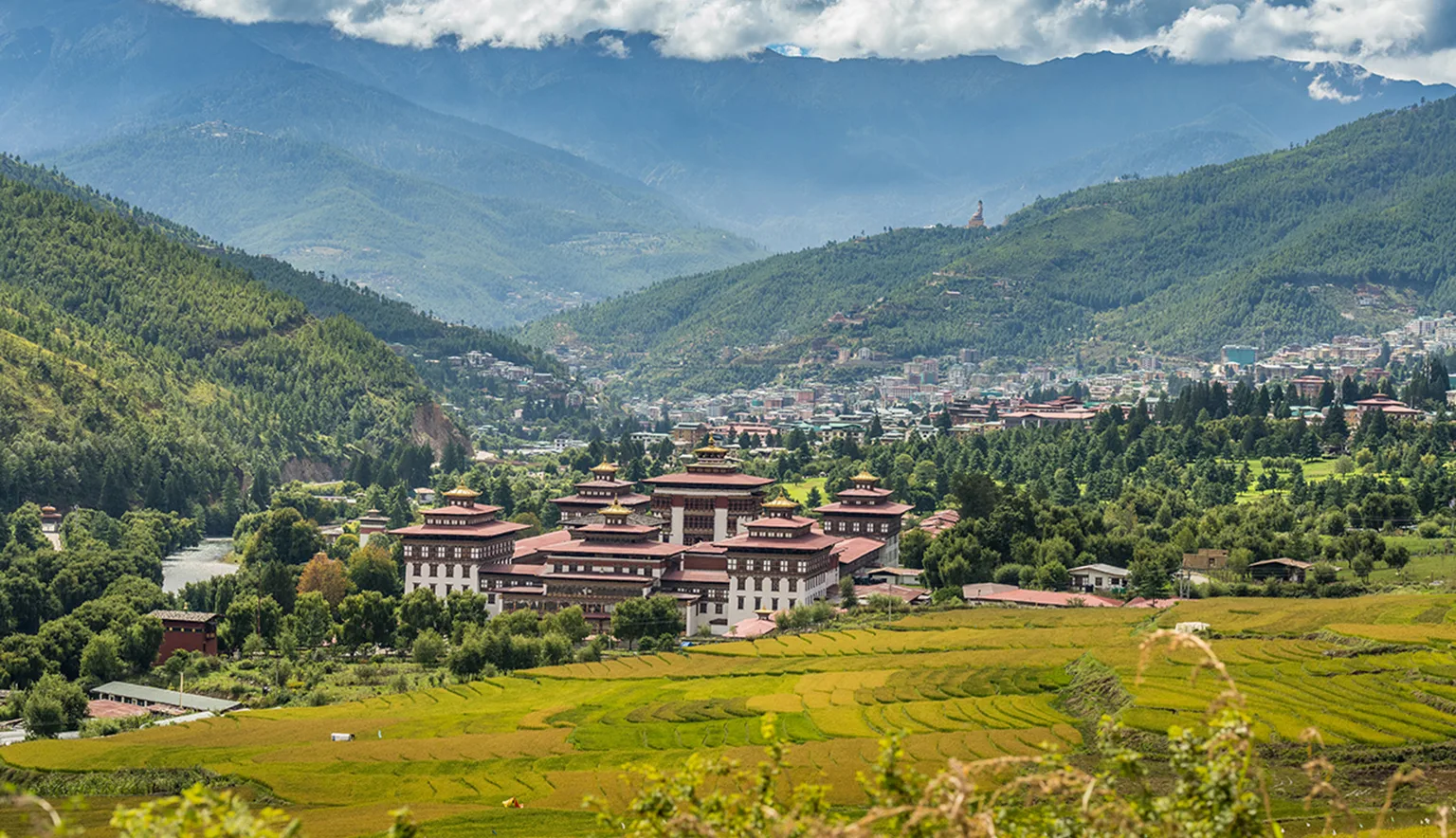
Thimphu. The base for most international shoots, the capital sits at 2,300 metres in the Wang Chhu valley, its centre on the eastern bank and the government quarter along the western ridge. Tashichho Dzong — the seat of government and the central monastic body — stands at the northern end. Exterior filming may be considered with approval, while interior access is more restricted. Memorial Chorten, the National Library, the Folk Heritage Museum and the Centenary Farmers’ Market carry the contemporary, everyday-life frames, while the Great Buddha Dordenma above the city and Simtokha Dzong at the valley mouth add a landmark and an older-dzong option.
Thimphu is also the principal accommodation and crew-assembly point, with the country’s broadest hotel base. It holds the main rental base for documentary-grade equipment, while larger technical packages may need to be sourced outside Bhutan, often through India. The Jigme Dorji Wangchuck National Referral Hospital is the principal medical reference for productions working at altitude.

Paro. The entry valley and a heritage centre in one, at 2,200 metres and about an hour by road from Thimphu. Paro Taktsang, the Tiger’s Nest, clings to a cliff at 3,120 metres and is the most photographed site in Bhutan. It is a steep climb of a few hours each way, which shapes how it can be staged: most productions cover the monastery on long lenses from the viewpoints, and filming inside the courtyards needs separate permission from the monastic body, which is not routinely granted. Kyichu Lhakhang, one of the country’s oldest temples, provides another potential setting for historic or religious sequences, subject to permission.

Paro Dzong (Rinpung Dzong), lower in the valley, offers a more accessible dzong frame — whitewashed walls, the wooden bridge over the Paro Chhu and the surrounding rice terraces. The National Museum of Bhutan in the Ta Dzong watchtower above provides another potential heritage location, subject to museum and filming approval, and Drukgyel Dzong at the head of the valley gives a further heritage frame. Paro is the staging point for the Haa valley and the Chele La pass at 3,988 metres, reached on day trips from the base, and the airport itself — its painted terminal set against the valley — is a recognisable frame that needs its own airport-authority clearance.

Punakha. Bhutan’s capital until 1955 and still the winter seat of the central monastic body, its dzong stands at the confluence of the Pho Chhu and Mo Chhu, with a cantilevered bridge giving one of the cleanest approaches in the country, and a long suspension bridge over the Pho Chhu that is itself a frame. The drive from Thimphu crosses the Dochu La pass at 3,100 metres, where the 108 chortens form an additional set. At 1,200 metres, Punakha is a noticeably lower and more comfortable base for rest days between Thimphu sequences.
The valley runs east through Wangdue Phodrang towards Trongsa and Bumthang, with rice terraces, traditional farmhouses, the terraced walk to Chimi Lhakhang and the Khamsum Yulley Namgyal Chorten above the Mo Chhu. Productions needing rural, everyday sequences usually anchor them here rather than in the capital, because the mix of working agriculture and intact traditional architecture sits closest to what they come for. Several heritage-style lodges host crews in comfort, though the higher-end properties book far ahead in the peak seasons.

Bumthang and Trongsa. East of Punakha, Trongsa Dzong occupies an elevated ridge above the Mangde Chhu and marks the central route into Bhutan’s eastern districts. Beyond it, the four valleys of Bumthang — Chokhor, Tang, Ura and Chhume — contain Jakar Dzong and long-established religious sites including Jambay and Kurjey Lhakhang. The settings are quieter and more rural than the western valleys but remain specifically Bhutanese. A production requiring identifiable Tibetan geography should follow the Tibet film permits pathway rather than treating Bhutan as a substitute for direct Tibet access.
The east requires a long mountain drive or a domestic flight where current schedules permit. Crew and accommodation capacity thin out beyond the western valleys, while Guwahati and Samdrup Jongkhar may provide a more practical cargo route depending on the locations, border operations and road conditions.
Crew, Equipment and Logistics in Bhutan
Bhutanese crew and Indian support. The Bhutanese film community is small and specialised, concentrated in Thimphu. Its strongest positions are in production design, art direction, location management and cultural advisory, where local knowledge is irreplaceable; camera, grip, sound and lighting run at a depth that suits documentary and short-form work rather than feature scale, and larger technical departments may need to be supplemented from outside Bhutan. That is one reason productions splitting a Himalayan schedule across both countries coordinate the Nepal side through our film fixer in Nepal team and keep the Bhutan unit compact.
For a feature, the usual pattern is a small Bhutanese key team — location manager, production designer, cultural advisor — alongside a technical unit rotated from India, with foreign heads of department travelling in on the larger projects. Much of the supporting unit comes from India for practical reasons: Indian nationals do not need advance visa clearance, they work at rates that fit the budget, English and Hindi are widely understood, and the Rupee is accepted at par with the Ngultrum.
This is what film production services in Bhutan realistically means at feature scale today — a compact local team for access and cultural work, the technical crew brought in, and the Royal University of Bhutan’s media programme slowly widening the local bench. Feature-scale productions engage film fixers in Bhutan who hold standing relationships with the specialist local hires across Thimphu and Paro, and who know that the key local specialists are limited in number and should be booked early.
Equipment and temporary import. Rental houses in Thimphu carry documentary-grade camera packages, monitors, basic lighting and audio. Feature-grade camera, lens, grip and lighting packages may need to be sourced outside Bhutan, often through India, depending on the technical brief. Power and altitude also feed the kit list: reliable mains cannot be assumed at remote locations, so generator support, battery depth, cold-weather contingencies and a data-and-comms plan for thin-connectivity valleys all belong in the budget.
Bhutan is a territory-specific temporary-import jurisdiction rather than an automatic ATA Carnet destination. The final equipment list, declared values, customs documentation and re-export procedure are confirmed with Bhutan’s Department of Revenue and Customs and the local counterpart before dispatch, and built into the schedule early so a package is not held at the border while the paperwork catches up.

Paro and the Indian land route. Paro International Airport is Bhutan’s principal international air gateway, served by Druk Air and Bhutan Airlines on limited regional routes that should be checked against the live production schedule. The approach is one of the more demanding commercial landings anywhere — the runway sits at 2,235 metres in a narrow valley ringed by high peaks, only specially certified pilots are cleared to land, and weather can delay or cancel flights around the monsoon shoulder. The schedule is limited, so a missed connection can cost a shoot day and crew moves are planned with slack.
Cargo is consolidated on the Indian side, commonly around Bagdogra and Siliguri, before moving by road through Phuentsholing. Our line producer India team coordinates the Indian-side aggregation, crew rotation and border handover. For eastern Bhutan, Guwahati and Samdrup Jongkhar may be more practical, subject to current border and road conditions.
Weather, altitude and medical planning. Altitude shapes the schedule. Thimphu sits at 2,300 metres, Paro at 2,200, Punakha lower at 1,200, and the mountain passes between roughly 3,100 and 3,900. Crew arriving from sea level need time to adjust before sustained activity at height. The clear, crisp light of roughly October to April suits most shoots and gives the cleanest mountain backdrops, while the summer monsoon brings cloud, road slips and a higher chance of Paro delays. The post-monsoon weeks are often preferred for clearer conditions and also the tshechu festival season, when Thimphu, Paro, Punakha and Bumthang draw large crowds — both an opportunity and an access limit, and aligning principal photography with a tshechu needs separate coordination through the Dzongkhag administration.
Productions seeking to avoid festival crowd pressure commonly consider the spring shoulder or winter, with Punakha as the comfortable lower-altitude base in the colder months. Medical and evacuation planning should be set case by case around road access, Paro flight operations and onward treatment availability in India or another regional medical centre.

Line Producer Bhutan: What the Team Handles
At feature scale, line producer Bhutan coordination covers the BICMA application, site-specific permissions, temporary-import planning, Indian crew and equipment support, and execution across Thimphu, Paro, Punakha and the eastern districts. Testing these requirements before the budget and calendar are locked is the central role of line production services in Bhutan.
Bhutan does not currently advertise a broad national production rebate, and international shoots must plan around limited air access through Paro, BICMA review, additional location permissions and imported technical support. That trade-off is justified when the brief requires Bhutan’s own architecture, landscapes and living Buddhist culture. Where a project is still comparing direct China or Tibet access with Himalayan alternatives, the wider decision belongs to the line producer East Asia hub.
Briefing the line producer Bhutan team during script breakdown allows locations, permissions, crew requirements, equipment routes, weather and altitude to be tested before travel is committed. The resulting dependencies and contingencies can then be built into the budget and schedule from the beginning.
