

Local film fixers in Bhutan coordinate the BICMA filming-permit application, location access, cultural consultation, crew movement and equipment-import planning. Restricted locations such as dzongs, monasteries, protected areas and government property require additional written permission from the relevant authority. Drone filming also requires prior confirmation from the Bhutan Civil Aviation Authority and should not be assumed available.
Within that framework, a line producer in Bhutan begins with early feasibility rather than permit guarantees. Thimphu provides the principal production base, Paro combines the main air gateway with major heritage locations, and Punakha supports dzong, river-valley and rural sequences. Every Bhutan-side permission and customs arrangement must be confirmed through the local counterpart before it enters the budget or schedule.
Film Fixers Bhutan: Recce, Access and Local Coordination
A film fixer in Bhutan checks who controls each proposed location, what consent is required, how the unit can reach and work at the site, and which local crew, equipment and transport are available. Recce findings inform daily logistics and identify unresolved permissions. The fixer coordinates with the appointed local counterpart and relevant authorities but does not issue approvals.
If you need a fixer in Bhutan, identify the locations, dates and local support your visiting team requires. To find a fixer in Bhutan for the assignment, check relevant experience, availability and who will carry out the agreed work. The appointment should distinguish the fixer’s responsibilities from those of the production and appointed local counterpart.
Line Producer in Bhutan: Budget, Schedule and Supplier Management
A line producer in Bhutan manages the agreed budget, schedule, supplier commitments and production reporting. The scope identifies who authorises expenditure, contracts suppliers and coordinates applications through the local counterpart. Travel, equipment movements, altitude, weather and outstanding approvals inform the working schedule.
Where a project is comparing Bhutan with other Himalayan or East Asian options, the regional planning sits with our line producer East Asia hub.
Filming Permits and Entry in Bhutan
Under the Bhutan Filming Regulation 2007, as amended on 19 March 2025, the Bhutan InfoComm and Media Authority (BICMA) is the sole authority responsible for issuing filming permits. The international application package identifies a cover letter, synopsis and filming programme, crew and equipment lists, passport copies and CVs, and the licence of the appointed local counterpart, and prior BCAA approval must be included when a drone is proposed. BICMA may request further project information where necessary, but the application is best described according to the current form rather than as an automatic script-and-budget submission.
The proposal is assessed against Bhutan’s filming rules, content conditions and local sensitivities. A BICMA permit does not itself grant access to dzongs, monasteries, protected areas, government property or other restricted locations; those require separate written permission from the relevant authority or rights holder. Lead times depend on the completeness of the submission and the additional approvals involved, so the current window should be confirmed through the local counterpart for each production. The regulations also require insurance and a security deposit for foreign filming. Final edited material is subject to authority review, with deposit return conditional on receipt and acceptance. Changes to the proposed subject or locations require prior written permission.
Those restricted-site approvals are a workstream of their own. Beyond the written permission each site needs, filming of religious ceremonies, of monks in a personal capacity, or of specific ritual objects is limited, and some interiors do not open to cameras regardless of budget. Travel to sensitive districts near the borders can require additional clearance. A film fixer in Bhutan maps these permissions site by site before the scout, because an approval that looks simple on paper can depend on a monastic body or a Dzongkhag administration that reviews on its own schedule.
Crew entry does not follow a single rule. Bhutan operates a Sustainable Development Fee, but it does not apply automatically to every foreign crew member: the Department of Immigration states that qualifying non-tourist categories are exempt, and the applicable production-entry category has to be confirmed for the live brief. Indian nationals can be issued an entry permit at the port of entry; other foreign nationals generally require advance visa clearance before travel. Because the categories and fees are revised periodically, the basis for each passport is checked at planning stage rather than carried over from an earlier shoot.
Drone work should not be budgeted until BCAA confirms that the proposed importing entity, operator and flight are eligible. BICMA’s film-permit application requires prior BCAA approval whenever a UAV is in the plan, and current BCAA guidance heavily restricts private drone import and operation, so aerial coverage is treated as conditional with a ground-based alternative kept in reserve.
Filming Locations in Bhutan
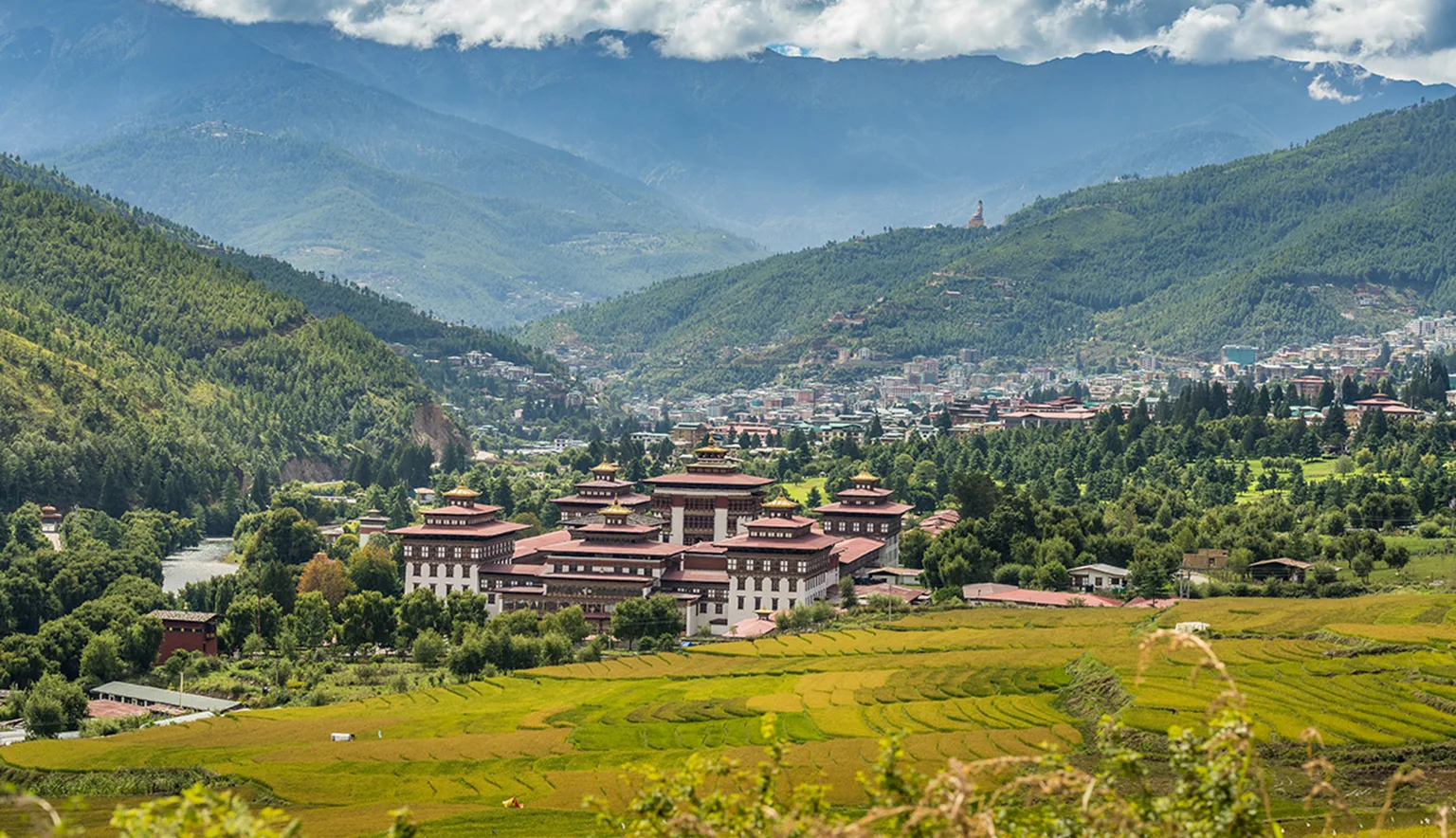
Thimphu. The capital sits at 2,300 metres in the Wang Chhu valley, its centre on the eastern bank and the government quarter along the western ridge. Tashichho Dzong — the seat of government and the central monastic body — stands at the northern end. Exterior filming may be considered with approval, while interior access is more restricted. Memorial Chorten, the National Library, the Folk Heritage Museum and the Centenary Farmers’ Market carry the contemporary, everyday-life frames, while the Great Buddha Dordenma above the city and Simtokha Dzong at the valley mouth add a landmark and an older-dzong option.
Thimphu is the principal accommodation and crew-assembly point. It holds the main rental base for documentary-grade equipment, while larger technical packages may need to be sourced outside Bhutan, often through India. The Jigme Dorji Wangchuck National Referral Hospital is the principal medical reference for productions working at altitude.

Paro. The entry valley and a heritage centre in one, at 2,200 metres and about an hour by road from Thimphu. Paro Taktsang, the Tiger’s Nest, clings to a cliff at 3,120 metres and is reached by a steep climb of a few hours each way, which shapes how it can be staged; filming inside the courtyards needs separate permission from the monastic body. Kyichu Lhakhang, one of the country’s oldest temples, provides another potential setting for historic or religious sequences, subject to permission.

Paro Dzong (Rinpung Dzong), lower in the valley, offers a more accessible dzong frame — whitewashed walls, the wooden bridge over the Paro Chhu and the surrounding rice terraces. The National Museum of Bhutan in the Ta Dzong watchtower above provides another potential heritage location, subject to museum and filming approval, and Drukgyel Dzong at the head of the valley gives a further heritage frame. Paro is the staging point for the Haa valley and the Chele La pass at 3,988 metres, reached on day trips from the base, and the airport itself — its painted terminal set against the valley — is a recognisable frame that needs its own airport-authority clearance.

Punakha. Bhutan’s capital until 1955 and still the winter seat of the central monastic body, its dzong stands at the confluence of the Pho Chhu and Mo Chhu, with a cantilevered bridge giving one of the cleanest approaches in the country, and a long suspension bridge over the Pho Chhu that is itself a frame. The drive from Thimphu crosses the Dochu La pass at 3,100 metres, where the 108 chortens form an additional set. Punakha sits at a lower elevation than Thimphu; accommodation, transfers and rest-day arrangements are assessed against the crew’s needs and schedule.
The valley runs east through Wangdue Phodrang towards Trongsa and Bumthang, with rice terraces, traditional farmhouses, the terraced walk to Chimi Lhakhang and the Khamsum Yulley Namgyal Chorten above the Mo Chhu. Productions needing rural, everyday sequences usually anchor them here rather than in the capital, because the mix of working agriculture and intact traditional architecture sits closest to what they come for. Several heritage-style lodges host crews in comfort, though the higher-end properties book far ahead in the peak seasons.

Bumthang and Trongsa. East of Punakha, Trongsa Dzong occupies an elevated ridge above the Mangde Chhu and marks the central route into Bhutan’s eastern districts. Beyond it, the four valleys of Bumthang — Chokhor, Tang, Ura and Chhume — contain Jakar Dzong and long-established religious sites including Jambay and Kurjey Lhakhang. The settings are quieter and more rural than the western valleys but remain specifically Bhutanese. A production requiring identifiable Tibetan geography should follow the Tibet film permits pathway rather than treating Bhutan as a substitute for direct Tibet access.
The east requires a long mountain drive or a domestic flight where current schedules permit. Crew and accommodation capacity thin out beyond the western valleys, while Guwahati and Samdrup Jongkhar may provide a more practical cargo route depending on the locations, border operations and road conditions.
Film Fixer Bhutan: Crew, Equipment and Local Logistics
Crew and equipment sourcing. Crew experience, working languages, equipment specifications and availability are assessed against the brief and dates. Bhutanese departments are considered alongside any regional or international sourcing the production requires. Travelling personnel and equipment are costed with their entry, work-authorisation, transport and customs requirements. For a separate Nepal shoot on the same schedule, our film fixer in Nepal team handles the Nepal side.
A Bhutan film fixer’s quotation should identify the preparation and filming days covered, the local coordination included and any separately charged travel or supplier costs. Transport for film crews in Bhutan is assessed against the route, passenger numbers, equipment load and proposed dates.
Equipment and temporary import. Rental availability in Thimphu is checked against the technical brief, with any packages not available locally sourced regionally or internationally and costed with their transport and customs requirements. Power and altitude also feed the kit list: reliable mains cannot be assumed at remote locations, so generator support, battery depth, cold-weather contingencies and a data-and-comms plan for thin-connectivity valleys all belong in the budget.
Bhutan is a territory-specific temporary-import jurisdiction rather than an automatic ATA Carnet destination. The final equipment list, declared values, customs documentation and re-export procedure are confirmed with Bhutan’s Department of Revenue and Customs and the local counterpart before dispatch, and built into the schedule early so a package is not held at the border while the paperwork catches up.
Paro and the Indian land route. Paro International Airport is Bhutan’s principal international air gateway, served by Druk Air and Bhutan Airlines on limited regional routes that should be checked against the live production schedule. Flight schedules, baggage and cargo arrangements and weather contingencies are checked for the travel dates, and crew moves are planned with slack.
Where an Indian land route is used, cargo may be consolidated on the Indian side, for example around Bagdogra and Siliguri, before moving by road through Phuentsholing; the route is confirmed for the specific shipment against air-cargo alternatives. Our line producer India team coordinates the Indian-side aggregation, crew rotation and border handover. For eastern Bhutan, Guwahati and Samdrup Jongkhar may be more practical, subject to current border and road conditions.
Weather, altitude and medical planning. Altitude shapes the schedule. Thimphu sits at 2,300 metres, Paro at 2,200, Punakha lower at 1,200, and the mountain passes between roughly 3,100 and 3,900. Crew arriving from sea level need time to adjust before sustained activity at height. Weather, road conditions and each festival’s actual dates are checked for the proposed shoot window; the summer monsoon brings cloud, road slips and a higher chance of Paro flight delays, and tshechu festivals in Thimphu, Paro, Punakha and Bumthang draw large crowds, so aligning principal photography with a tshechu needs separate coordination through the Dzongkhag administration.
Medical and evacuation planning should be set case by case around road access, Paro flight operations and onward treatment availability in India or another regional medical centre.

Bhutan does not currently advertise a broad national production rebate, and international shoots must plan around limited air access through Paro, BICMA review, additional location permissions and any travelling technical support. That trade-off is justified when the brief requires Bhutan’s own architecture, landscapes and living Buddhist culture.
