

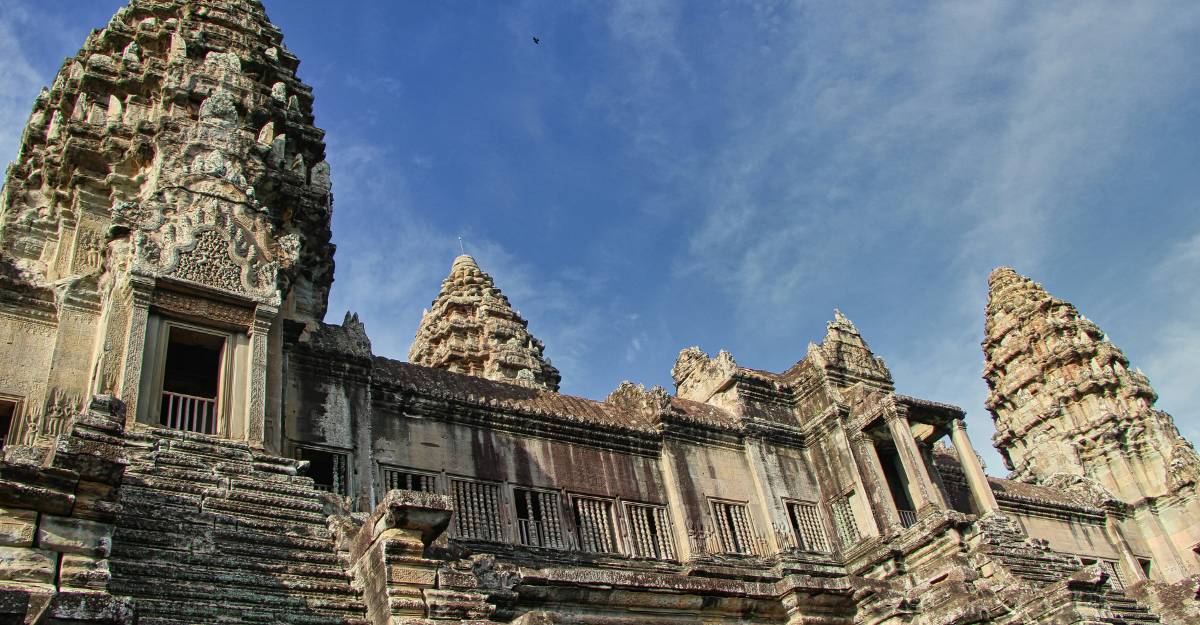
Film fixers in Cambodia operate across two working production bases — Phnom Penh, the commercial capital with the deepest crew bench and the Cambodian Film Commission office; and Siem Reap, the gateway to Angkor Wat and the APSARA Authority permit chain. Cambodia film production rates and permit process sit at the cost-arbitrage end of the Southeast Asian production spectrum. Compact international shoots typically anchor in Phnom Penh with a Siem Reap extension for Angkor heritage work, or the reverse for heritage-led briefs.
This rate and permit reference is written for foreign productions engaging a line producer Cambodia team on compact features, documentaries, commercials or streamer episodic work. Cambodia sits at the cost-arbitrage end of the Southeast Asian production spectrum, materially below Vietnam or Thailand on standard department day rates and equipment rental, with a permit calendar that runs on a similar six-to-eight-week backward-planning discipline. state-level context and cross-territory routing sit on our Southeast Asia line producer hub.
Every figure below is a working benchmark in US dollars, drawn from executed 2024 to 2026 shoots. Cambodian riel converts at roughly 4,050 KHR to the US dollar. Actual quotes vary with production scale, day counts, peak-season timing (November to February for the dry-weather window), and whether the line producer is booked at short-form ad-film scale or feature-package scale.

Cambodian Film Commission and the permit chain
Cambodia’s national film permit is administered by the Ministry of Culture and Fine Arts, through its Department of Cinema and Cultural Diffusion (historically referenced as the Cambodian Film Commission). For a foreign production the Ministry works through a registered Cambodian production company as counterpart, and the counterpart submits the shooting schedule, crew list, equipment list and script synopsis on the production’s behalf. A foreign producer cannot file the application directly, which makes counterpart selection the most consequential permit decision on the shoot.
CFCC application process and lead time
Standard national film permit processing typically runs six to eight weeks from complete application to approved permit. The Department reviews applications on a rolling basis and typically issues clearance within twenty to thirty working days of a clean submission. Application fees typically fall in the USD 200 to USD 500 range (published fee schedules can shift year to year) for a compact production, before any location-specific fees are layered on. Fees scale with production scale — an episodic series with a longer schedule sits at the higher end of the band, a short-form ad shoot at the lower end.
APSARA Authority for Angkor Wat and Siem Reap heritage
Any shoot inside the Angkor Archaeological Park, including Angkor Wat, Ta Prohm, the Bayon, Angkor Thom and Banteay Srei, requires a separate permit issued by the APSARA National Authority in Siem Reap. APSARA filming fees start in the approximate USD 300 to USD 1,000 per day band for standard filming and rise materially for closed-park sessions, aerial photography or after-hours access. The APSARA permit runs on its own calendar independent of the national permit — both must be secured, and the lead time on APSARA is typically four to six weeks after national permit clearance. Angkor Wat itself is the highest tier and can require Ministry-of-Culture cross-sign-off for hero shoots.
Provincial governor coordination beyond Phnom Penh and Siem Reap
Shoots touching provincial locations outside the two main bases — Koh Kong on the coast, Mondulkiri in the northeast highlands, Battambang for French colonial architecture, Sihanoukville for beachfront — require additional coordination through the relevant provincial governor’s office. Provincial permits typically add USD 100 to USD 400 per shoot day per province and layer on top of the national clearance. Rural locations touching national parks or protected biodiversity areas add the Ministry of Environment as a third parallel authority. Film fixers in Cambodia coordinate this layer with the relevant authorities and local counterparts, confirming the current application requirements for each production brief.

Phnom Penh crew market, day rates and departmental structure
Cambodia film production rates by department are set below. The Cambodian crew market centres on Phnom Penh, with a smaller working bench in Siem Reap for tourist-facing and heritage productions. Total working crew depth is materially shallower than Vietnam or Thailand, which means peak-season windows compress the availability curve fast — a January shoot for an international brand needs crew heads booked eight weeks out at minimum. Rate bands below reflect standard 12-hour production days at Phnom Penh baseline. Cambodian rate data is materially less publicly documented than Vietnamese or Thai equivalents, and these bands represent working market benchmarks rather than published rate cards; producers should treat them as prep-scoping ranges and verify against fresh quotes from local counterpart.
Above-the-line rates for foreign briefs
A senior line producer in Cambodia books at USD 400 to USD 1,000 per day; junior LP or a coordinator running a compact brief sits at USD 250 to USD 400. Director rates for foreign briefs typically span USD 500 to USD 1,500 per day depending on tier and reel. Director of photography rates typically fall in the USD 400 to USD 1,200 per day, with international-credit DOPs at the top of the band. Production designer for a period or set-heavy brief runs USD 350 to USD 800 per day. Executive producer for the international-facing project management layer is USD 300 to USD 700 per day.

Below-the-line day rates in Phnom Penh
Technical departments in Phnom Penh run below Vietnamese equivalents by approximately ten to fifteen per cent for comparable-tier roles for comparable roles. First AD typically sits in the USD 120 to USD 200 per day; camera operator plus focus puller at USD 150 to USD 300 combined; gaffer at USD 100 to USD 200; sound recordist at USD 120 to USD 220. Boom operator adds USD 50 to USD 90. Production manager runs USD 150 to USD 250; location manager USD 100 to USD 180; script supervisor USD 80 to USD 150. Costume designer for character-driven shoots runs USD 120 to USD 300, make-up department head USD 150 to USD 250.
Crew rate variance across Phnom Penh, Siem Reap and coastal Cambodia
Phnom Penh sets the baseline. Siem Reap runs at Phnom Penh baseline plus five to ten per cent during the November-to-February peak tourist window, driven by accommodation and per-diem inflation rather than crew day rates on their own. Koh Kong, Sihanoukville and Kep on the coast add ten to fifteen per cent to Phnom Penh baseline off-peak, and twenty per cent or more during peak, because the crew that services those shoots typically travels from Phnom Penh and carries transport and accommodation on top. Mondulkiri and rural highland shoots add fifteen to twenty-five per cent for logistics and fixer coordination beyond the standard urban permit stack.

Camera, lighting and equipment rental economics
Cambodia’s rental market is shallower than Vietnam or Thailand — the small number of established rental houses in Phnom Penh cover feature-grade camera, lighting and grip packages, but specialist kit for heavy-VFX or motion-control briefs is typically flown in from Bangkok or Ho Chi Minh City. Rates below assume a Phnom Penh-based rental with local crew.
Camera body and lens set rentals
Arri Alexa Mini LF body-only typically rents in the USD 600 to USD 900 band per day in Phnom Penh. Sony Venice 2 and RED V-Raptor XL packages typically sit in the USD 500 to USD 750 approximate band. A Sony FX6 or FX3 for documentary-style delivery runs USD 250 to USD 400 per day. Cooke S7/i lens set adds USD 350 to USD 550 per day; Zeiss Master Prime set USD 450 to USD 700; Angénieux Optimo zoom set USD 400 to USD 600. Camera assistant labour, filter set, follow-focus and monitoring bundle adds USD 100 to USD 200 per day when quoted separately.
Lighting, grip and power
HMI 4K and 6K units rent at USD 120 to USD 250 per unit per day. A working LED bank (Aputure Nova, Aputure LS, ARRI SkyPanel mix) runs USD 200 to USD 400 per day. Generators size to lighting order — a 60kVA silent generator with fuel and operator runs USD 200 to USD 350 per day. Grip package (C-stands, flags, silks, dolly track, low-mode heads) bundles at USD 200 to USD 400 per day. Sound package (mixer, boom, wireless kit, playback) runs USD 150 to USD 300 per day depending on channel count.
Drone, gimbal and specialist camera support
DJI Inspire 3 or comparable cinema drone with pilot certified to the State Secretariat of Civil Aviation (SSCA) runs USD 400 to USD 700 per day. major heavy-lift drones for Alexa Mini LF payload sit at USD 800 to USD 1,400. Drone permits for Angkor airspace are held separately by APSARA Authority — a Ta Prohm aerial can take four to six weeks additional lead time. Ronin 2 gimbal with operator runs USD 300 to USD 500 per day. Steadicam operator plus vest and sled books at USD 500 to USD 900 per day and travels from Ho Chi Minh City or Bangkok for high-end briefs.

Post-production, DIT and colour grading in Phnom Penh
Post-production capacity in Cambodia is thinner than the peers. Most international briefs finish DI and colour grading in Bangkok or Ho Chi Minh City after shooting Cambodia. Local DIT services in Phnom Penh run USD 200 to USD 400 per shoot day for dailies and on-set colour benchmark. A small number of Phnom Penh post facilities handle offline edit at USD 150 to USD 300 per suite day. Sound design and mix for feature-length work is typically routed through Bangkok, adding four to seven days of finishing time to the schedule. Producers evaluating Cambodia for a picture-locked-in-country delivery need to factor the Bangkok or HCMC post leg into the total schedule and travel logistics.
Cambodia versus Vietnam and Thailand on the SEA cost map
For a foreign producer weighing three Southeast Asian territories on cost grounds, the differences between Cambodia, Vietnam and Thailand come down to crew depth, equipment availability and heritage-register fit rather than pure day rates. Cambodia is materially cheaper on paper but shallower on specialist kit; Vietnam offers a middle band with deeper crew; Thailand is the most expensive but carries the largest rental house infrastructure and international-crew density in the region.
When Cambodia wins the brief
Cambodia wins for period, heritage or documentary-register briefs where Angkor Wat, Ta Prohm or the extended Khmer temple route sits at the visual centre — no substitute location in Southeast Asia reads as Angkor. It wins for compact shoots that can absorb a shallower crew market in exchange for ten to twenty per cent lower total spend versus Vietnam. And it wins for humanitarian, documentary or NGO-adjacent briefs where the Cambodian counterpart architecture and CFCC working relationship are established through prior work.
| Item | Cambodia (Phnom Penh) | Vietnam (HCMC/Hanoi) | Thailand (Bangkok) |
|---|---|---|---|
| Line producer day rate | USD 400-1,000 | USD 500-1,300 | USD 700-1,800 |
| DOP day rate | USD 400-1,200 | USD 500-1,500 | USD 800-2,000 |
| Gaffer day rate | USD 100-200 | USD 120-250 | USD 180-350 |
| Sound recordist day rate | USD 120-220 | USD 140-280 | USD 200-400 |
| Arri Alexa Mini LF (body) | USD 600-900 | USD 700-1,050 | USD 850-1,300 |
| HMI 4K (per unit) | USD 120-250 | USD 150-280 | USD 200-350 |
| National permit application | USD 200-500 (CFCC) | USD 250-600 (Dept of Cinema) | USD 500-1,500 (Thai FSO) |
| Heritage location fee (top tier) | USD 300-1,000+ (APSARA) | USD 200-800 (UNESCO sites) | USD 500-2,000 (Ayutthaya, Sukhothai) |
Cross-border routing when Cambodia pairs with Vietnam or Thailand
A meaningful share of international briefs that touch Cambodia pair it with a Vietnam or Thailand leg on the same trip. Cambodia to Vietnam via Phnom Penh to Ho Chi Minh City is a two-hour flight or a six-hour drive; Cambodia to Thailand via Phnom Penh to Bangkok is a one-and-a-half-hour flight. Both routes support single-crew mobilisation across two countries when the shoot is scheduled as one continuous schedule, and both benefit from ATA Carnet routing when equipment travels overland at Moc Bai (Vietnam) or Poipet (Thailand) border crossings.
For a producer planning a compact Southeast Asian brief that includes Cambodia, scheduling matters more than raw territory cost. The peak dry-weather window for Cambodia (November to February) overlaps with peak windows in Vietnam and Thailand, which means cross-border crew and equipment availability compresses fast during that four-month band. Advance booking six to eight weeks minimum, and locking counterpart contracts across all three territories in parallel rather than sequentially, is what keeps a multi-country schedule from stalling.
Cost delta versus peer territories
Held against the same compact two-day scripted brief with a mid-tier crew, Cambodia typically lands approximately ten to twenty per cent below Vietnamese equivalents on total production spend, and approximately twenty-five to forty per cent below Thai equivalents. Vietnamese scope is set out on our film fixers in Vietnam page for the direct working comparison. Thai equivalents at the higher-end of the SEA cost spectrum are covered on our film fixers in Thailand page. The Cambodia film production rates land materially below Vietnamese and Thai equivalents, but the deciding factor sits in whether the historical register is Khmer (Cambodia wins), Indochinese court (Vietnam wins), or Thai-Buddhist temple (Thailand wins), rather than in the raw crew rate delta.

Engaging a line producer Cambodia for a compact brief
Counterpart Selection and Filing Experience
A full-service Cambodian counterpart works like a production company rather than a vendor — briefing, scouting, CFCC and APSARA permit routing, crew booking, equipment vendor sequencing and delivery are treated as one continuous mandate from script-breakdown through post-shoot audit. Engaging the counterpart at script-breakdown, not one month before principal photography, is what keeps the CFCC and APSARA review calendars on the right side of the schedule. Both authorities carry queue overhead that a rushed application cannot absorb.
A Cambodian counterpart that coordinates the filing with the MCFA Department of Cinema office in Phnom Penh, the APSARA Authority in Siem Reap and the relevant provincial or location authorities, filing correctly and in parallel, is what keeps an application on schedule, without changing the formal approval requirements. Foreign producers benefit from selecting a counterpart on documented filing experience rather than on lowest quoted price — the counterpart selection is the single most consequential decision on the shoot after script.
Full working scope, Phnom Penh and Siem Reap production zones, coastal register at Sihanoukville and Koh Kong, and the Mondulkiri highland alternative sit on the parent page referenced in the intro. That desk carries the CFCC counterpart architecture, engagement pathway and cluster placement for the full Cambodian production layer.
Post-shoot audit and counterpart engagement fee
Cambodian counterpart selection also matters for post-shoot audit. The Department of Cinema and APSARA both retain oversight for the duration of the shoot and expect the counterpart to file a close-out report post-shoot, typically covering equipment return manifests, crew departure lists and any location-specific photography clearance follow-ups. A line producer Cambodia holding standing counterpart relationships handles the post-shoot administrative layer as part of the working brief rather than as an additional cost line, which for foreign producers is the difference between a clean project close-out and a delayed final invoice release. Booking the counterpart on relationship and track record rather than lowest quoted price is the discipline that produces predictable close-outs on international briefs.
A full-service counterpart budgets the engagement fee as a separate line rather than folding it into per-day production management. That transparency lets a foreign producer see exactly what the counterpart layer costs, and it lets the counterpart carry accountability without conflating it with vendor management. On a compact ten-day feature or a five-day commercial, the counterpart line typically sits at approximately five to ten per cent of total production spend before rebate, which is proportionate to the operational and administrative weight the counterpart carries through the shoot and the audit that follows.
