

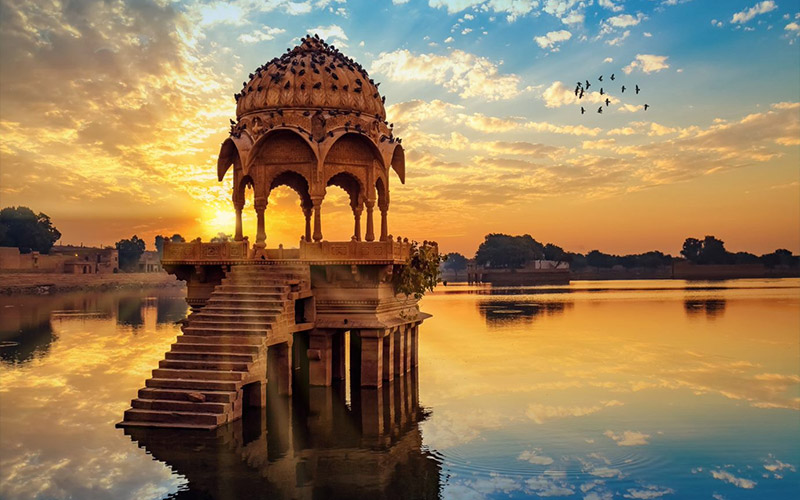
Filming in India means choosing between distinct visual environments inside one national production system: Rajasthan’s desert and palace architecture, Ladakh’s high-altitude Buddhist plateau, Kerala’s tropical backwaters, Mumbai’s dense contemporary city, Delhi and Hyderabad’s Mughal and imperial heritage, Goa’s Portuguese-colonial coast, and the Buddhist-border terrain of the Northeast. This guide compares those places by how they read on screen and which other territories they can double for, from Central Asia and the Middle East to Southeast Asia and southern Europe. In production language, these may also be described as alternative or “cheat” locations: places selected for the visual role they can perform rather than the name on the map.
The aim here is the location decision, not the paperwork. Celluloid Pact runs the crew, permits and scheduling for international shoots across these regions through our line producer India network; this page is the location-and-comparison companion to that execution work, with production costs and the incentive detail carried on their own pages.
How to Choose a Filming Location in India
Four things decide where an international brief should shoot in India: the look the script needs, the season it can shoot in, the crew base nearby, and how hard the site is to access. India’s range is unusually wide for a single country, so a brief that would normally split across several nations, a desert palace here, a Buddhist monastery there, a tropical delta somewhere else, can often be built around one or two Indian bases instead. The table below is the quick comparison; the sections after it go location by location.
| Location | Visual use | Principal production base | Best season | Main planning constraint |
|---|---|---|---|---|
| Rajasthan | Persian, North African, Central Asian and Mughal heritage; desert | Jaipur / Jodhpur | October to March | Monument access; heat outside winter |
| Ladakh | Tibetan plateau, Western Sichuan, high Himalaya | Leh | June to September | Altitude acclimatisation; short season; area permits |
| Kerala | Southeast Asian river delta, tropical coast and hills | Kochi | November to March | Monsoon timing |
| Mumbai | Contemporary Asian metropolis; studios and post | Mumbai | October to March | City density and public-space permissions |
| Delhi & Hyderabad | Mughal-Persian and imperial heritage; film-city studios | Delhi / Hyderabad | October to March | Monument clearances |
| Goa | Portuguese-colonial and Mediterranean-feel coast | Panjim | November to February | Heritage-zone and peak-season access |
| Northeast (Tawang) | Tibetan-border, Burmese highland, SE Asian frontier | Guwahati / Tezpur | Varies by state and altitude; confirm for the final route | Area permits, remoteness, longer lead time |
Indian Locations That Double for Other Territories
Rajasthan: Persian, North African and Central Asian heritage

Rajasthan is India’s strongest match for Persian-heritage, North African, Mughal-period and Central Asian settings. Its desert forts and palaces have carried international features for years: Christopher Nolan’s The Dark Knight Rises used Mehrangarh Fort in Jodhpur for its pit-prison sequence, Tarsem Singh’s The Fall shot at Jaipur’s stepwells and Chand Baori, and The Best Exotic Marigold Hotel built its world across Jaipur and Udaipur. Productions reach for Rajasthan when a Persian or Moroccan-style shoot cannot go to the source, whether for cost, capacity or access.
Each city offers a different register. Jodhpur’s Mehrangarh reads as a fortified citadel; Jaisalmer’s sandstone stands in for Saharan and Maghreb settings; Udaipur’s lake palaces carry Mughal-Persian luxury; and the Thar Desert beyond Jaisalmer doubles for Saharan and Central Asian steppe. Our film fixers in Rajasthan handle state permits, the multi-city move across Jaipur, Jodhpur, Udaipur and Jaisalmer, and the separate monument approvals. Protected monuments run through the Archaeological Survey of India, and major sites such as Mehrangarh add their own trust-managed access rules, so heritage-heavy schedules need those clearances opened early and treated as the pacing item rather than assuming a fixed turnaround. The comfortable shooting window runs October to March, before the desert heat.
Ladakh: Tibetan plateau and Western Sichuan
Ladakh offers India’s clearest high-altitude Tibetan-plateau visual analogue when a Tibetan-Buddhist or Western Chinese setting cannot route through Tibet directly. Leh and the surrounding valleys sit between roughly 3,500 and 5,500 metres, giving high monasteries, mountain villages and lunar landscapes. Its Buddhist monasteries, Thiksey, Hemis, Diskit, Lamayuru, stand in for Tibetan ones, and the Pangong Tso lake and Nubra Valley have anchored a long line of Indian features including 3 Idiots and Bhaag Milkha Bhaag. Where a brief needs genuinely Tibetan architectural identity rather than the look, Tibet itself is still the better route.

Altitude is what sets Ladakh apart from other stand-ins and what has to be built into the schedule. Crews need roughly two to three days to acclimatise before shooting high, and the higher points, Pangong at about 4,350 metres, Khardung La and Tanglang La above 5,300, need careful sequencing. Generator power, battery life and consumables all need contingency at altitude. Most units base in Leh and radiate out to Pangong, Nubra, the Suru Valley and the Lamayuru monasteries. Several of these areas require entry permits: foreign nationals may require Protected Area Permits for notified locations, while Indian nationals may require Inner Line Permits, and the applicable requirement depends on the site, nationality and current government rules. The season is short: roughly June to September, when the passes are open.
Kerala: Southeast Asian river delta and tropical coast
Kerala carries the tropical river-delta and backwater look that stands in for Southeast Asian, Vietnamese Mekong and broader tropical-coastal settings. The Alleppey backwaters, Vembanad Lake and the Kuttanad waterways give houseboats, palm channels and delta villages that read convincingly as Mekong or island Southeast Asia when the real thing carries permit or scheduling difficulty. Inland, the Western Ghats add tropical mountain and rainforest, and the Munnar tea estates double for hill-country plantations from Sri Lanka to the Vietnamese highlands.

The season is the thing productions underestimate. The Southwest Monsoon runs June to September and delivers genuine monsoon imagery but blocks most general work; the lighter Northeast Monsoon follows October to December. For a dry Southeast-Asian look, aim at November to March; for monsoon-specific work, shoot into the Southwest Monsoon but carry generous weather-contingency days. Permissions come from a mix of local municipal and district bodies, with the Kerala State Film Development Corporation facilitating the process rather than acting as the sole authority. Our film fixers in Kerala handle that coordination, the backwater logistics and the move between coast and hills.
Mumbai: contemporary Asian metropolis and studio base
Mumbai is one of India’s principal production bases for contemporary urban work and a common operational base for inbound shoots, even when some locations are elsewhere. Its density, its deep Hindi-film crew pool and its post-production capacity make it a flexible stand-in for a generic large Asian city, and the natural place to run pre-production, casting and India-side coordination from. Mumbai permissions depend on the proposed location and activity, with municipal, police, traffic, port, railway, airport, private-property and studio approvals handled through their respective authorities. Our film fixers in Mumbai run that coordination across Mumbai, Pune and Lonavala and the Hindi-film production-services layer.

The studio infrastructure is the second reason productions route through Mumbai. Film City in Goregaon, ND Studios at Karjat, Yash Raj Studios and the wider cluster cover sound stages, controlled interiors, VFX-supported shooting and full-pipeline post. Interior-heavy sequences and extended studio schedules pair naturally with location work elsewhere. The Mumbai-Pune-Lonavala belt also keeps rural and semi-urban locations close to the studios, so a unit can move between stage and location in a single day without relocating.
Delhi and Hyderabad: Mughal-Persian heritage and studio scale
Delhi carries the Mughal-Persian and imperial register. Old Delhi’s Jama Masjid, Red Fort and Chandni Chowk give the Mughal band; Humayun’s Tomb adds the Indo-Islamic; and Lutyens Delhi and India Gate supply the early-twentieth-century imperial architecture that British-Raj and post-colonial government stories reach for, with Rashtrapati Bhavan and the Parliament quarter available only as highly controlled locations with restricted filming access. As a stand-in it substitutes for Persian, Central Asian and Mughal-empire settings that cannot route through Iran or Afghanistan. Our film fixers in Delhi NCR handle the state and municipal permits across Delhi, Noida and Gurugram and the monument-access protocols.

Centrally-protected monuments such as the Red Fort, Humayun’s Tomb and Qutb Minar require Archaeological Survey of India clearance with conditions on lighting, crew size and footprint, and those clearances, not the national permission, usually set the schedule, so they are opened well ahead. Hyderabad complements Delhi at the other end of the scale: Ramoji Film City is among the largest studio complexes in the world, and the Golconda Fort, Charminar and Qutb Shahi tombs add Deccan-Islamic heritage, which is why many productions pair a Hyderabad studio base with heritage location days.
Goa: Portuguese-colonial heritage and coast
Goa holds the Portuguese-colonial heritage that stands in for Lusophone-Atlantic, Brazilian colonial and Macau settings. Old Goa’s baroque churches, the Basilica of Bom Jesus, Se Cathedral and St. Cajetan, provide one of Asia’s most distinctive Portuguese architectural environments, and the Fontainhas Latin Quarter in Panjim adds Indo-Portuguese streets of colour-washed houses and balcaos for residential and old-quarter work. The coastline beyond delivers open, palm-lined beaches and fishing villages. The Bourne Supremacy filmed its opening India sequences in Goa, providing an international-production precedent for the coastline and village environment. Our film fixers in Goa handle permit coordination, heritage-zone access and the coastal logistics.

Permissions in Goa run through the state government and local bodies, with panchayat-level sign-off for specific shoot sites, so the current single-window contact is confirmed with the state rather than assumed. Goa’s crew base is smaller than Mumbai’s, so most productions bring their heads of department from Mumbai or Delhi and source support locally; the short Mumbai-Goa flight, subject to the current schedule, makes pairing a Mumbai studio schedule with Goa location days straightforward. November to February offers the most comfortable weather but overlaps Goa’s peak visitor season, so accommodation, traffic and high-demand location access should be secured early.
Northeast India: Tibetan border and Southeast Asian frontier
The Northeast, Tawang and the rest of Arunachal Pradesh, Nagaland, Mizoram and the wider region, offers a Buddhist-Himalayan-border and Southeast-Asian frontier look for briefs that need Tibetan-border, Myanmar-adjacent or remote-frontier settings. Tawang Monastery is one of the largest Buddhist monasteries in Asia, and the surrounding Arunachal terrain sits right on the Tibetan border; Nagaland’s Dzukou Valley can pass for a Japanese or East Asian upland, and Mizoram’s hills read as Burmese highland. The look is distinctive enough that productions accept the extra effort when the brief specifically calls for it.

Access is the constraint. Much of the region sits behind entry permits: foreign nationals may require Protected Area Permits for notified locations, while Indian nationals may require Inner Line Permits, and the applicable requirement depends on the site, nationality and current government rules; the crew base is also thin, so most units bring their key crew from Mumbai or Delhi. Tawang in particular needs layered clearance from the district administration and the Arunachal state government, and inner-monastery access needs the monastic leadership’s consent, so lead times are long and are planned well ahead. The Tawang setting also carries diplomatic and cultural sensitivity, which is worth handling with an early cultural review and careful narrative framing.
Seasons, Crew Bases and Travel Between Regions
Most of India shoots best from October to March, when the north and the deserts are cool and the south is between monsoons. Ladakh is the exception, open roughly June to September when the passes clear, which is exactly when the plains are hottest, so a brief that pairs Rajasthan with Ladakh is really two separate seasons and usually two trips. Kerala’s calendar turns on the monsoon: dry-look work waits for November to March, monsoon-look work shoots into the June-September rains with contingency built in.

Crew depth is concentrated. Mumbai, Hyderabad and Chennai are major full-department production bases, while Delhi is a strong base for northern location work. Kochi has substantial Malayalam-industry crew depth, and Jaipur and Guwahati supply regional production support while heads of department travel in. That shapes the plan: a remote location leg is usually a Mumbai or Delhi core crew plus regional hires, not a fully local unit. Travel between regions runs on domestic flights, Mumbai to Jaipur, Leh, Kochi or Goa are all short hops, with road moves inside each region. Because the country is large, most schedules base in one region at a time rather than criss-crossing, and a producer sequences the legs around each region’s season rather than the calendar as a whole.
When an Indian Stand-In Works and When It Does Not
An Indian stand-in works when the brief needs a look rather than a specific, recognisable place. Persian, North African, Central Asian and Mughal heritage read convincingly through Rajasthan or Delhi when Iran, Morocco or Central Asia are not options. A Tibetan-Buddhist setting reads through Ladakh when the schedule cannot absorb Tibet’s access. Southeast Asian delta and tropical-coast work reads through Kerala; Portuguese-colonial through Goa; a generic contemporary Asian city through Mumbai; and a Tibetan-border or Southeast-Asian frontier through the Northeast.
It stops working when the story depends on a place the audience will recognise as itself, or on architectural or cultural detail specific to the real location. A script that needs the actual identity of Lhasa, or a named Moroccan medina, or a real Vietnamese city, is better served at the source even when the source is harder to reach. The honest test at script-breakdown is whether the location is playing a character or providing a texture: texture travels well to India, identity often does not. Where identity matters, the source location is usually the better answer even when it is harder to reach.
What Changes the Permit and Budget Plan
Two things move an India plan the most: the permit chain and the incentive. The national filming permission runs through India Cine Hub, the government single-window formerly known as the Film Facilitation Office, with feature and series applications routed via the Ministry of Information and Broadcasting and documentaries, commercials and music videos via the Ministry of External Affairs. A complete application is normally cleared within about three weeks. What actually sets the schedule is everything that sits alongside it, local and municipal permissions, monument clearances through the Archaeological Survey of India, Protected Area Permits for foreign nationals and Inner Line Permits for Indian nationals in notified mountain and Northeast locations, and any security or defence coordination, each on its own timeline. Those are the items to open first.
On the money side, India’s current central scheme provides up to 40% of qualifying Indian expenditure: a base reimbursement of up to 30%, a 5% bonus for employing at least 15% Indian labour and another 5% for significant Indian content, subject to the overall ₹30 crore project cap. A service production applies for interim approval before shooting and submits its final claim with audited documentation after production. Because the qualifying-spend rules and the caps shape the budget structure, they are best modelled at script-breakdown. The full mechanics sit on our India film rebate and state incentives guide, and indicative day rates and crew banding on our India film production rates page, so this page keeps to the location decision and points the cost and incentive detail there.
Building a Multi-Region India Shoot
India’s real advantage on a wide brief is that several looks can hang off one base. Mumbai is the usual centre: pre-production, casting and studio work run there, with location legs flown out to Rajasthan, Kerala, Goa or the north. A Persian-heritage feature can pair Rajasthan forts with a Mumbai studio schedule; a tropical brief can pair Kerala backwaters with Munnar’s hills; a Mughal story can run Old Delhi against a Hyderabad studio base. The season is the sequencing constraint, since the plains, the coast and Ladakh peak at different times.

Treat each region as a separate production leg rather than forcing the country into one continuous road schedule. A Mumbai–Rajasthan–Goa route can share preparation, casting and selected heads of department, while Kerala, Ladakh and the Northeast usually need their own travel, weather and equipment plans. Decide which crew and equipment remain common, what is sourced regionally and where weather or access buffers sit before locking the budget.
Moving From Location Comparison to Production Planning
Once the location shortlist is set, the work moves from comparison to planning: fixing the season each leg has to hit, opening the permit and monument clearances that pace the schedule, building the crew around a Mumbai or Delhi core with regional support, and modelling the qualifying spend against the incentive. That is line-producer work, and it pays to start it at script-breakdown rather than production-prep, because India’s breadth means most briefs have more than one credible route through the country and the choice between them shapes the budget.
Celluloid Pact runs that execution layer through our line producer India network, across permits, crew, equipment and multi-state scheduling, with the per-city teams linked above handling the groundwork in each region. Send the shoot window, the locations under consideration and the production scale for an initial India plan.
