

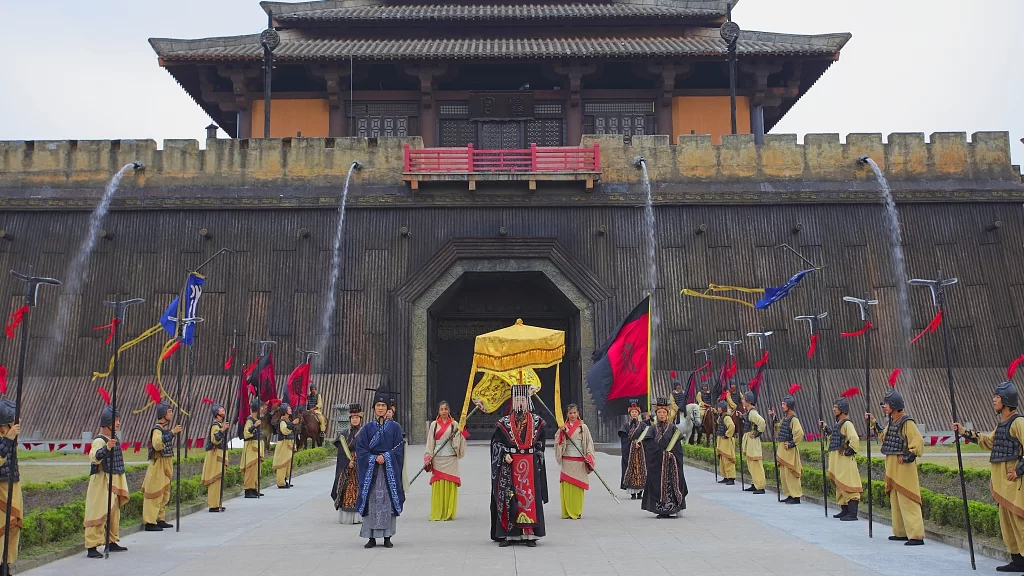
Filming in East Asia divides into two routes — direct production in the mainstream markets and credible stand-in substitution across the corridor. East Asia’s mainstream production destinations are Korea, Japan and China. Each anchors a different position in the corridor — Korea as the K-drama-era mid-band tier, Japan as the top-tier infrastructure and Edo-period heritage destination, China as the largest single film market and the deepest internal infrastructure layer in Asia. For most international briefs covering East Asia, the decision frame starts with these three.
The frame for filming in East Asia shifts when China direct-access becomes operationally tight. Foreign-production routing through China has tightened over the past several years — China Film Administration approval, co-production thresholds for theatrical release and content-review timelines have all become heavier than the mid-2010s production environment. International productions increasingly separate location-specific Tibet requirements from substitutable Himalayan material: identifiable TAR locations require the direct China/Tibet process, while Nepal and Bhutan provide stand-in alternatives for generic high-altitude and Buddhist-cultural settings.
East Asia production routes and service coverage
This guide compares direct production and stand-in routes across Korea, Japan, China, Tibet, Nepal and Bhutan for productions that need East Asian production access or credible China stand-in alternatives. The cluster sits under our broader East Asia line producer and film fixer network, which carries the multi-territory execution layer when a single brief routes across more than one corridor leg.
| Territory | Tier | Access | Cost band | Best for |
|---|---|---|---|---|
| Korea | Mainstream | KOFIC support; permits through local authorities and location owners | High | K-drama urban, Joseon palaces, contemporary high-density |
| Japan | Mainstream | Open via JFC + prefecture commissions | Very High | Tokyo ultra-modern + Kyoto Edo-period heritage |
| China | Mainstream | Increasingly gated by China Film Administration approval | High | Shanghai/Beijing urban, Guilin karst, Yangtze valley |
| Tibet | Direct, restricted-access territory | Licensed Chinese partner + TAR and location-specific approvals | Variable | Lhasa monastery, Yarlung Tsangpo, Everest northern base |
| Nepal | Himalayan stand-in | Film Development Board + relevant authorities | Low | Annapurna, Khumbu, Boudhanath, Pashupatinath — doubles for Western Sichuan and Himalayan-side China |
| Bhutan | Buddhist-cultural stand-in | Royal Government coordination | Medium | Tiger’s Nest, Paro/Thimphu — living Druk Yul Buddhist heritage |

When we recommend direct China vs stand-in alternatives
The decision between direct China filming and stand-in routing depends on the specific brief and its visual-register requirements. This recommendation matrix maps common briefs for filming in East Asia to the territory routing that usually delivers the best operational outcome.
| Production brief | Recommended routing | Reason |
|---|---|---|
| Shanghai skyline / Pudong urban-density | China direct | Architectural specificity does not substitute |
| Beijing government district / Forbidden City | China direct | Specific monument-zone identity |
| Tang-dynasty palace setting | Korea (Joseon palace substitution) | Shared architectural lineage, faster permits, lower cost |
| Edo-period or pre-modern East Asian heritage | Japan | Tang-period architectural inheritance, JFC permit framework |
| Generic Buddhist monastery / Tibetan-Buddhist visuals | Nepal (Boudhanath, Kathmandu cluster) | Credible substitution, predictable permits, low cost |
| High-altitude Himalayan landscape / Western Sichuan | Nepal (Annapurna, Khumbu, Manaslu) | Topology match, established expedition logistics |
| Living Buddhist culture / authentic practice | Bhutan (Druk Yul tradition) | Active Buddhist culture vs heritage display |
| Tibetan monument zones (Potala Palace, Jokhang) | Tibet direct (if access permits) | Specific architectural identity, China Film Administration routing |
Korea: mainstream production base for K-drama urban and Joseon palace registers
Korea has the deepest mature international-production infrastructure in East Asia outside Japan. KOFIC (Korean Film Council) operates the Korean Filming Incentive, the international co-production approval layer and the production-support routing that international productions navigate. Seoul concentrates the studio-and-crew infrastructure, with parallel hubs at Busan and Incheon. The K-drama industry’s standing-set infrastructure — convenience stores, basement bars, school courtyards, traditional alleyways — has matured into a working location ecosystem that international productions access on per-project terms.
KOFIC handles applicable incentive and production-support applications, while filming permissions route through municipal authorities, regional film commissions, location owners and any specialist authority required by the location. Productions running Korea anchor work through our line producer Korea team for KOFIC application handling, cross-municipality coordination and the K-drama-industry crew-availability windows that affect international productions during peak production cycles.
Korean line-production teams handle the China-substitution decision tree from a position of structural advantage. KOFIC’s international-production support framework runs predictable timelines, Korean municipal commissions clear permits on operational tempo, and the Korean industry’s long-standing experience producing Chinese-period drama for Korean domestic distribution gives the production layer deep working knowledge of the Joseon-versus-Tang-period visual register. Productions weighing Korean substitution for Chinese-period portions of a brief work through Korean line-production teams that have already executed similar substitution logic on Korean-domestic productions.

Japan: mainstream production base for ultra-modern Tokyo and Edo-period Kyoto
Japan is one of East Asia’s most mature production markets, with deep equipment, crew and post-production infrastructure. The country operates through the Japan Film Commission Promotion Council with parallel prefecture-level film commissions handling location and permit work. The visual register splits into the ultra-modern Tokyo + Kanto metropolitan band (Shibuya, Shinjuku, Tokyo Bay) and the Edo-period heritage Kyoto + Kansai band (Gion, Higashiyama, Arashiyama bamboo grove, the temple complexes at Kinkaku-ji and Ryoan-ji).

Japan does not operate a permanent automatic national cash rebate. However, METI/VIPO programme cycles can provide selective production support for qualifying projects, subject to live application rounds, expenditure requirements and funding limits. Productions running Japan anchor through our line producer Japan team for cross-prefecture coordination, the multi-commission permit chain and the Shinkansen routing logic between metros.
Japan’s Kyoto and Nara temple complexes — Kinkaku-ji, Ginkaku-ji, Ryoan-ji, Todai-ji and the broader Kansai Buddhist-architectural network — were built on Chinese Tang-period architectural precedents. The shared lineage means productions covering Buddhist-architectural, Tang-Chinese, ancient-East-Asian or pre-modern-Asian heritage register can substitute Japanese temple work for direct Chinese filming where the visual brief tolerates substitution. The Cultural Heritage Agency permit framework for temple work runs predictable timelines and the Japanese production-service infrastructure handles international productions on established protocols.

China: the production reality and why stand-in alternatives matter
China remains the largest single film market in Asia and the deepest internal-production-industry layer on the continent. Shanghai, Beijing, Hengdian World Studios, the Guilin Karst Mountains and the Yangtze river corridor anchor the visual register that productions covering contemporary-Chinese urban, ancient-Chinese heritage, period-historical or landscape-led briefs reference. International productions including The Painted Veil, Mission: Impossible III, Looper, Skyfall and the long pipeline of Hollywood co-productions through the mid-2010s established the production-access pathway.
The production-access reality has shifted. China Film Administration approval for foreign productions has become structurally heavier than the mid-2010s environment. Content-review requirements, co-production thresholds for theatrical-release access, and the broader regulatory landscape have tightened on multiple fronts. International productions running China-themed briefs increasingly model two parallel scenarios — direct China filming for portions of the schedule that genuinely require it, and stand-in routing for portions where credible alternatives work commercially.

Stand-in substitution and direct China filming trade-offs
The stand-in math depends heavily on the brief. Productions covering modern Shanghai or Beijing urban-density usually need direct China filming — the architectural specificity does not substitute. Productions covering Chinese heritage, Buddhist-architectural, period-historical, mountain-landscape or rural-China registers often substitute credibly through direct Tibet access or the Himalayan stand-in corridor through Nepal and Bhutan, or selective Korean-Joseon and Japanese-Edo substitution. The line-production layer’s job at script-breakdown stage is to map which portions of the China brief tolerate substitution and which require direct routing.
China direct filming remains operationally possible for productions that commit to the full approval-and-co-production framework. Productions weighing direct China against stand-ins should model the China-direct path with realistic schedule, approval-timeline and content-review buffers, against the stand-in path with the visual-register concessions that come with substitution. The right answer depends on the brief, the budget, the schedule constraint and the production-side appetite for navigating the current Chinese approval landscape.

China Film Administration approval framework and co-production routing
The current Chinese production-access framework runs through the China Film Administration for content review and approval, with the National Radio and Television Administration handling broader media-content regulation. Foreign productions seeking China theatrical release face the co-production threshold logic — qualifying co-productions (with mandated Chinese co-producer participation, Chinese content elements and approval through the co-production pathway) access theatrical distribution under a different framework than non-co-production foreign films. The thresholds and content-review timelines vary by production type and the current regulatory environment.
Hengdian World Studios in Zhejiang Province operates as China’s largest soundstage-and-standing-set production base, with extensive period-Chinese architectural sets that productions covering ancient-Chinese, Ming/Qing-period or imperial-Chinese settings route to when direct location work is operationally constrained. The studio complex has handled the bulk of Chinese-domestic period drama production and a long line of international productions through co-production frameworks. Hengdian represents the closest China-direct equivalent to the Atlas Studios Morocco model — a soundstage-anchored production base that compresses location-construction work for period briefs.
Tibet: Direct Access and Himalayan Stand-In Alternatives
Tibet sits inside Chinese sovereignty, so any brief requiring identifiable Lhasa or Tibet Autonomous Region locations — the Potala Palace, Jokhang Temple, the Yarlung Tsangpo valley — runs through the direct China/Tibet process rather than a standalone fixer route. Our Tibet film permits and China co-production framework guide carries the complete permit chain, authorities, rates and timelines.
Where the brief needs only a generic Himalayan-Buddhist setting rather than an identifiable Tibetan monument, it can route credibly through Nepal or Bhutan at lower cost and with a cleaner permit path — the Nepal and Bhutan stand-in tiers below cover those options.

Nepal: topology-based Himalayan stand-in for Buddhist heritage and high-altitude China
Nepal carries the strongest topology-based China stand-in register in the Himalayan band. The country provides two distinct visual layers that map onto different China briefs. The high-altitude alpine register — Annapurna, Manaslu, the Khumbu region and the Everest base-camp approach — doubles credibly for Western Sichuan’s mountain landscape, the Tibetan plateau’s high-altitude register and the Himalayan-side China landscape that productions covering remote-China briefs reference. Ama Dablam, Machapuchare and the Annapurna circuit provide alpine-photography frames at altitudes and visual scale that few other corridors match.
The Buddhist-heritage register — Boudhanath stupa, Pashupatinath temple complex, the Kathmandu monastery cluster, the Pokhara temple band — provides credible substitution for Tibetan-Buddhist visual settings when direct Tibet access is constrained. The cultural-and-architectural lineage between Nepalese and Tibetan Buddhist heritage means productions covering monastery, prayer-flag, stupa-centred or Buddhist-cultural visuals can credibly anchor through Nepal alongside whatever direct Tibet filming the schedule still includes.
Cost positioning is materially below direct Tibet or China routes. The Film Development Board, Nepal and the relevant ministry-level production support frameworks operate predictable permit cycles. Productions running Nepal as the primary stand-in for portions of a China brief work through our line producer Nepal team for permit handling, high-altitude shooting logistics, monastery-access coordination and the scheduling against any direct Tibet or China filming portions of the brief. The cost-band-to-visual-register match makes Nepal one of the most operationally efficient China stand-in routes for topology-driven briefs.

High-altitude operational considerations for alpine stand-in work
High-altitude shooting in the Annapurna, Khumbu and Manaslu regions requires structured acclimatisation and medical-officer routing. Foreign crew arriving from sea level need acclimatisation days before extended shoot activity above 2,500 metres, with the threshold climbing toward 3,500 metres for serious altitude-presentation risk. The Everest base-camp approach via Lukla operates an established expedition-logistics framework that productions can route through — porter and yak-train cargo, multi-day approach schedules, established teahouse accommodation along the trekking corridor and the helicopter-evacuation framework for the rare medical-emergency scenarios.
Annapurna circuit work runs through Pokhara as the operational base, with Machapuchare and Annapurna South providing the iconic mountain-face register that productions covering Tibetan plateau-adjacent or Western Sichuan mountain landscape route to. The Khumbu region anchors through Lukla’s STOL airport with onward routing to Namche Bazaar, Tengboche monastery and the Ama Dablam approach. Both corridors handle international features, documentary work and expedition-driven productions on established operational frameworks that Tibet-direct routing under current Chinese permit constraints does not consistently match.
Bhutan: living Druk Yul Buddhist heritage for cultural-register substitution
Bhutan provides the narrowest but most authentic stand-in register in the East Asian Buddhist-cultural band. The country’s Druk Yul Buddhist tradition operates as living practice rather than heritage display — monastery work, prayer rituals, the dzong-architecture complexes at Punakha, Paro and Thimphu, and the Tiger’s Nest at Taktsang anchor visual settings that productions covering authentic-Buddhist-cultural briefs reference. The difference from Nepal is sociological — Nepal’s Buddhist heritage operates alongside Hindu and broader-South-Asian cultural settings, while Bhutan’s Buddhist register operates as the country’s organising cultural framework.
The trade-off is operational. Bhutan operates under structured Royal Government coordination — international productions need royal-side approval, scripted-content review for culturally-sensitive material and an established Bhutanese co-producer or production-service partner. Access is structured rather than restricted, but the operational layer requires Royal Government engagement that productions used to Western or East Asian permit frameworks sometimes find heavier than expected.
Productions running Bhutan as a Tibetan-Buddhist or Chinese-Buddhist stand-in for portions of a China brief work through our film fixer in Bhutan team for the Druk Yul permit chain, Royal Government coordination, Paro Airport entry and the Thimphu-Paro-Punakha valley scheduling logic. The cost band sits above Nepal but below direct Tibet, and the operational path is materially more predictable than direct-Tibet production access.

Bhutan filming permits and cultural approvals
Bhutan’s filming permits run through the Bhutan InfoComm and Media Authority (BICMA) as the principal permit issuer, alongside the ministry, cultural and location-specific approvals — and the scripted-content review for culturally-sensitive material — that a Bhutanese shoot requires. International productions cannot navigate the process directly: an established Bhutanese co-producer or production-service counterpart is mandatory, and because the governing bodies and their remits are periodically restructured, the current permit route and issuing authorities should be verified live before scheduling. Temporary import arrangements for production equipment must be confirmed with Bhutanese customs and the appointed local counterpart before travel. The Thimphu-Paro-Punakha valley network provides multi-location coverage within a contained radius. Druk Yul living-Buddhist tradition gives Bhutan unique authenticity for productions covering active Buddhist practice — a different visual register than Tibet’s location-specific monument and monastic register or Nepal’s broader-South-Asian-context Buddhist heritage.
How to choose: mainstream tier vs stand-in tier decision tree
The right approach to filming in East Asia for any single brief depends on four decisive variables. Producers running mainstream-tier briefs weigh China access against Korean/Japanese alternatives; producers running stand-in-driven briefs weigh which Himalayan or Tibetan corridor matches the topology and cultural register the brief actually needs.
By creative brief and visual register
Contemporary Asian urban routes to Tokyo (top register), Seoul (mid-band density), Shanghai or Beijing (when direct China is viable). Period Chinese, Tang-dynasty or ancient-China heritage routes to Korea (Joseon palace substitution), Japan (Edo-period substitution) or direct China when the brief specifies historically-Chinese-monument settings. Tibetan-Buddhist heritage and monastery work routes to direct Tibet when access is viable, otherwise Nepal (Boudhanath, Kathmandu monasteries) or Bhutan (Druk Yul living tradition). High-altitude alpine and Himalayan landscape routes to Nepal as first-choice (Annapurna, Khumbu, Manaslu) given the topology-and-cost match.
By China-access risk tolerance
Risk tolerance determines how much of the schedule can depend on Chinese approval. With sufficient margin, a project can commit to the direct pathway. A moderate-risk plan reserves China for irreplaceable scenes and moves substitutable material to stand-in territories, while a compressed schedule usually makes those alternatives the primary route. This choice belongs at script-breakdown stage, before permit uncertainty begins shaping the budget and production calendar.
By cost band and schedule
Mainstream-tier cost positioning runs Japan (very high), China (high), Korea (high), Hong Kong (high). Stand-in tier runs Bhutan (medium), direct Tibet variable, Nepal (low). Productions optimising for cost in the East Asian band route stand-in heavy; productions optimising for visual register depth route mainstream heavy. Permit lead times also favour stand-ins — Nepal and Bhutan run predictable permit cycles, Korea and Japan run multi-commission permit chains, China and Tibet run the longest lead times.
Concrete routing examples
A few working examples make the multi-tier logic concrete. A Marco Polo period adventure feature with Mongol-China and Tang-dynasty Beijing settings might route Korean Joseon palace work for the imperial-court scenes, direct China filming (under co-production framework) for the Beijing-specific Forbidden City scenes, Mongolia for the Genghis-era steppe sequences and Nepal alpine work for the cross-Himalayan journey portions.
A documentary covering Tibetan Buddhism in the contemporary era might run direct Lhasa for the monument-and-monastery work (where the brief specifically requires Tibetan religious authorities and locations), Bhutan for the living-Buddhist practice scenes (where Druk Yul tradition operates as active culture rather than heritage display) and Nepal for the diaspora-monastery scenes at Boudhanath and the broader Tibetan-exile community work. Each tier carries a distinct visual register that the brief actually needs — substitution between them is editorial choice rather than operational necessity.
For multi-territory East Asian briefs that span mainstream and stand-in tiers, the line-production coordination layer carries the multi-territory execution logic. Productions running anchor work through our East Asia line producer hub coordinate the multi-territory permit chains, equipment movement via ATA Carnet across multiple customs frameworks, crew rotation and the schedule-and-budget coherence that single-territory routing cannot reach.

Engaging a line producer for East Asian mainstream and stand-in routing
Most productions arrive at an East Asian brief with a single-territory plan and revise to a multi-territory schedule once the China-access reality, the stand-in alternatives and the mainstream-tier cost bands are mapped against the brief. A Chinese-period drama that started planning around direct China filming often rebalances toward Korea + Nepal for portions where stand-in substitution works commercially. A contemporary East Asian thriller anchored in Tokyo sometimes adds a Shanghai leg for direct-China urban-density coverage when approval timelines permit. A Buddhist-cultural feature spanning Tibetan-Buddhist visual settings often anchors Nepal or Bhutan as the operational base with selective direct Tibet filming for irreplaceable monument-zone scenes.
A multi-territory team coordinates the relevant permit frameworks, temporary-import planning, crew sourcing and the direct-China-versus-stand-in schedule. Single-territory briefs can engage the appropriate country team directly; cross-border briefs use hub-level coordination to keep budget, movement and delivery aligned.
Why script-breakdown engagement matters for East Asian briefs
East Asian briefs benefit from line-producer involvement at script-breakdown stage rather than production-prep. The reason is the mainstream-vs-stand-in decision that the corridor’s structure makes possible. Briefs that contain Chinese-period, Tibetan-Buddhist, Himalayan-alpine or Buddhist-monastery visual settings have multiple credible routing options across mainstream-tier and stand-in-tier territories, each delivering a different cost-band and operational-overhead profile. Early-stage line-producer engagement lets the routing decision inform the budget rather than the budget constraining the routing after the fact.
Multi-territory equipment movement and crew rotation logic
The line-production layer also carries the operational logic of multi-territory equipment movement. Temporary-import procedures differ across China, Nepal, Bhutan, Korea and Japan; ATA Carnet availability and the applicable customs process must be verified for each territory rather than assumed across the itinerary. Crew rotation similarly requires multi-territory scheduling, with most multi-tier briefs anchoring through Bangkok, Hong Kong or Seoul as the regional crew-rotation hub.
Compared with the mid-2010s, East Asian planning now places greater weight on China approval risk and mature stand-in options. Briefs spanning Chinese, Tibetan-Buddhist or Himalayan settings benefit from separating irreplaceable direct-access scenes from material that can move elsewhere, then aligning permits, crew and schedule across the selected territories.
